


 Join
JoinSafety Blog
STEM Course Safety Protocols for Science Certified Teachers Assigned to Teaching Technology and Engineering
By Ken Roy
Posted on 2026-05-11
Disclaimer: The views expressed in this blog post are those of the author(s) and do not necessarily reflect the official position of the National Science Teaching Association (NSTA).
Science instructional spaces and technology and engineering instructional spaces have much in common. For instance, both have potential safety hazards and resulting health and safety risks for teachers and students. Although science instructional spaces tend to have mainly biological and chemical hazards, technology and engineering instructional spaces are more likely to have physical hazards.
Teachers in either instructional space should be aware of potential safety risks, but many schools don’t have enough certified teachers for their technology and engineering classes. School administrators have tried to address this teacher shortage assigning a certified science teacher to teach technology and engineering components for both STEM and STEAM programs in addition to the science component.
This blog post provides a basic safety protocol framework appropriate for science teachers assigned to teach introductory high school engineering and technology components of STEM or STEAM courses. Teachers should also follow safety practices consistent with guidance from the Occupational Safety and Health Administration (OSHA), the National Science Teaching Association (NSTA), the International Technology and Engineering Educators Association (ITEEA), and the National Fire Protection Association (NFPA).
Instructor Preparation and Training
Science-certified teachers should first review district policies for STEM technology and engineering teaching assignments. Teachers must also obtain tool-specific training before using equipment such as drill presses, saws, soldering irons, and small CNC or 3-D printers. Next, teachers should complete a safety hazard analysis and risk assessment for all activities. Finally, they should secure and maintain current Safety Data Sheets (SDSs) for any chemicals that will be used in the class (for instance: adhesives, epoxies, solvents, and paints).
Student Safety Orientation
Before students begin any hands-on work, they should receive instruction on general laboratory and classroom instructional space safety rules and emergency procedures. Next, they should learn about proper tool use and personal protective equipment (PPE) requirements. Information on safer material handling should also be shared with students.
Teachers should give students details about better professional safety practices, including written safety rules. Students and parents should be required to sign a document that covers safety compliance rules and teachers should have documentation for students’ completion of safety training.
Personal Protective Equipment (PPE)
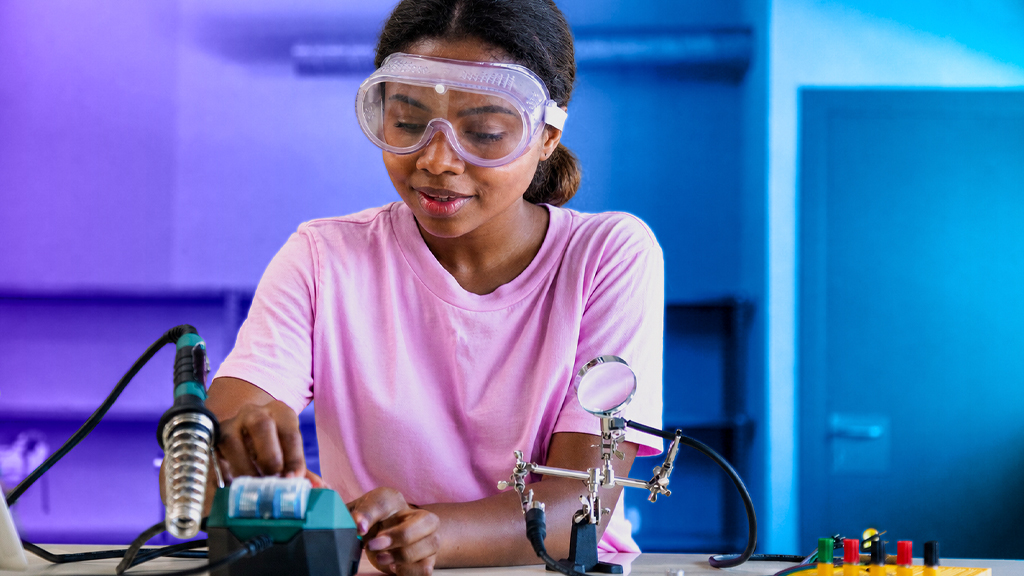
Different PPE items for engineering and technology classes are required depending on the determined potential safety hazard analysis and resulting risk assessments. For example, when students will be cutting, drilling, sanding, or soldering, ANSI/ISEA Z87.1 D3 safety goggles or safety glasses with side shields as appropriate are required. If students will be exposed to loud equipment such as power tools, they must have hearing protection. When they are soldering or using hot tools, students need heat-resistant gloves. They must also have aprons or shop coats to protect their clothing and skin. If students will be grinding any objects, they need face shields and safety goggles. Finally, students should be reminded to tie back long hair and remove any loose jewelry. Only closed-toe shoes should be allowed.
Tool and Equipment Safety
General safety protocols for tool and equipment use include the following:
- Inspect tools before use.
- Use only tools for which students have received training.
- Maintain proper machine guarding.
- Follow lockout and tag-out procedures if equipment is damaged.
- Provide adequate supervision whenever power tools are used.
Younger students or student in introductory classes should use low-risk tools (hand tools, small power tool, etc.). Students using advanced or high-risk machines require direct instructor supervision.
Engineering Materials Safety
Students in STEM lab instructional spaces might use cardboard, wood, plastic, and foam board, among other materials, as well as low-temperature hot glue and small electronics. Safety considerations when using these materials include the following:
- Ensure proper ventilation for adhesives or soldering.
- Use safer storage for sharp materials.
- Avoid flammable solvents.
- Avoid toxic resins if the instructional space does not have proper ventilation.
Electrical Safety
Working with electricity presents known potential hazards and resulting health and safety risks. For example, to ensure safer activities involving electricity and circuits, teachers should use low-voltage power supplies (≤12 V DC–24 V DC) whenever possible. Prior to beginning activities, teachers should inspect wires for damage and any possible short circuits. Power should be disconnected before circuits are modified
Fire and Emergency Preparedness
To ensure fire and emergency preparedness, teachers should make sure that STEM laboratory instructional spaces have the following engineering controls:
- Fire extinguisher (ABC type, typically)
- First-aid kit
- Eye-wash/shower access within approximately 10 seconds of travel (common lab standard)
- Emergency shutoffs for electricity and gas (if present).
In addition, the space should have well-defined and clear evacuation routes in case the event of an emergency, and also combustible storage should be minimized to reduce fire load risks.
Classroom Management and Supervision
Classroom management and supervision are legal requirements under duty and standard of care for STEM lab teachers. Constant visual supervision must be maintained when students are using hand and power tools so a limited number of students should be operating tools simultaneously. Teachers should also have established and clear tool checkout procedures. Most important, teachers should stop any unsafe behavior immediately to help prevent accidents.
Housekeeping
The OSHA housekeeping standard requires safer instructional spaces, including by ensuring a space has clean floors that are free of slips, trips, and falls hazards. Tools need to be well organized in appropriate storage areas. The instructional space should have appropriate ways for students to store and dispose of scrap materials. Wood and metal dust control units should be located near the power tools that produce the dust and scrapes.
Incident Reporting
STEM lab instructional spaces can be dangerous places with numerous potential hazards and resulting health and safety risks so appropriate incident-reporting protocols must be followed. All injuries or near-misses must be documented and reviewed to improve future safety practices. Supervisors, administrators, safety compliance officers, and chemical hygiene officers need to be made aware of these incidents in writing.
Bottom Line
A science-certified teacher teaching engineering and technology should ideally receive additional training in technology education safety because engineering instructional spaces involve a number of potential safety hazards and resulting health and safety risks that are not typically encountered in science laboratory instructional spaces.
Submit questions regarding health and safety issues in science and STEM instructional spaces to Ken Roy at safersci@gmail.com. Follow Ken Roy on X: @drroysafersci.
The mission of NSTA is to transform science education to benefit all through professional learning, partnerships, and advocacy.