


 Join
Productive Talk: What’s Different?
Student discussion is a key part of science learning. Build skills to shift classroom talk away from recitation and towards student-centered discussion that promotes sensemaking.
Introduction
In this module, you will examine the research-based shifts in classroom discourse patterns away from traditional talk patterns, such as I-R-E (Initiate-Response-Evaluation), and towards Productive Talk. Discover effective, practical, and equitable strategies for facilitating academic discourse that promote a shift away from classroom talk that is focused on recitation and towards student-centered talk that promotes reasoning and sensemaking.
Learning Module Outcomes
By the end of this learning module, you will be able to:
- Explain the purpose and importance of productive talk in a sensemaking classroom.
- Identify classroom conditions that support productive talk.
- Analyze the use of productive talk goals and moves in science classrooms.
Demonstrated competency
To demonstrate competency, you will:
- Apply key ideas about productive talk to an instructional context, making decisions that support students in contributing ideas to the discussion.
Anticipated student impact
As you apply the knowledge and skills developed in this learning module, students may have increased opportunities to:
- Contribute ideas by sharing their thinking and building on and responding to other students’ ideas.
Badge earned
When all evidence submitted in this learning module meets the criteria for demonstrating competency, you will be awarded the following badge:
- Productive Talk: What’s Different?
Before You Begin
This learning experience is designed for educators who have some familiarity with the foundational ideas of sensemaking. You do not need to be an expert, and there are no required prerequisite modules. You will get the most out of this experience if you are already familiar with the instructional shifts described below.
Helpful background knowledge and experiences include
- A basic understanding of sensemaking
- Familiarity with phenomenon-based teaching and learning
- Experience facilitating classroom discussions
If any of these ideas are new to you, you may still participate. However, we encourage you to use these related PLUs to build background knowledge as needed:
- What is Sensemaking?
A Note About Showing Evidence of Competency
When you demonstrate evidence of competency of the knowledge and skills developed in this learning module, you will earn a verifiable, digital badge and a certificate of completion. You can add this badge to your professional portfolio and share it within your professional networks.
Throughout this learning module there are questions for you to answer and reflect on your thinking. Some questions will be identified as competency questions. Your responses to these questions will be reviewed as evidence of your competency.
A reviewer will evaluate and provide feedback on each of these questions and indicate whether the criterion for demonstrating competency is:
- Met: Your response provides sufficient evidence.
- Partially Met: Your response provides some evidence, but additional detail, clarification, or revision is needed.
- Not Met: Your response does not yet provide evidence OR does not address the criterion.
To earn the digital badge, all evidence you submit must show “criteria met.” If one or more criteria are partially met or not met, the module will be returned to you with feedback. You will then have the opportunity to revise and resubmit your evidence.
Open ended questions that are not identified as competency questions will not be reviewed. However, you are strongly encouraged to respond to these questions, as they are designed to support your learning and preparation for the competency task.
A Note for Pre-Service Teachers
This learning module asks participants to reflect on their experiences facilitating classroom talk and the typical patterns of classroom talk they use while teaching. Consider using your college/university teaching program, the school/district in which you were placed for classroom observations, or the school/district in which you were placed for student teaching as your implementation context.
Resources
Resources that support the learning in this PLU can be accessed from the Productive Talk: What’s Different? collection.
Note for Watching Classroom Videos
Real classroom videos of students and their teachers support learning in this PLU. The ground rules presented below are intended to help you (1) focus on observing what the students and teacher are saying and doing to figure things out, and (2) appreciate the bravery of the people in this classroom in allowing others to learn from their work.
Ground Rules for Watching Real Classrooms:
- Teaching and the classrooms are complex. There is much we don’t know about the students and the teacher and their history together.
- Presume expertise on the part of the teacher.
- Assume what the kids are saying and doing makes sense to them.
- Focus on how the classroom talk (teacher and students) serves the learning goals of the lesson and the science and engineering practices involved.
Adapted from Classroom Discussions: Seeing Math Discourse in Action, Grades K–6. A Multimedia Professional Learning Resource and the Next Generation Science Exemplar Program (NGSX)
Focus and Connect
Respond to the questions below to “consider and commit” to your thinking before, during, and after completing this learning module. Take the time to reflect and articulate your current thinking.
Build and Refine Ideas
Shifting from Traditional Talk to Productive Talk
Watch the video from 05:32 through 15:29. (If you’d like to watch the introductions, watch the video from the beginning through 05:32.) The presenter reviews common classroom talk patterns and compares the characteristics of the I-R-E Talk Pattern to characteristics of Productive Talk Patterns.
Question 2.a
How do productive talk patterns differ from I-R-E (Initiation-Response-Evaluation) talk patterns in fostering classroom discussion?
(Participants do not need to record a response. Consider the question and check your ideas against what is inside the expandable content box.)
Access The Most Common Forms of Classroom Talk (Resource #1 in the Productive Talk: What’s Different? collection). This excerpt from Helping Students Make Sense of the World Using Next Generation Science and Engineering Practices reviews the most common forms of classroom talk. It will help you gain a foundational understanding of the key differences between I-R-E Talk Patterns and Productive Talk.
The next video offers a look into an elementary classroom that includes 2nd and 3rd grade bilingual students. These students are working together to explain and predict the effect of water flow on different types of surfaces in the school yard, including black top, soil, and wood chips. As a group, students use the data they’ve gathered to develop an initial model that explains the relationships between water flow and the changes that occur on the surfaces.
As you watch, pay attention to
- how students are engaging in discussion with one another, and
- the role the teacher is playing in the discussions.
Question 2.c
What evidence of rich, meaningful conversations did you observe in the NSTA video 'NGSS: Supporting Talk,' and how do these discussions reflect effective strategies for fostering student engagement and deeper understanding in the classroom?
(Participants do not need to record a response. Consider the question and check your ideas against what is inside the expandable content box.)
Think about the video you just watched. Consider:
- What types of support (routines or structures) might students need to be in place to engage in productive talk in the classroom?
- What types of support might you (teachers) need to facilitate discussions like the one in the class you observed?
Share your thoughts in the Supports Needed for Productive Talk Google Form (Resource #2 in the Productive Talk: What’s Different? collection.)
After you have added your ideas, read the responses shared by others in the Supports Needed for Productive Talk (Responses) document (Resource #3 in the Productive Talk: What’s Different? collection).
The Talk Science Primer identifies seven elements of academically productive talk. These are:
- A belief that students can do it
- Well-established ground rules
- Clear academic purpose
- Deep understanding of the academic content
- A framing question and follow-up questions
- An appropriate talk format
- A set of strategic “talk moves”
Establishing a Culture of Productive Talk
Read the following excerpt from the Talk Science Primer:
A culture of talk is more likely to take hold when teachers develop a common set of discussion norms across classrooms, and limit the list to just three to five important ground rules…Teachers implementing a culture of productive talk often have an all-class discussion in which students explain how the expectations will benefit their discussions. Teachers report that this norm setting is best done at the beginning of the school year, when possible.
Once the expectations are introduced, they need to be reinforced until they become an established part of the school culture. Teachers sometimes identify one of the norms to work on prior to the start of the discussion. Posting the norms in the classroom will help you and the students keep them in mind.
Examine two samples of classroom norms used to support students in engaging in productive talk.
First, read Science Class: Establishing Classroom Norms for Discussion, an excerpt from Ready, Set, SCIENCE!: Putting Research to Work in K-8 Science Classrooms (Resource #4 in the Productive Talk: What’s Different? collection)
Then, review the OpenSciEd Community Agreements (Resource #5 in the Productive Talk: What’s Different? collection) as an example of classroom norms that support productive talk. OpenSciEd is an Open Educational Resource, and these are examples of norms developed during the first unit of each grade level, and revisited throughout the year.
Question 2.f
How can establishing and reinforcing classroom norms support a classroom culture where all students feel safe, valued, and encouraged to participate in scientific discussions?
(Participants do not need to record a response. Consider the question and check your ideas against what is inside the expandable content box.)
Strategic Talk Moves
One of the elements of academically productive talk is a set of strategic talk moves. The Goals for Productive Discussions and Nine Talk Moves checklist highlights strategies educators can use to facilitate meaningful classroom discussions. These strategies encourage active listening, critical thinking, and deeper understanding while fostering student engagement, collaboration, and sensemaking.
Read the Checklist: Goals for Productive Discussions and Nine Talk Moves (Resource #6 in the Productive Talk: What’s Different? collection).
Question 2.i
How do the nine productive talk moves encourage sensemaking and reasoning in the classroom, and how do they shift the focus away from simple recall and recitation (I-R-E) toward deeper student engagement and understanding?
(Participants do not need to record a response. Consider the question and check your ideas against what is inside the expandable content box.)
The Talk Moves Map is a visual representation of different prompts teachers can use to facilitate productive classroom discussions, allowing students to actively participate, build on each other's ideas, and deepen their understanding of science ideas by providing structured ways to contribute to the conversation. It's a tool to help teachers guide the flow of discussion with specific prompts that relate to different situations. Take a moment to read the Talk Moves Map (Resource #7 in the Productive Talk: What’s Different? collection).
Consider how you might use talk moves to respond to a student during a whole group discussion in this scenario.
Imagine that you are teaching the middle school OpenSciEd Unit 7.6: Earth’s Resources & Human Impact, Lesson 10. During this class period, students are working toward figuring out what is happening in the world to cause the sharp rise in CO2. Students have already done the following:
- Based on data, they recognized that CO2 was rising over the last couple of centuries, but really started to spike around 1950.
- Read about what was happening in the world when CO2 started going up, and found that in the 1700s the world’s energy use began to change, as people started using coal, and that in the 1900s cars were produced on large scales.
Students have been evaluating the following graph to try to figure out which sources of energy are contributing to the rise of CO2 in the atmosphere.
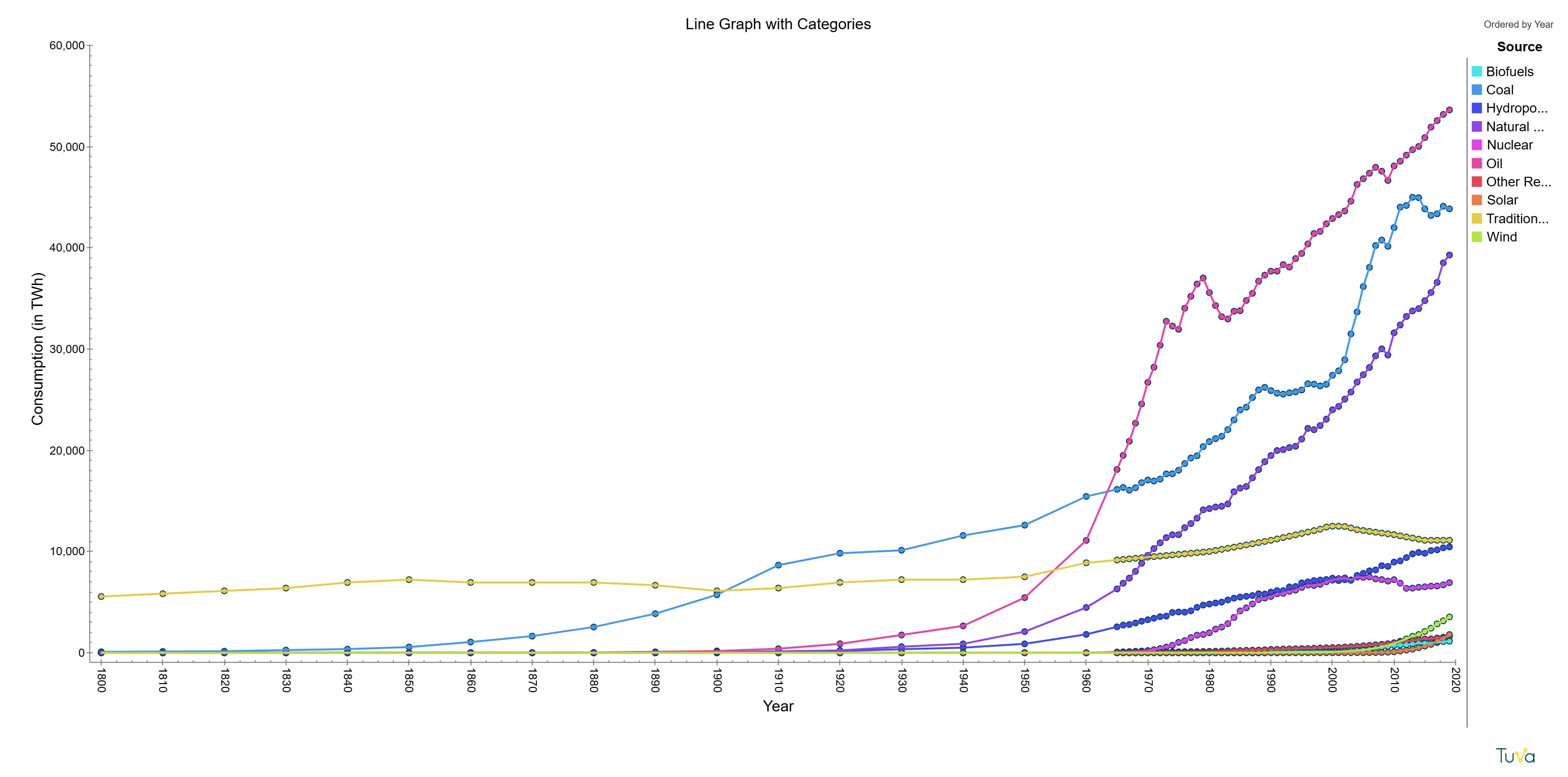
After providing time for students to analyze the graph with a partner, you invite students to share what they noticed in the data. One student raises their hand and says, “I noticed that the coal is really good and so is oil.” This response doesn’t make sense to you in the context of what students are trying to figure out.
This is a real scenario that occurred in a 7th grade classroom. Now you will observe how this teacher responded to this moment in class, and how she continued to facilitate the conversation.
Make a copy of the Productive Talk Goals and Moves resource (Resource #8 in the Productive Talk: What’s Different? collection). As you watch the video, record your observations in your copy of the Talk Goals and Moves resource. Consider:
- What talk moves do you notice this teacher using?
- What other strategies do you notice this teacher using that supports productive talk?
Question 2.k
Compare your completed copy of the Productive Talk Goals and Moves to these observations.
Appropriate Talk Formats
One of the elements of academically productive talk is an appropriate talk format. Read this excerpt from the Talk Science Primer:
There are different ways to organize groups for talk - whole group discussion, small group work, and partner talk. Each talk format creates different opportunities for talk and allows students to participate in a number of ways with different levels of support.
We can think of these formats as tools teachers can use strategically to support productive talk.
Read pages 7-9 of the Talk Science Primer (Resource #9 in the Productive Talk: What’s Different? collection), beginning where it says “Part 4: How can teachers support productive talk?” and stop where it says “Goals for Productive Discussions.” As you read, consider the following questions:
- What are the key features of each of the three talk formats?
- How do the different talk formats support student sensemaking?
Record your ideas on paper or in a digital document. When you’re ready, compare your ideas to the notes below.
Inclusive Science Instruction
Read STEM Teaching Tool #6: How can I get my students to learn science by productively talking with each other? (Resource #10 in the Productive Talk: What’s Different? collection.)
Next, read this excerpt from Chapter 11 of A Framework for K-12 Science Education.
Relating Youth Discourses to Scientific Discourses
Many equity-focused interventions have leveraged the discourse (i.e., sense-making) practices of youth to productively engage them in the language and discourse styles of science and in the learning of science. While traditional classroom practices have been found to be successful for students whose discourse practices at home resemble those at school—mainly students from middle-class and upper-middle-class European/American homes [43]—this approach does not work very well for individuals from historically nondominant groups. For these students, traditional classroom practices function as a gatekeeper, barring them because their community’s sense-making practices may not be acknowledged [38, 44-46].
Recognizing that language and discourse patterns vary across culturally diverse groups, researchers point to the importance of accepting, even encouraging, students’ classroom use of informal or native language and familiar modes of interaction [47-49]. The research literature contains multiple examples. Lee and Fradd [47] noted distinct patterns of discourse (e.g., use of simultaneous or sequential speech) around science topics in groups of students from different backgrounds. Rosebery, Warren, and Conant [50] identified connections between Haitian Creole students’ storytelling skills and their approaches to argumentation and science inquiry; they used those connections to support their learning of both the content and the practices of science. Hudicourt-Barnes demonstrated how bayodyans—the Haitian argumentative discussion style—could be a great resource for students as they practice science and scientific discourse [51].
As these studies indicate, diverse linguistic practices for making sense of natural phenomena can generate learning and be leveraged in instruction [9, 46, 50]. Brown has recently extended this line of work by developing an instructional model that helps students bridge the transition from using their vernacular language for scientific phenomena to using disciplinary terminology and forms of discourse; essentially, they describe and discuss the same phenomena in both modes in turn [46]. The challenge for teachers is to know enough about their students’ relevant linguistic practices to be able to support this transition in the classroom.
A classroom rich in discourse is also a classroom that offers particular challenges for students still learning English. On the other side of the coin, engagement in the discourse and practices of science, built as it is around observations and evidence, also offers not only science learning but also a rich language-learning opportunity for such students. For both reasons, inclusion in classroom discourse and engagement in science practices can be particularly valuable for such students.
National Academies of Sciences, Engineering, and Medicine. 2012. A Framework for K-12 Science Education: Practices, Crosscutting Concepts, and Core Ideas. Washington, DC: The National Academies Press.
Apply Your Learning
Facilitating Productive Talk Scenario
Read the Why Are the Rusty Patched Bumble Bees Disappearing? Classroom Discussion vignette (Resource #11 in the Productive Talk: What’s Different? collection). As you read, consider how the discussion is facilitated so that students have opportunities to share their ideas and respond to others ideas.
Open the Productive Talk: Responding in the Moment worksheet (Resource #12 in the Productive Talk: What’s Different? collection). Use this tool to share how you could shift the classroom conversation in the vignette to support students in sharing ideas with one another. Record your responses in the document.
Before submitting your copy of Productive Talk: Responding in the Moment, review the criteria below.
Reflect and Extend
In this final section you will reflect on your learning. Review your previous responses to help prepare for responding to the following questions.
Read the excerpt below from A Discourse Primer for Science Teachers, by Ambitious Science Teaching (Resource #14 in the Productive Talk: What’s Different? collection)
What are the first steps to using talk more productively?
Expert teachers cultivate high quality classroom discourse. But this kind of expertise is learnable. What does it take? Nothing more than deliberate practice—figuring out what aspects of discourse described in this chapter you want to work on with students, then being methodical about trying out “pieces” of talk and assessing how students respond. We can help you with places to start. Consider the checklist here. It represents a kind of discourse environment that you can aspire to…
- The classroom environment will be safe for students to express their ideas.
- Goals of classroom discussions will be anticipated by the teacher and made clear to students.
- The teacher and students will model interactions that foster critiques of unsupported ideas while encouraging the sharing of ideas and respect for those who are sharing.
- Focal questions and tasks will be predominantly of high cognitive demand for making sense of science ideas and phenomena.
- Strategies for allowing time to think in whole class discussions will be used (wait time, think-pair-share).
- A variety of discourse moves will be used to manage the initiation and development of ideas while at the same time honoring the thinking of all members of the class.
- Students’ puzzlements and ideas will be treated as resources for the learning of the whole class.
- Students’ language and forms of communication will be scaffolded from what they bring to class toward more academic ways of speaking.
- Meta-cognitive questions will be part of all lessons so that students learn to assess their own thinking and monitor progress toward longer term goals.