


 Join
STEM Identities: Fostering STEM
What is STEM identity, and how can classroom experiences shape the way students see themselves in STEM? Examine research and classroom practice to identify ways educators can support students in developing STEM identities.
Introduction
In this learning module, you will deepen your understanding of STEM Identity by examining research around how students’ STEM identities are developed. You will consider how your practice as an educator impacts students’ STEM identities and reflect on why STEM identities are important for students’ futures in STEM. Finish this learning module with a model of what it looks like to build STEM identities in a classroom and research-based strategies to help your students build their STEM identities.
Learning Module Outcomes
By the end of this learning module, you will be able to:
- Define what STEM identity is and why it matters.
- Understand how students’ experiences contribute to the development of STEM identity.
- Evaluate how classroom practices and instructional choices can support the development of students’ STEM identities.
Demonstrated Competency
To demonstrate competency, you will:
- Apply key ideas about STEM identity to identify and explain instructional choices that can foster the development of students’ STEM identities.
Anticipated Student Impact
As you apply the knowledge and skills developed in this learning module, students may have increased opportunities to:
- Develop interest and confidence in STEM, be recognized for their STEM contributions, and see themselves as people who belong in STEM.
Badge Earned
When all evidence submitted in this learning module meets the criteria for demonstrating competency, you will be awarded the following badge:
- STEM Identities: Fostering STEM Identity
Before You Begin
This learning experience is designed for educators who have some familiarity with the foundational ideas of sensemaking and three-dimensional teaching and learning. You do not need to be an expert, and there are no required prerequisite modules. You will get the most out of this experience if you are already familiar with the instructional shifts described below.
Helpful background knowledge and experiences include:
- Students engage in science and engineering practices to figure out science ideas.
- Students use their own ideas as resources for making sense of phenomena and solving problems.
- Teachers create opportunities for students to contribute, revise, and build on one another’s ideas.
If any of these ideas are new to you, you may still participate in this learning module. However, we encourage you to use these related learning modules to build background knowledge as needed:
- What is Sensemaking?
- Course: The Three Dimensions of Teaching and Learning
A note about showing evidence of competency:
When you demonstrate evidence of competency of the knowledge and skills developed in this learning module, you will earn a verifiable, digital badge and a certificate of completion. You can add this badge to your professional portfolio and share it within your professional networks.
Throughout this learning module there are questions for you to answer and reflect on your thinking. Some questions will be identified as competency questions. Your responses to these questions will be reviewed as evidence of your competency.
A reviewer will evaluate and provide feedback on each of these questions and indicate whether the criterion for demonstrating competency is:
- Met: Your response provides sufficient evidence.
- Partially Met: Your response provides some evidence, but additional detail, clarification, or revision is needed.
- Not Met: Your response does not yet provide evidence OR does not address the criterion.
To earn the digital badge, all evidence you submit must show “criteria met.” If one or more criteria are partially met or not met, the module will be returned to you with feedback. You will then have the opportunity to revise and resubmit your evidence.
Open ended questions that are not identified as competency questions will not be reviewed. However, you are strongly encouraged to respond to these questions, as they are designed to support your learning and preparation for the competency task.
A note for pre-service teachers:
This learning module asks participants to consider how to encourage students’ development of STEM identities in the classroom. Consider using your college/university teaching program, the school/district in which you were placed for classroom observations, or the school/district in which you were placed for student teaching as your experience to reflect on, respond to questions, and apply new or revised ideas.
Resources
Resources that support the learning in this PLU can be accessed from the STEM Identities: Fostering STEM Identity Collection
Note for watching classroom videos
Real classroom videos of students and their teachers support learning in this learning module. The ground rules presented below are intended to help you (1) focus on observing what the students and teacher are saying and doing to figure things out, and (2) appreciate the bravery of the people in this classroom in allowing others to learn from their work.
Ground Rules for Watching Real Classrooms:
- Teaching and the classrooms are complex. There is much we don’t know about the students and the teacher and their history together.
- Presume expertise on the part of the teacher.
- Assume what the kids are saying and doing makes sense to them.
- Focus on how the classroom talk (teacher and students) serves the learning goals of the lesson and the science and engineering practices involved.
Adapted from Classroom Discussions: Seeing Math Discourse in Action, Grades K–6. A Multimedia Professional Learning Resource and the Next Generation Science Exemplar Program (NGSX)
Focus and Connect
Take a moment to think about your experiences in science and STEM that have led to your current role in education. Complete the statement below.
Read the excerpt on identity from Creating Pathways for Equity in STEM Through Family Engagement (Resource #1 in the STEM Identities: Fostering STEM Identity Collection).
“As social creatures, we develop a sense of who we are by interacting with others. This self-perception can change as our social settings change. At home we might see ourselves as parents, at work we might play the role of a technical expert, and when listening to friends we might see ourselves as advisors. Quite often we juggle our various identities at the same time, each of which is in a dynamic, never-ending process of change and development.”
Consider this quotation as you respond to the following questions.
Build and Refine Ideas
What is STEM Identity?
To thoughtfully consider students’ identities and to do meaningful work in supporting students' development of STEM identities, educators must begin by building awareness of their own self-identities (Rogers & Scott, 2008).
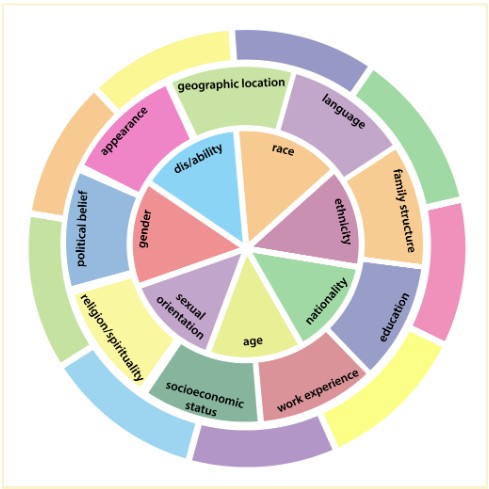
Download a copy of the blank identity wheel from the MIT Open Learning Library (Resource #2 in the STEM Identities: Fostering STEM Identity Collection). This identity wheel is broken into three layers:
- The innermost layer contains parts of identity that are often central to how people think about themselves and are less likely to change.
- The middle layer contains aspects of identity that may change with time and context.
- The outermost layer does not contain any categories and allows you to consider the incorporate other aspects of your identity not related to the other layers.
Think about how you see yourself and how others see you, and complete the identity wheel.
Read the excerpt from The development of the personal self and professional identity in learning to teach (Resource #3 in the STEM Identities: Fostering STEM Identity Collection).
“Contemporary conceptions of identity share four basic assumptions: (1) that identity is dependent upon and formed within multiple contexts which bring social, cultural, political, and historical forces to bear upon that formation; (2) that identity is formed in relationship with others and involves emotions; (3) that identity is shifting, unstable, and multiple; and (4) that identity involves the construction and reconstruction of meaning through stories over time.”
Question 2.a: Look back at the multiple aspects of your identity. Choose one aspect of your identity that has changed over time. What do you think led or contributed to this change?
(Participants do not need to record a response. Consider the question and check your ideas against what is inside the expandable content box.)
Read the following excerpt from A Framework for K-12 Science Education (Resource #4 in the STEM Identities: Fostering STEM Identity Collection) about the importance of helping students develop a STEM identity.
“Learning science depends not only on the accumulation of facts and concepts but also on the development of an identity as a competent learner of science with motivation and interest to learn more…Such identity formation is valuable not only for the small number of students who, over the course of a lifetime, will come to view themselves as scientists or engineers but also for the great majority of students who do not follow these professional paths. Science learning in school leads to citizens with the confidence, ability, and inclination to continue learning about issues, scientific and otherwise, that affect their lives and communities.
For these reasons, instruction that builds on prior interest and identity is likely to be as important as instruction that builds on knowledge alone. All students can profit from this approach, but the benefits are particularly salient for those who would feel disenfranchised or disconnected from science should instruction neglect their personal inclinations.”
Identity is complex, but can be summarized with answers to these questions:
- Who do I think I am, or who can I be?
- Where do I belong?
- How do I think other people see me?
STEM Identity can be defined by the answers to these questions:
- Am I a STEM person? Can I be a STEM person?
- Do I belong in STEM spaces?
- Do/Can other people see me as a STEM person?
People who have developed STEM identities are those who “think about themselves as science learners and develop an identity as someone who knows about, uses, and sometimes contributes to science” (Center for the Advancement of Informal Science Education, 2018).
How is STEM Identity Developed?
Watch the Scaling Up For STEM with Dr. Dou video from 28:00 to 32:10. Dr. Remy Dou is an Associate Professor at Florida International University (FIU) with dual appointments in the Department of Teaching and Learning and the STEM Transformation Institute. In this video clip, Dr. Dou defines STEM Identity.
Question 2.c: How did Dr. Dou define STEM Identity?
(Participants do not need to record a response. Consider the question and check your ideas against what is inside the expandable content box.)
Read the opening quote and the first two paragraphs from the article Creating Pathways for Equity in STEM Through Family Engagement (Resource #1 in the STEM Identities: Fostering STEM Identity Collection).
Identity conflicts can arise when there is a sense of discrepancy between the beliefs, norms, and expectations of different personal identities. Consider your own experiences. Have you ever experienced an identity conflict? How did it feel? How did that conflict affect the task, activity, or situation you were in?
Question 2.e: What identities might your students see as in conflict with a STEM identity? Why?
Please respond to this question in the Students’ STEM Identities Google Form (Resource #5 in the STEM Identities: Fostering STEM Identity Collection).
Review the responses to question 2.e shared by other participants in the Students’ STEM Identities Responses (Resource #6 in the STEM Identities: Fostering STEM Identity Collection).
Question 2.f: What patterns do you notice in the responses shared?
(Participants do not need to record a response. Consider the question and check your ideas against what is inside the expandable content box.)
Read this excerpt from Constructing STEM identity: An expanded structural model for STEM identity research (Dou & Cian, 2021)
“...we approach STEM identity with an understanding that its development does not occur in a vacuum, but rather takes on meaning for the individual inasmuch as their other ways of being fit within their conceptions of STEM and STEM professionals. In other words, the extent to which an individual exhibits STEM interests, feels recognized as a STEM person, and sees themselves as such can be limited and/or facilitated by other personal identities (e.g., gender identity, ethnic identity) and their personal experiences relevant to STEM.”
Dou and Cian conclude that gender, home support, and childhood science talk are significant predictors of confidence in STEM (performance-competence) and STEM recognition, which in turn impacts the development of a students’ STEM identity. Study participants who identified as female report a lower sense of confidence in science and STEM, which is consistent with many works that identify the system challenges that women pursuing STEM-related fields face.
Additionally, these findings suggest that a home and childhood that supports science-related conversations that the child perceives to be supportive of science and STEM is more important for developing a students’ STEM identity than direct access to science and STEM at home, through parents’ careers or formal science and STEM materials.
Read this excerpt from the CAISE identity report, The Role of Identity in STEM Learning and Science Communication (Bell, et. al., 2018) (Resource #7 in the STEM Identities: Fostering STEM Identity Collection).
“The way that identity shapes learning is through the evolving choices and expectations of a learner. When people engage with STEM, having a STEM identity influences their expectations of how interesting and successful the experience will be. If they find the experience to be engaging and satisfying, the experience will then strengthen their STEM identity, leading to a positive feedback loop that can reinforce ongoing participation and learning. Conversely, when learners have less engaging or unsuccessful experiences… [it] might erode a developing STEM identity and make it less likely a learner will choose to participate in related activities in the future.”
A positive feedback loop is a process by which a change in a system causes an effect that amplifies or reinforces that initial change. Positive feedback loops can impact systems in beneficial and detrimental ways. Students’ interest and engagement in STEM activities creates a positive feedback loop with students’ developing STEM identities, with each impacting the other.
Read the following excerpt from A Framework for K-12 Science Education (Resource #4 in the STEM Identities: Fostering STEM Identity Collection) about the importance of connecting to students’ interests and experiences. (p. 28)
“A rich science education has the potential to capture students’ sense of wonder about the world and to spark their desire to continue learning about science throughout their lives. Research suggests that personal interest, experience, and enthusiasm—critical to children’s learning of science at school or in other settings—may also be linked to later educational and career choices [27-30]. Thus, in order for students to develop a sustained attraction to science and for them to appreciate the many ways in which it is pertinent to their daily lives, classroom learning experiences in science need to connect with their own interests and experiences.”
Consider these classroom practices that can build students’ interest and support the development of students’ STEM identities.
Positioning Students as STEM Knowers and Doers
Students develop confidence in STEM when they are positioned as the knowers and doers of science or STEM in the classroom.
In classrooms where students engaged actively in science practices, students were more likely to feel recognized as a scientist. That increased recognition led to increases in students’ STEM motivation, STEM identity, and STEM career aspirations (Starr, et al., 2020). In three-dimensional teaching and learning, students have opportunities to engage with Science and Engineering practices as they make sense of phenomena. The important distinction between this type of learning and traditional labs or engineering activities is that students are positioned as the scientists and engineers in the room, whose thinking and ideas drive the progress of the learning and what is being figured out or solved.
When students are positioned as the knowers and doers of STEM, the role of the teacher shifts as well. It is the teacher’s job to value all students’ contributions as a part of the sensemaking process, and support students in going public with their ideas so that individual contributions are visible. Cooperative learning that centers engagement with the science and engineering practices and the use of durable skills has a direct impact on students’ beliefs that they can do STEM.
Expanding Recognition and Belonging in STEM
Students can be successful in science or STEM classes, and even enjoy science and STEM, while still not seeing themselves as “STEM people” (Archer, et. al., 2010). For many students, a science or STEM identity is seen as being in conflict with their own identities, even when it is something that they enjoy.
As previously discussed, recognition of STEM ability by others is particularly predictive of the development of students’ STEM identities. Intentional recognition by teachers can have lasting impacts on students’ persistence in STEM. Teacher recognition of STEM ability should not be limited to correct answers or prior knowledge, but should focus on durable skills like collaboration, communication, and critical thinking.
While recognition of STEM abilities is a powerful way to build STEM identities, students from marginalized groups may face challenges in developing a sense of recognition in science and STEM. Historically, the people who are recognized as scientists and engineers have excluded marginalized groups. Individual recognition alone may not communicate a student’s belonging in STEM when they see “STEM people” as others.
Educators can make intentional choices to include diverse representations of STEM professionals, introduce and acknowledge non-traditional STEM career pathways, and highlight everyday uses of STEM in students’ communities to broaden students’ perception of what counts as STEM and who can be recognized as a STEM person.
Using Meaningful STEM
Students are more likely to develop STEM identities when they build an understanding of science and STEM as a way to make sense of the world and solve problems. Students develop identity and agency when they use STEM to address problems that are meaningful to them. In particular, topics or problems that are related to their own experiences, interests, concerns, and local communities can support meaningful connections.
Designing instruction that is relevant to students interests and their local community is one way to create meaningful STEM connections. When that is not possible, educators must support students in making connections between the phenomenon or problem under study and their everyday lives, to support students in seeing how the work they are doing can be meaningful.
Apply Your Learning
In this section, you will watch classroom videos and evaluate how these experiences support students in developing their STEM identity. Download a copy of the STEM Identities: Evaluating Practice document (Resource #8 in the STEM Identities Collection).
You will identify three specific moments from the video(s) that illustrate one of the following classroom practices that supports the development of students’ STEM identities:
- Positioning students as the knowers or doers of STEM
- Expanding recognition and belonging in STEM
- Making STEM meaningful
Read about the context for each video before watching. Then, complete the STEM Identities: Evaluating Practice document, including the reflection questions.
Classroom Video Analysis
Classroom Video 1
This classroom video shows students engaging in the first lesson of Unit 7.5: Ecosystem Dynamics from the OpenSciEd Middle School curriculum. Prior to this clip, students were introduced to a news headline that said orangutans will be extinct in 10 years. Students shared their ideas about why they think that may happen, and then read some information about orangutans.
Watch the video from 10:35 - 21:00.
Classroom Video 2
This classroom video shows students engaging in Unit 7.6: Human Impact + Computer Science from the OpenSciEd Middle School curriculum. Several students in this classroom are multilingual learners. Prior to this clip, students used micro:bits to collect data as they considered how temperature affects evaporation.
Watch the video from 27:45 to 36:45.
Respond to the video analysis questions in the STEM Identities: Evaluating Practice document and the reflection questions.
Before submitting your copy of the STEM Identities: Evaluating Practice document, review the criteria below.
Reflect and Extend
Read the excerpt below from How to foster the formation of STEM identity: studying diversity in an authentic learning environment (Resource #9 in the STEM Identities: Fostering STEM Identity Collection).
“STEM identity has been shown to have a powerful role in an individual’s success in educational environments, as well as on their career goals and trajectories. Historically, however, STEM identity formation for underrepresented students has been hampered by the lack of representation in STEM fields, which predominantly consist of white males. One educational challenge is diversifying STEM classrooms, both in terms of the students themselves and also in terms of the science and scientists they learn about.”
Examine the characteristics of the STEM workforce, ages 18-74, in 2011 and 2021.
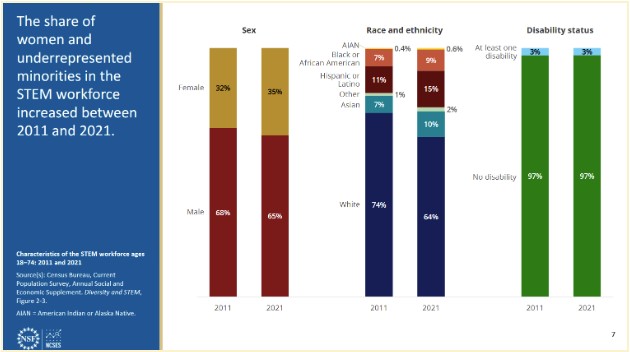
Source: Diversity and STEM 2023 (Resource #10 in the STEM Identities: Fostering STEM Identity Collection).
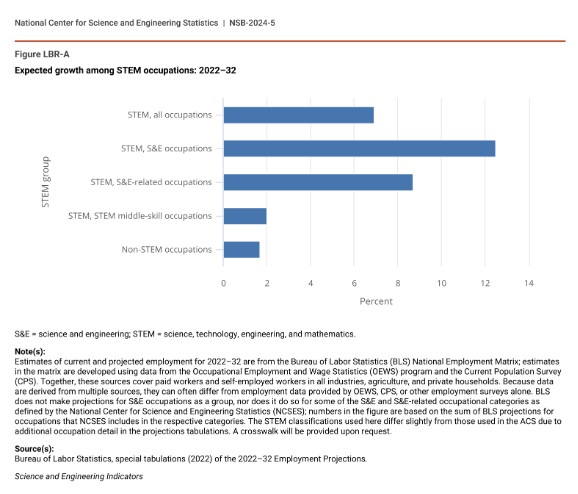
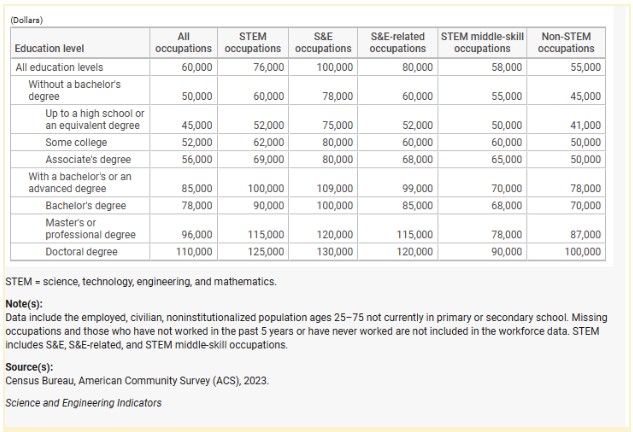
Next, consider the following pieces of data about the expected growth among STEM occupations and median salary for individuals at different education levels.
Read the blog post from The Concord Consortium, Giants in the classroom: Developing students’ STEM identities (Resource #12 in the STEM Identities: Fostering STEM Identity Collection).
Citations
- Archer, L., DeWitt, J., Osborne, J., Dillon, J., Willis, B. and Wong, B. (2010), “Doing” science versus “being” a scientist: Examining 10/11-year-old schoolchildren's constructions of science through the lens of identity. Sci. Ed., 94: 617-639. https://doi.org/10.1002/sce.20399
- Bell, J., Besley, J., Cannady, M., Crowley, K., Grack Nelson, A., Philips, T., Riedinger, K., & Storksdieck, M.(2018). The Role of Identity in STEM Learning and Science Communication: Reflections on Interviews from the Field. Washington, DC: Center for Advancement of Informal Science Education.
- Dewsbury, B. M. (2020). Deep teaching in a college STEM classroom. Cultural Studies of Science Education, 15(1), 169-191.
- Dou, R., & Cian, H. (2022). Constructing STEM identity: An expanded structural model for STEM identity research. Journal of Research in Science Teaching, 59(3), 458–490. https://doi.org/10.1002/tea.21734
- National Academies of Sciences, Engineering, and Medicine. 2012. A Framework for K-12 Science Education: Practices, Crosscutting Concepts, and Core Ideas. Washington, DC: The National Academies Press. https://doi.org/10.17226/13165.
- Rodgers, C.R. & Scott, K.H. (2008). The development of the personal self and professional identity in learning to teach. In Cochran-Smith, M. Feiman-Nemser, McIntyre, D.J., and Demers, K.E. (Eds.), Handbook of research on teacher education. Abingdon: Routledge.