


 Join
Discover how engaging in science and engineering practices creates opportunities for students to develop career readiness competencies, and why that matters!
Introduction
In this learning module, you will explore how integrated STEM learning experiences provide opportunities for students to develop career readiness competencies. Examine the connections between the science and engineering practices and the NACE career readiness competencies, and consider how doing STEM by engaging with the practices creates opportunities to develop behaviors and skills associated with the career readiness competencies. Consider how you can support students in their application of career readiness competencies to new contexts.
Learning Module Outcomes
Learning Targets
By the end of this learning module, you will be able to:
- Identify connections between the science and engineering practices and career readiness competencies.
- Explain how making skills and behaviors related to career readiness competencies explicit to students can support their transfer to new contexts.
Demonstrated Competency
To demonstrate competency, you will:
- Analyze a STEM lesson to explain how engagement in the science and engineering practices creates opportunities to develop career readiness competencies.
- Propose a revision to a STEM lesson to make a skill or behavior associated with a career readiness competency more explicit to students.
Anticipated Student Impact
As you apply the knowledge and skills developed in this learning module, students may have increased opportunities to:
- Develop behaviors and skills related to career readiness competencies through meaningful engagement in science and engineering practices.
Badge Earned
When all evidence submitted in this learning module meets the criteria for demonstrating competency, you will be awarded the following badge:
- Integrated STEM: Building Career Competencies
Before You Begin
This learning experience is designed for educators who have some familiarity with the foundational ideas of three-dimensional teaching and learning and the science and engineering practices. You do not need to be an expert, and there are no required prerequisite modules. You will get the most out of this experience if you are already familiar with the ideas and practices described below.
Helpful background knowledge and experiences include:
- A basic understanding of sensemaking and phenomenon-based teaching and learning.
- Familiarity with the science and engineering practices and their role in three-dimensional science instruction.
- Familiarity with engineering and integrated STEM teaching and learning.
If any of these ideas are new to you, you may still participate. However, we encourage you to use these related asynchronous learning options to build background knowledge as needed:
- Professional Learning Unit: What is Sensemaking?
- Professional Learning Course: The Three Dimensions of Teaching and Learning
A note about showing evidence of competency:
When you demonstrate evidence of competency of the knowledge and skills developed in this learning module, you will earn a verifiable, digital badge and a certificate of completion. You can add this badge to your professional portfolio and share it within your professional networks.
Throughout this learning module there are questions for you to answer and reflect on your thinking. Some questions will be identified as competency questions. Your responses to these questions will be reviewed as evidence of your competency.
A reviewer will evaluate and provide feedback on each of these questions and indicate whether the criterion for demonstrating competency is:
- Met: Your response provides sufficient evidence.
- Partially Met: Your response provides some evidence, but additional detail, clarification, or revision is needed.
- Not Met: Your response does not yet provide evidence OR does not address the criterion.
To earn the digital badge, all evidence you submit must show “criteria met.” If one or more criteria are partially met or not met, the module will be returned to you with feedback. You will then have the opportunity to revise and resubmit your evidence.
Open ended questions that are not identified as competency questions will not be reviewed. However, you are strongly encouraged to respond to these questions, as they are designed to support your learning and preparation for the competency task.
Resources
Resources that support the learning in this PLU can be accessed from the Integrated STEM: Building Career Competencies Collection.
Focus and Connect
Reflect on your current ideas and experiences related to STEM teaching and learning.
Read this excerpt from Chapter 1 of STEM Integration in K-12 Education: Status, Prospects, and an Agenda for Research:
“Advocates of more integrated approaches to teaching and learning, both within and across disciplines, note that the professional practices that inspired the focus on individual disciplines have been transformed in many workplace and research settings to emphasize multidisciplinary enterprises, such as biomedical engineering. More generally, many real-world contexts and problems typically involve more than one of the disciplines. For example, designing alternative energy systems that run on solar or wind energy, understanding how to maintain a clean water supply, or maintaining fragile ecosystems will require knowledge and practices from across the STEM disciplines.
Moreover, professional scientists and engineers in the vast, interconnected enterprise of companies, academic institutions, and government laboratories that conduct research and develop new products and services almost always work in ways that integrate the disciplines of STEM. In fact in some research areas the necessity of more interdisciplinary approaches is increasing. In the life sciences, for example, there is recognition that some of the most important and interesting questions in modern biology will require closer interaction not only within the subdisciplines in biology but also among professionals in biology, chemistry, physics, computer science, mathematics, and engineering (NRC 2009a). Similar interactions among earth, behavioral, and social sciences also will become increasingly essential to addressing critical issues facing humanity and the planet.
More generally, scientists use technological tools to conduct experiments and mathematics and statistics to interpret the data produced by those experiments; engineers draw on scientific knowledge and mathematical reasoning to develop and model potential design inventions and solutions; technologists who build and maintain the products and systems designed by engineers must understand the scientific and mathematical principles governing their operation. And these professionals interact with one another in increasingly diverse and multidisciplinary teams. Connections among the STEM disciplines extend beyond the workplace. In their day-to-day affairs, citizens encounter situations that require them to make decisions using a mix of STEM-related knowledge and skills—whether choosing appropriate medical care, interpreting statistical data in the latest political poll, or buying energy-saving appliances. Indeed, the arguments for general scientific and technological literacy, and for numeracy, have been well articulated (e.g., AAAS 1991; NAE and NRC 2002; NRC 1989).
…the NGSS calls for deeper connections among mathematics, science, and engineering, and it encourages making connections between the subdisciplines of science, such as how energy is understood in biology and physics. As noted, the standards explicitly include practices and core ideas from engineering that should be taught in science classrooms. The Common Core State Standards (NGACPB 2010) in mathematics also suggest opportunities for making connections among the STEM subjects. For instance, the practice labeled “model with mathematics” calls for students to “apply the mathematics they know to solve problems arising in everyday life, society, and the workplace,” which will necessarily involve ideas and practices from science, engineering, or technology.”
Read this excerpt from the Next Generation Science Standards:
“The Next Generation Science Standards (NGSS)* represent a commitment to integrate engineering design into the structure of science education by raising engineering design to the same level as scientific inquiry when teaching science disciplines at all levels, from kindergarten to grade 12. There are both practical and inspirational reasons for including engineering design as an essential element of science education.” (NGSS Appendix 1 Engineering Design in the NGSS, page 1)
*and other Framework-based three-dimensional standards
Respond to this question on the Integrated STEM Opportunities Collaborative Whiteboard (Resource #1 in the Integrated STEM: Building Career Competencies Collection). Then, review the responses that other participants have shared.
Read the following excerpt from the Next Generation Science Standards :
“We anticipate that the insights gained and interests provoked from studying and engaging in the practices of science and engineering during their K-12 schooling should help students see how science and engineering are instrumental in addressing major challenges that confront society today, such as generating sufficient energy, preventing and treating diseases, maintaining supplies of clean water and food, and solving the problems of global environmental change (NRC 2012, p. 9). Providing students a foundation in engineering design allows them to better engage in and aspire to solve the major societal and environmental challenges they will face in the decades ahead.” (NGSS Appendix 1 Engineering Design in the NGSS, page 1)
Build and Refine Ideas
Goals for Integrated STEM Learning
Read this excerpt from Chapter 2 of STEM Integration in K-12 Education: Status, Prospects, and an Agenda for Research that describes some of the common goals and objectives of STEM programs for students:
STEM Literacy and 21st Century Competencies
Two high-level goals associated with integrated STEM education are STEM literacy and 21st century competencies.
STEM literacy is a relatively new idea that has not been well defined in literature or practice, although significant work has gone into elaborating aspects of literacy in the individual STEM disciplines (e.g., AAAS 1990; ITEEA 1996; NRC 1989). From these efforts it is possible to infer that STEM literacy might include some combination of (1) awareness of the roles of science, technology, engineering, and mathematics in modern society, (2) familiarity with at least some of the fundamental concepts from each area, and (3) a basic level of application fluency (e.g., the ability to critically evaluate the science or engineering content in a news report, conduct basic troubleshooting of common technologies, and perform basic mathematical operations relevant to daily life).
Twenty-first century competencies are a blend of cognitive, interpersonal, and intrapersonal characteristics that may support deeper learning and knowledge transfer. Cognitive competencies include critical thinking and innovation; interpersonal attributes include communication, collaboration, and responsibility; and intrapersonal traits include flexibility, initiative, and metacognition.
STEM Workforce Readiness
One goal of integrated STEM education is the development of a STEM-capable workforce. Efforts to achieve this goal may focus on increasing the number of individuals who (1) develop STEM skills through school-to-work, tech prep, or career and technical education (CTE) experiences in high school, (2) earn STEM-related degrees at the certificate, associate’s, or bachelor’s levels, equipping them for jobs such as K–12 STEM teachers, medical assistants, nurses, and computer and engineering technicians, or (3) pursue professional degrees in one of the STEM fields…
Preparing Students for Workforce Readiness
Examine the size of the 2023 workforce by occupational group and education level.
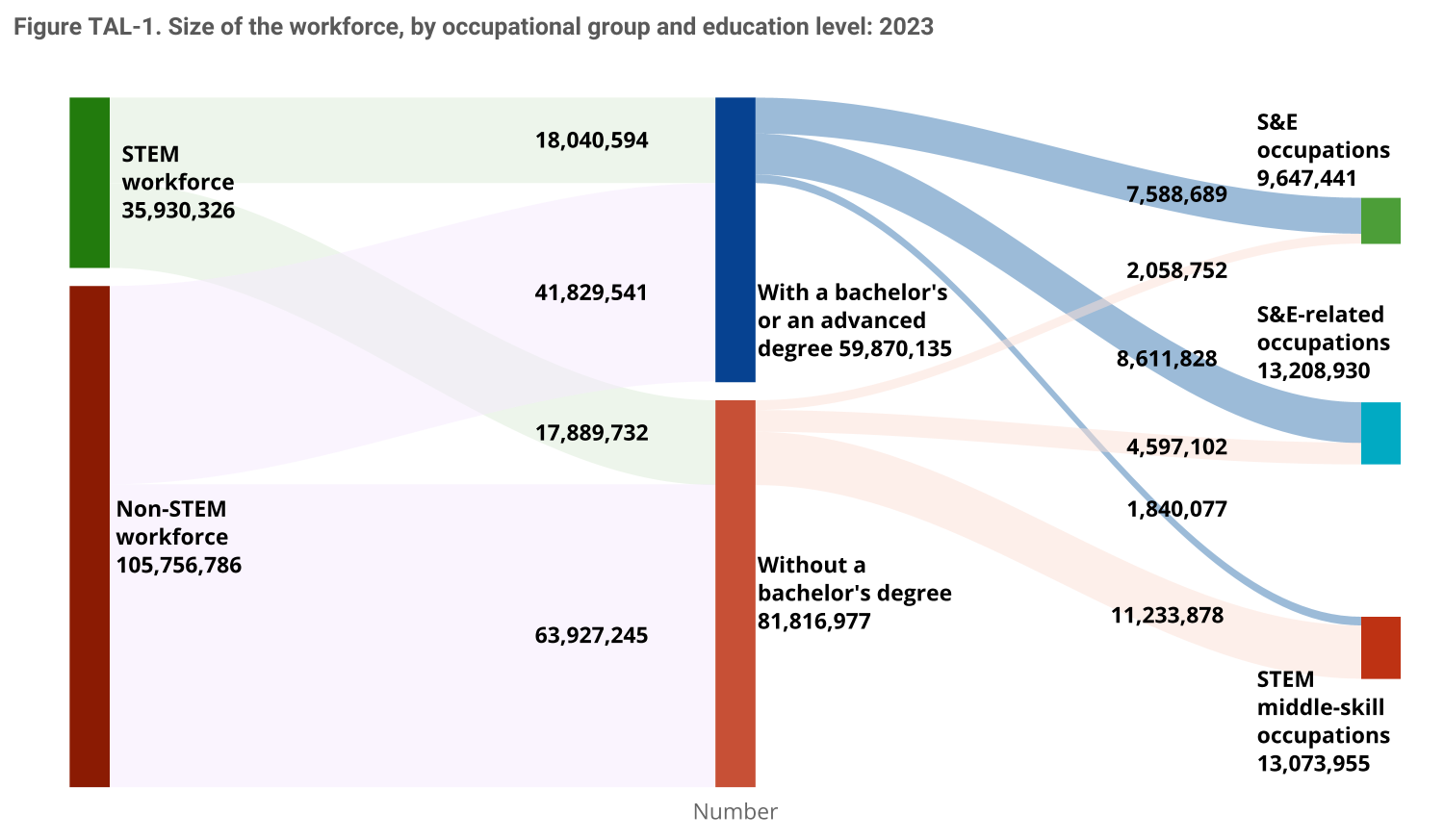
Source: National Center for Science and Engineering Statistics
Now, examine the expected growth among STEM occupations through 2032.
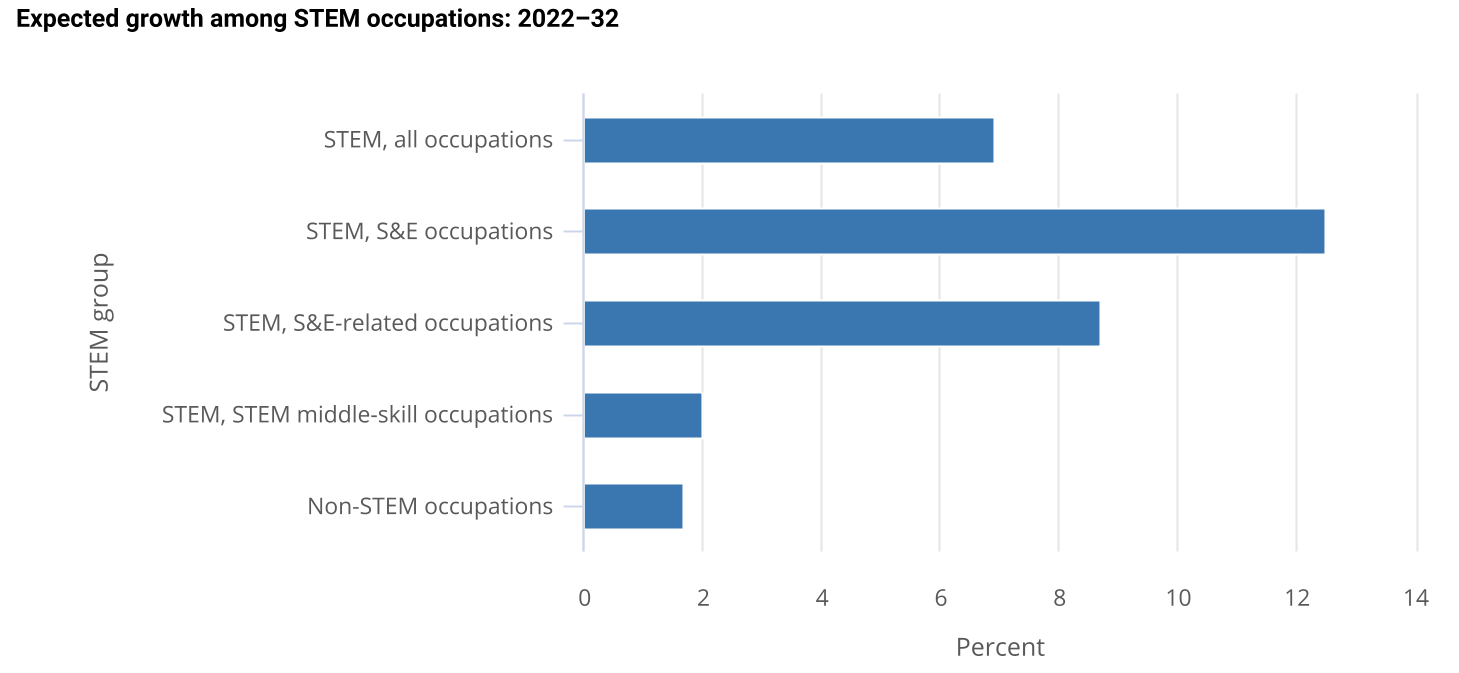
Source: Projected Growth of Employment in STEM Occupations
Question 2.b
What do you notice about the STEM workforce? What do these data make you think about when you consider the futures your students are preparing for?
(Participants do not need to record a response. Consider the question and check your ideas against what is inside the expandable content box.)
Respond to this question on the Necessary Skills and Competencies Collaborative Whiteboard (Resource #2 in the Integrated STEM: Building Career Competencies Collection). Then, review the responses shared by others.
Science and Engineering Practices and Career-Ready Competencies
A Framework for K-12 Science Education (hereafter “the Framework”) and NGSS envision science and engineering as intertwined so that neither can be fully addressed without the other. The NGSS and high-quality instructional materials (HQIM) are designed so that engaging in engineering is part of learning science. In turn, this integrated design can help prepare students for careers in STEM, or for addressing challenges of the future as knowledgeable, informed citizens.
Career readiness is a foundation from which to demonstrate requisite core competencies that broadly prepare students for success in the workplace. The National Association of Colleges and Employers (NACE) has identified eight Career Readiness Competencies (CRCs).
Access and read the NACE Career Readiness Competencies (Resource #3 in the Integrated Stem: Building Career Competencies Collection). As you read, consider the following:
- What do you notice about the Career Readiness Competencies? What stands out to you?
- What connections do you see to the responses shared on the Necessary Skills and Competencies Collaborative Whiteboard (Resource #2 in the Integrated STEM: Building Career Competencies Collection)?
The Science and Engineering Practices (SEPs), as described by the Framework, are the major practices that scientists and engineers use as they build models and theories about the world and design and build systems, respectively. The term “practices” intentionally emphasizes that each practice requires both skills and knowledge that is specific to that practice. As students “do science and engineering” by engaging with the SEPs, students develop an understanding of how scientists and engineers work.
Read the Science and Engineering Practices (Resource #4 in the Integrated STEM: Building Career Competencies Collection). Note that the descriptions here describe each practice at the broad, component level. There are specific expectations for what students are expected to do with that practice at each grade band, called elements.
As you read, consider how the Science and Engineering Practices and the NACE Career Readiness Competencies connect to one another.
Access and create a copy of the SEPs and Career Competencies Comparison worksheet (Resource #5 in the Integrated STEM: Building Career Competencies Collection). Identify at least six ways that doing science and engineering creates opportunities for students to engage in the sample behaviors of the career competencies.
Transfer of Career-Related Competencies
You have identified many ways that engaging with the science and engineering practices create opportunities for students to develop career-related competencies and their associated skills or behaviors. However, engaging in activities that develop these skills does not necessarily mean students recognize how they might apply these skills in other scenarios.
Consider times that you have transferred a specific skill to new situations. For example, imagine that you are moving to a new city and have rented a mid-size moving truck to drive. Having never driven a truck before, you may feel a little nervous about your ability to drive the truck. After you pick up the truck, you’re pleasantly surprised at how normal it feels. Driving the truck is both an unfamiliar and familiar experience (modified from Perkins & Saloman, 1988). Can you think of a time where it has been more difficult to transfer a skill to a new situation?
Some skills transfer readily to new situations, particularly when the new experience is similar to previous experiences. Other times, it can be difficult to recognize how existing knowledge and skills can be useful in a new situation.
Read the following excerpts from How People Learn:
Processes of learning and the transfer of learning are central to understanding how people develop important competencies. Learning is important because no one is born with the ability to function competently as an adult in society. It is especially important to understand the kinds of learning experiences that lead to transfer, defined as the ability to extend what has been learned in one context to new contexts (e.g., Byrnes, 1996:74). Educators hope that students will transfer learning from one problem to another within a course, from one year in school to another, between school and home, and from school to workplace. Assumptions about transfer accompany the belief that it is better to broadly “educate” people than simply “train” them to perform particular tasks (e.g., Broudy, 1977). (page 51)
When people think about transfer, it is common to think first about learning something and then assessing the learner’s abilities to apply it to something else. But even the initial learning phase involves transfer because it is based on the knowledge that people bring to any learning situation; see Box 3.8. The principle that people learn by using what they know to construct new understandings (see Chapter 1) can be paraphrased as “all learning involves transfer from previous experiences.” This principle has a number of important implications for educational practice. First, students may have knowledge that is relevant to a learning situation that is not activated. By helping activate this knowledge, teachers can build on students’ strengths. Second, students may misinterpret new information because of previous knowledge they use to construct new understandings. Third, students may have difficulty with particular school teaching practices that conflict with practices in their community. (page 68)
Research on learning and transfer suggests that learners may need support recognizing connections between what they already know and unfamiliar situations. In How People Learning, the National Research Council (2000) describes how prompting learners to consider relevant past experiences can improve their ability to transfer learning to new contexts. Additionally, the research emphasizes the role of metacognition - a students’ awareness and understanding of their own thinking and learning processes.
When learners are encouraged to identify and reflect on the strategies they use in-the-moment, they can become better equipped to recognize opportunities to apply those strategies in new situations, including those beyond the classroom. For educators, this means that supporting students in developing a skill or competency is only part of the goal. Helping students recognize and name the skills and competencies they are building and how they are using them will support their future ability to transfer that skill.
Apply Your Learning
Analyze a Lesson
In this portion of the learning, you will analyze a middle school lesson to consider how students are engaging with the science and engineering practices (SEPs) and with various career readiness competencies, and what changes you might make to the lesson to better support the transfer of the career-related competencies.
To complete this task you will need two materials.
First, access the How does the design of the Artemis I five-segment booster minimize energy transfer from the rocket propellant to the metal case? lesson plan (Resource #6 in the Integrated STEM: Building Career Competencies Collection).
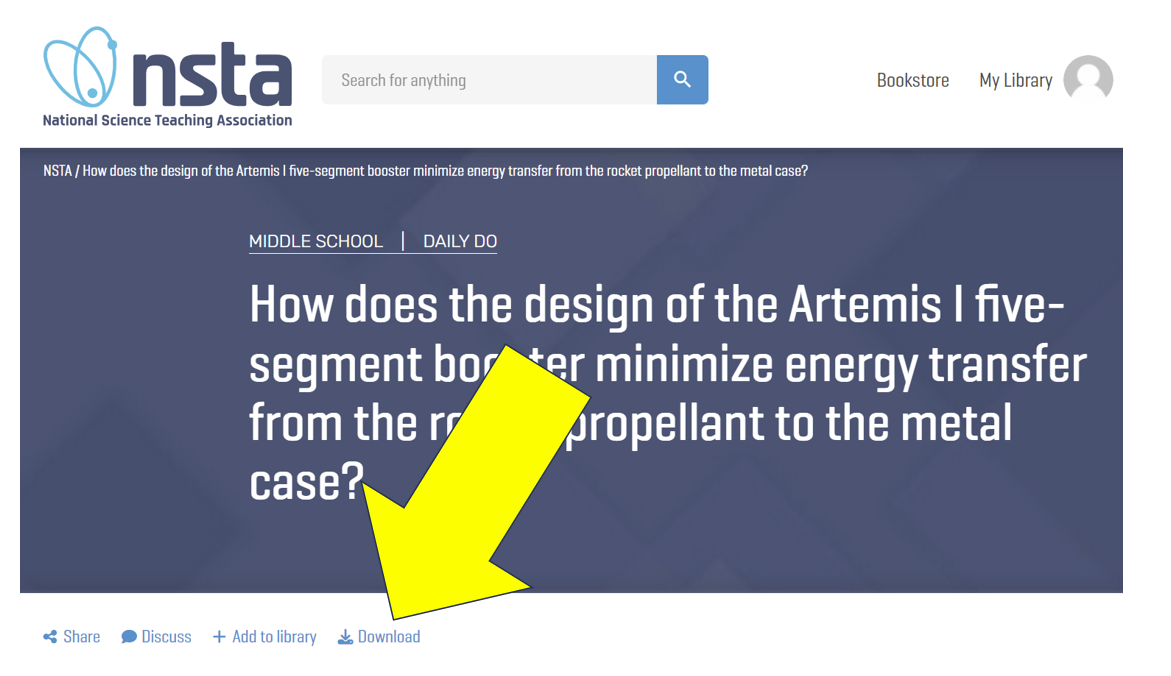
Note: The teacher guide is accessed by clicking the “Download” button at the top of the lesson’s webpage. You must be logged into your NSTA member account or free guest account to see the download button.
Next, access and make a copy of the SEP and Career Readiness Competencies Engagement Tracker (Resource #7 in the Integrated STEM: Building Career Competencies collection).
Read the lesson. As you read, look for evidence of engagement with the SEPs and development of the career readiness competencies. Complete the SEP and Career Readiness Competencies Engagement Tracker.
Reflect and Extend
In this final section you will reflect on your learning. Review your previous responses to help prepare for responding to the following questions.
Share your final thoughts on why you think it is important and achievable to integrate STEM and career readiness competencies into science classrooms.
Resources
Resources that support the learning in this PLU can be accessed from the Integrated STEM: Building Career Competencies Collection.
In addition to materials used throughout this learning experience, resources to deepen or extend your learning are also included for your reference.