


 Join
JoinAI Literacy Is Thinking Literacy: Using the Science and Engineering Practices to Guide Intentional AI Use
By Velma Itamura
Posted on 2026-07-13
Disclaimer: The views expressed in this blog post are those of the author(s) and do not necessarily reflect the official position of the National Science Teaching Association (NSTA).
Science education is rooted in curiosity and doing. Students begin to think scientifically when they notice something, wonder why it happens, ask questions, and look for ways to investigate. Just as students would not learn to swim by only reading about swimming and never getting in the pool, they can’t engage in the work of science without the right opportunities.
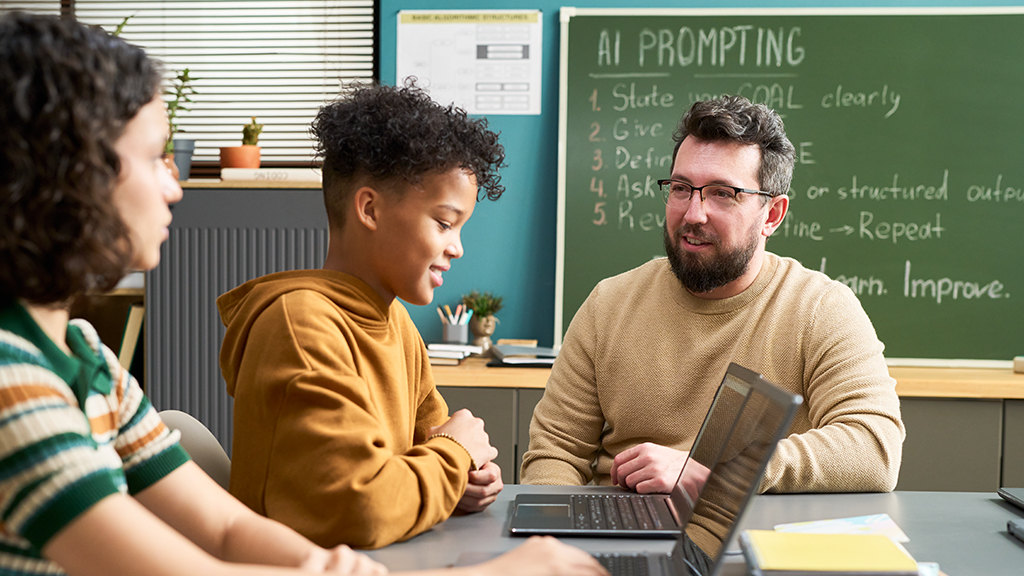
As artificial intelligence (AI) becomes part of students’ everyday learning, AI tools deserve careful attention. With AI tools, students can generate summaries, explanations, model descriptions, and polished written responses in seconds. For science educators, the question is not only whether students will use AI but also how to design learning experiences so students continue to ask questions, pursue evidence, and do the thinking that leads to understanding. Intentional AI use begins with the learning, not the tool. The Science and Engineering Practices in the Next Generation Science Standards can help teachers keep that learning at the center.
AI Literacy Is Thinking Literacy
When people talk about AI literacy, the conversation often turns quickly to tools: how to write a prompt, check an output, cite AI use, or understand that AI-generated responses can be inaccurate or incomplete. These skills matter, but in science classrooms AI literacy also must include the thinking students use to decide whether an answer makes sense.
Students need opportunities to evaluate evidence, identify what is missing, compare explanations, and recognize when a fluent response is not the same as a well-supported one. AI literacy, then, can be understood as thinking literacy: learning when to trust; when to question; when to seek additional evidence; and when to return to one’s own observations, data, or reasoning. For science educators, the Science and Engineering Practices offer a powerful place to begin because these practices already describe the kinds of thinking students need as they make sense of the natural world.
The Science and Engineering Practices as a Framework for AI Literacy
The Science and Engineering Practices provide a useful framework for making intentional decisions about AI use because they focus attention on what students are doing with ideas. The practices help teachers plan for questioning, modeling, analyzing data, constructing explanations, arguing from evidence, and communicating information, which are the same kinds of thinking students need when they interact with AI-generated responses.
Instead of asking, “Can students use AI for this task?” science teachers can ask, “What practice are students engaging in, and how could AI support that practice without taking over?”
In each case, the purpose of AI is tied to the practice. AI becomes a tool for critique, comparison, revision, or reflection, not a replacement for student sensemaking. The Science and Engineering Practices help keep the focus where it belongs: on the thinking students need to do to make sense of the natural world.
Science and Engineering Practice | How the Practice Supports AI Literacy |
| Asking Questions and Defining Problems | Students learn to frame questions before turning to AI, then evaluate whether AI-generated questions are testable, relevant, and connected to the phenomenon or problem. |
| Developing and Using Models | Students develop or revise their own models, then compare AI-generated explanations or representations against their observations, data, and current thinking. |
| Planning and Carrying Out Investigations | Students plan investigations before using AI, then use AI to critique their procedure for possible flaws, gaps, missing controls, unclear variables, or data-collection issues. |
| Analyzing and Interpreting Data | Students interpret data, then evaluate whether AI-identified patterns, trends, or outliers are supported by the evidence. |
| Using Mathematics and Computational Thinking | Students first use calculations, data displays, or computational tools to make sense of evidence, then use AI to check for errors, test assumptions, identify missing patterns, or evaluate whether a representation accurately supports the evidence. |
| Constructing Explanations and Designing Solutions | Students draft explanations or solutions, then use AI to identify where evidence, reasoning, clarity, or constraints may need further attention. |
| Engaging in Argument from Evidence | Students critique AI-generated claims, identify what evidence is included or missing, and defend their arguments using data or scientific reasoning. |
| Obtaining, Evaluating, and Communicating Information | Students compare AI-generated information with trusted sources; identify inaccuracies or omissions; and communicate what they accepted, questioned, or revised. |
How to Plan for AI Use Before, During, and After Learning
One way to keep AI use intentional is to plan what students will do before, during, and after they use it.
Before using AI, students should engage with the phenomenon, data, model, problem, or question by making observations, generating questions, identifying patterns, or drafting an initial explanation. This approach protects the early thinking that develops from curiosity, uncertainty, and productive struggle. When using AI, students should have a clear purpose, such as comparing explanations, critiquing a claim, identifying missing evidence, or soliciting feedback on their reasoning. After they use AI, students should show if and how their thinking changed by explaining what they accepted, rejected, questioned, or revised.
Teachers can use a simple planning question to guide this process: What thinking should students do before AI, what role should AI play during the task, and what evidence will show that students are still reasoning afterward?
Keeping Sensemaking at the Center
AI will continue to shape how students access information, generate ideas, and produce written responses. Science teachers can help students use these tools with a critical eye because science already encourages students to question, investigate, evaluate evidence, revise explanations, and communicate their reasoning. Intentional AI use should protect that work by ensuring students still have opportunities to be curious, struggle productively with ideas, test explanations against evidence, and explain if and how their thinking changed.
The Science and Engineering Practices can help teachers make intentional decisions about when AI belongs in the classroom, what role it should play, and what evidence will show that students are still doing the thinking needed to learn. In an AI-shaped world, students need more than access to technology. They need repeated opportunities to ask questions, use evidence, test ideas, evaluate information, and make sense of what happens around them. These habits of mind support more than science learning. They help students become literate global citizens who can use AI with purpose, discernment, and responsibility.
 Velma Itamura, MBA, is a science education leader with more than 29 years of experience as a classroom teacher, state science curriculum specialist, assessment developer, and national science education consultant. She is co-founder and Operations Director of the Science & Technology Advancement Center (STAC), where her work focuses on science learning, assessment, accessibility, and the intentional use of emerging technologies to support student sensemaking. Her current work explores how AI can be used purposefully in science classrooms while keeping curiosity, evidence, and student thinking at the center.
The mission of NSTA is to transform science education to benefit all through professional learning, partnerships, and advocacy.