


 Join
JoinFrom Chalkboards to AI
Beyond the Screen: How the Convergence of Digital, Media, and AI Literacies Sharpens Scientific Thinking
By Christine Anne Royce, EdD, and Valerie Bennett, PhD, EdD
Posted on 2026-04-23
Disclaimer: The views expressed in this blog post are those of the author(s) and do not necessarily reflect the official position of the National Science Teaching Association (NSTA).
Let’s be honest: Science class shouldn’t ever be just about memorizing the Krebs cycle, understanding plate tectonics, or balancing complex chemical equations. In the modern era, a student’s ability to navigate the world scientifically is as much about what they do with a screen as what they do with a Bunsen burner. Today, being scientifically literate means surviving a Saturday morning scroll through TikTok without falling for a “miracle cure,” a deepfake of a natural disaster, or a convincingly written but entirely hallucinated artificial intelligence (AI) summary of climate data.
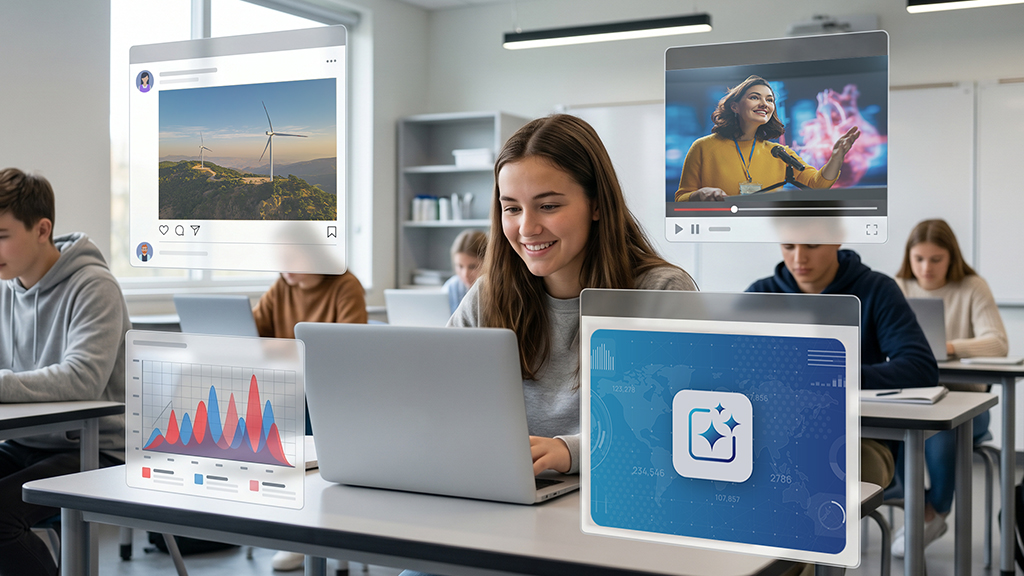
As science educators, we have always been in the business of evidence. We teach students to observe, hypothesize, test, and verify. But much of the “evidence” that our students see today is generated by algorithms and large language models (LLMs) at a speed and volume we’ve never seen before. To help our students navigate the sheer quantity of what they consume, we must weave together three critical threads of modern understanding: digital literacy, media literacy, and AI literacy.
Defining the Literacies: The Modern Scientist’s Toolkit
Before we can teach these concepts, we have to understand exactly what they encompass. While these terms are often used interchangeably in casual conversation, each represents a distinct set of skills and cognitive frameworks. By using definitions from leading educational and global organizations, we can anchor our teaching in established standards.
Digital Literacy
According to Law et al. (2018, 132), digital literacy is the ability to “access, manage, understand, integrate, communicate, evaluate and create information safely and appropriately through digital technologies.”
In the context of the science classroom, this idea is the fundamental “how to.” It involves technical proficiency in navigating a digital ecosystem. A digitally literate student knows how to use a database to find peer-reviewed research, organize and graph lab results on a spreadsheet, and protect their personal data while using online simulations. This literacy is the bedrock upon which all other digital interactions are built.
Media Literacy
The National Association for Media Literacy Education (NAMLE n.d.) defines media literacy as the ability to “access, analyze, evaluate, create, and act using all forms of communication.”
Media literacy focuses heavily on the message and the messenger. It involves asking, Who created this? Why did they send it? What techniques are being used to grab my attention? For a science student, media literacy is the primary shield against fake news, clickbait science, and sensationalized headlines that distort raw data to fit a specific narrative. Media literacy involves understanding the rhetorical and psychological forces at play behind the information we consume.
AI Literacy
A relatively new but essential addition to the list, AI literacy can be defined as the “knowledge and skills that enable humans to critically understand, evaluate, and use AI systems and tools to safely and ethically participate in an increasingly digital world” (Mills et al. 2024, 4).
AI literacy moves beyond the “what” of a message and into the “how” of its generation. AI literacy involves understanding that AI is not a sentient being or a truth engine, but rather a probabilistic system or a prediction machine. Someone with AI literacy understands that a chatbot doesn't know science; it simply calculates which word is statistically most likely to follow the previous one based on its training data.
Individual Before Integrated
It might seem counterintuitive to advocate for teaching these concepts separately before we integrate them, but mastery requires a deep dive into the mechanics of each literacy. Just as a chemistry student must understand the properties of hydrogen and oxygen before they can truly grasp the complexity of aqueous reactions, every student needs to understand the individual elements of literacy.
Building Technical Proficiency (Digital Literacy)
When we teach digital literacy on its own, we are focusing on the mechanics of the digital world. If a student cannot navigate a file structure, cite a digital source correctly, or understand how a URL indicates a site’s credibility (for example, “.gov” vs. “.com”), they will struggle to perform even basic scientific inquiries. Teaching this idea separately ensures that a student’s technical frustration doesn't become a barrier to scientific discovery.
Honing Psychological Awareness (Media Literacy)
Media literacy is essentially the study of human influence. By teaching it in isolation, we help students see how a scientific documentary might use minor-key music, fast-paced editing, or cherry-picked experts to manipulate viewers’ emotions. This concept is about human persuasion. When students understand the intent behind a piece of media, they are less likely to be led astray by biased reporting on scientific issues such as vaccines or environmental policy.
Demystifying the Black Box (AI Literacy)
AI literacy requires a shift in how we think about computers. Traditionally, we view computers as logic machines, where you could predict an outcome based on the input. AI doesn’t work that way. Teaching AI literacy separately allows us to focus on concepts such as training data, neural networks, and hallucinations without the distraction of a specific media message. Students need to know that the machine isn’t thinking in the human sense; it is performing high-level pattern recognition.
Teaching These Literacies for Different Grade Levels
K-5: From "Seeing Is Believing" to Asking Why
In the early grades, science is primarily about observation and wonder. We teach kids to look at a leaf, watch a caterpillar transition into a butterfly, and describe exactly what they see. However, in a world of AI-generated images and filtered videos, “seeing is believing” is no longer a safe motto to teach a young scientist. By introducing these concepts early, we help children develop skepticism without cynicism. They start to understand that digital tools are models, and like any scientific model, these tools have limitations. This lesson reinforces the core scientific habit of mind: Verify before you trust. It encourages them to ask, “How do we know this is true?”—the most fundamental question in science.
Middle School (6–8): Navigating the "Algorithm" of Information
Middle schoolers live in a “digital Wild West,” you could say. They are often the most active consumers of social media, yet they are still developing the executive function skills needed to filter the firehose of information they receive daily. This age range is where digital literacy shifts from “how to use a device” to “how to navigate an ecosystem.” This integration forces metacognition. Students have to think about how they know what they know. When they realize that AI can confidently lie to them or that an algorithm intentionally feeds them controversial content to keep them engaged, their evaluative thinking skills skyrocket. They stop being passive consumers and start being active investigators. They begin to see that the digital world has its own set of rules and laws that they must understand to remain grounded in reality.
High School (9–12): Data Ethics and the Future of Inquiry
By the time they reach high school, students are no longer just learning science; they are beginning to do science. They are the ones who will use AI to model climate change, sequence genomes, or engineer new materials. They need to understand the “black box” of digital tools from an ethical and systemic perspective. This understanding prepares students for systemic thinking. They begin to see that science doesn’t exist in a vacuum; instead, it is filtered through digital platforms, interpreted by AI, and shared via media. Understanding this pipeline makes students more rigorous researchers and more informed citizens. They learn that in the 21st century, the scientific method doesn’t end at the lab bench, and it extends to the computer screen. They become aware that the data they receive are only as good as the digital systems used to collect and transmit the data.
Integration as a Cognitive Firewall
While teaching these skills separately provides students with necessary tools, integrating the skills will give students the system they need to understand. When we weave these skills together, we create a triple threat against misinformation and a powerhouse for critical thinking.
Imagine how these could apply to a student researching a topic for a class debate:
- Digital literacy allows the student to bypass the “sponsored” links on a search engine and navigate to a peer-reviewed journal or a government report.
- AI literacy allows the student to use an AI summarizer to get the gist of a 50-page technical paper while remaining acutely aware that AI might oversimplify the chemical reactions or miss the nuances of the paper’s limitations section.
- Media literacy allows the student to recognize whether a journal was funded by an energy conglomerate or an environmental advocacy group, which can help the student weigh the potential for bias in the conclusions.
If any one of these factors is missing, the student’s thinking is compromised. The technically proficient student (digital literacy) might still be fooled by a clever AI-generated graph (AI literacy) designed to push a specific political agenda (media literacy). The media-savvy student might recognize a bias but lack the technical skill to find the raw data needed to debunk it. Integration is what turns a student consumer into a scientist.
Why Science Teachers Are the Best Leaders on These Topics
You might ask, Shouldn’t the computer science teacher or the librarian teach these ideas? While those colleagues are vital partners, the science teacher is uniquely positioned to lead this charge. Why? Because these literacies are, at their core, about evidence-based reasoning.
The scientific method is the ultimate framework for literacy:
- Observation: What am I seeing on my screen?
- Hypothesis: I think this might be an AI-generated image meant to scare people.
- Experimentation: I’ll do a reverse image search (digital literacy) and check the fingers on the people in the photo for AI glitches (AI literacy).
- Conclusion: The photo is fake, and the source has a history of posting misleading content (media literacy).
To all fellow science educators: You don’t have to be a computer scientist or a coding expert to bring these literacies into your classroom. You just have to be a scientist. Use the same curiosity, the same demand for evidence, and the same rigor you bring to a lab experiment, and apply all of these to the digital world.
We are moving from an era where the challenge was how to find information to an era where the challenge involves how to filter information. Teaching these literacies separately gives our students the tools; teaching them together gives them the wisdom to use those tools for the betterment of society. Let’s get our students ready for the future—one click, one prompt, and one critical thought at a time.
The following video and audio synopsis of this blog were generated using Google NotebookLM's features. They have been reviewed for alignment to the blog and accuracy.
References
Law, Nancy, David Woo, Jimmy de la Torre, and Gary Wong. 2018. A Global Framework of Reference on Digital Literacy Skills for Indicator 4.4.2. UNESCO Institute for Statistics. https://unesdoc.unesco.org/ark:/48223/pf0000265403
Mills, Kelly, Pati Ruiz, Keun-woo Lee, Merijke Coenraad, Judi Fusco, Jeremy Roschelle, and Josh Weisgrau. 2024. AI Literacy: A Framework to Understand, Evaluate, and Use Emerging Technology. Digital Promise. https://digitalpromise.dspacedirect.org/server/api/core/bitstreams/c09bc1b5-a869-4fc3-b47b-c3bfd6575ca0/content
National Association for Media Literacy Education (NAMLE). n.d. What Is Media Literacy? Media Literacy Defined. https://namle.net/resources/media-literacy-defined/
National Science Teaching Association. 2024. Understanding AI: A Teacher’s Guide https://www.nsta.org/blog/understanding-ai-teachers-guide
 Christine Anne Royce, EdD, is a past president of the National Science Teaching Association (NSTA) and currently serves as a professor in teacher education and the co-director for the MAT in STEM education at Shippensburg University. Her areas of interest and research include the use of digital technologies and tools within the classroom, global education, and the integration of children’s literature into the science classroom. She is an author of more than 140 publications, including the Science and Children “Teaching Through Trade Books” column.
 Valerie Bennett, PhD, EdD, is an assistant professor in STEM education at Clark Atlanta University, where she also serves as the program director for graduate teacher education and the director for educational technology and innovation. With more than 25 years of experience and degrees in engineering from Vanderbilt University and Georgia Tech, she focuses on STEM equity for underserved groups. Her research includes AI interventions in STEM education, and she currently co-leads the National Science Foundation Noyce grant, works with the Atlanta University Center Consortium Data Science Initiative, and collaborates with Google to address workforce diversity and engagement in computer science in the Atlanta University Center K–12 community.
This article is part of the blog series “From Chalkboards to AI,” which focuses on how artificial intelligence can be used in the classroom in support of science, as explained and described in A Framework for K–12 Science Education and the Next Generation Science Standards.
NSTA’s mission is to transform science education to benefit all through professional learning, partnerships, and advocacy.