

 Join
JoinInterpreting Science-in-the-Wild
By Douglas Allchin
Posted on 2026-09-08
Disclaimer: The views expressed in this blog post are those of the author(s) and do not necessarily reflect the official position of the National Science Teaching Association (NSTA).
In 2025 the U.S. Department of Energy commissioned a special Climate Working Group that later reported that fears of global warming had been vastly exaggerated for years and that there was no real crisis. Should citizens have heeded their conclusions?
Earlier, the Secretary of Health and Human Services announced that the U.S. would withhold $1.2 billion in funding to an international immunization organization because they “ignored the science,” citing a 2017 study that correlated infant mortality with vaccinations. Were consumers justified in viewing this as a reason not to vaccinate their own children?
These two cases epitomize the civic purpose of science education. That is, we expect science to inform public policy and personal decisions. Science teachers should thus help students learn, as the NGSS puts it, how to “obtain, evaluate and communicate information” (Science and Engineering Practice #8).
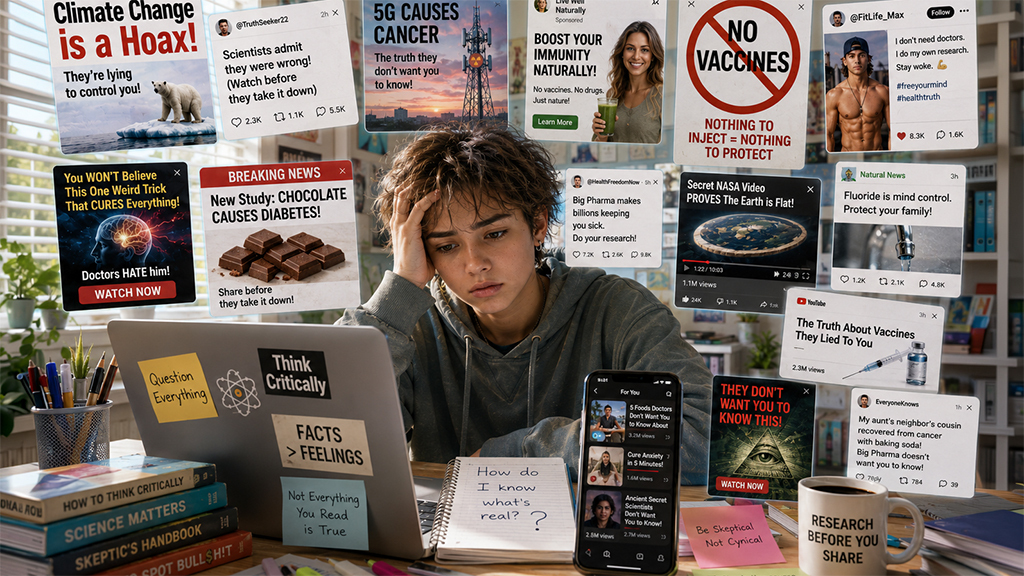
But this is a formidable challenge nowadays. Misinformation is everywhere — on the internet, on social media, from influencers, in advertising. What is genuine science, what is mere imitation? This is not memorizing School Science. Or trying to decipher a peer-reviewed journal article. This is science-in-the-wild: beyond the textbook, beyond the safeguards provided by the world of professional discourse and its system of checks and balances. How do we prepare students for the task of deciding which claims, or who, in public media can be trusted?
The frequent assumption is that if students learn a bit of scientific reasoning, they can sort fact from faux on their own — exemplifying the Enlightenment ideal of intellectual independence. Unfortunately, this hope is misplaced. You need expertise to disentangle plausible but ultimately flawed arguments. You need deep experience to recognize biased, cherry-picked data. Without specialized background, you cannot spot the technical mistakes, the experimental or statistical sources of error, the other possible explanations, and so forth. This is the special role of scientific experts. They are uniquely qualified to unravel falsehoods and misleading claims. We rely on them to do this advanced work on our behalf. As noted by philosopher John Hardiwg, and echoed by educator Stephen Norris, in today’s culture of distributed knowledge we cannot escape our inevitable dependence on experts.
As a consumer, there is no point trying to sort through the data or the chain of reasoning if they are tainted from the outset. We need to take the challenge of science-in-the-wild seriously: that agents of disinformation are not interested in an honest argument or genuine evidence. Their aim is not to engage in science. Their aim is to mislead, to obfuscate, to erode trust, to derail policy, or confound public opinion. They do not “play fair.” Why should we waste our time or effort in weighing their evidence or measuring their arguments if it is all bogus?
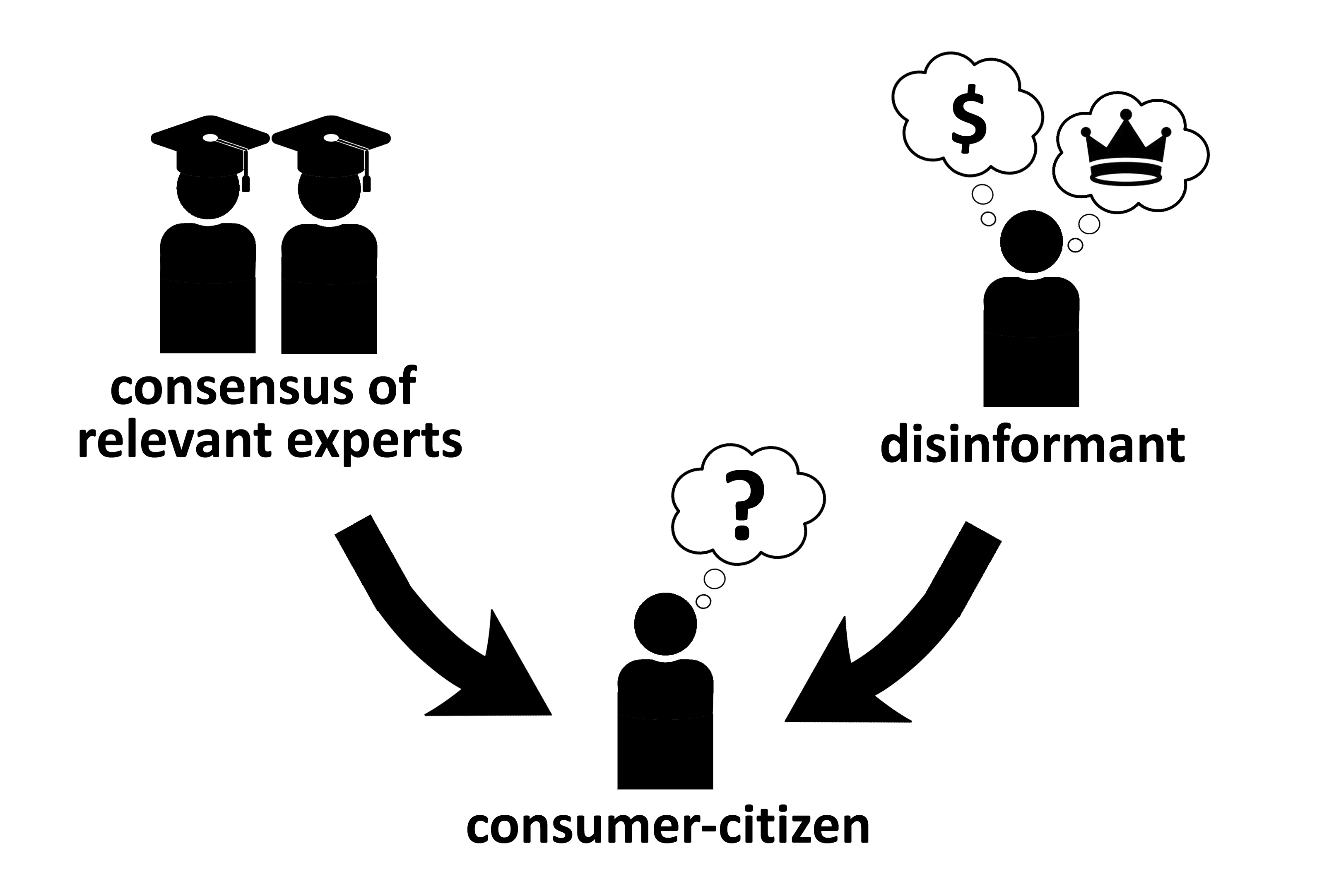
The chief challenge of preparing students for science-in-the-wild is not to bolster their scientific reasoning. Rather, we need to help them focus on whether the very source of information is credible itself (see figure). Are they expert enough to vouch for the claims? Do they have a track record of faithfully conveying the consensus? Or is there a conflict of interest, say? Who speaks for real science?
In today’s treacherous information environment, we need to include science media literacy as an essential element of functional science literacy. Not, “What is the nature of science?” but “What is the nature of science communication?” We are not interested solely in the process of producing and validating scientific knowledge, but also in the intellectual work of consuming knowledge. We can generally trust scientists to assemble reliable knowledge. But that is not enough. We still need to learn how to distinguish authentic science from imposters in the media.
So, civically-responsible science education will involve numerous learning activities. First: skills in basic fact-checking. Can you investigate who is making the claim? What is their motive, possibly hidden or deliberately disguised? Can you crowd-source the claim online? These questions help highlight the art of critical ignoring: disregarding what unknown others have chosen to present to you and doing quick lateral research on what perhaps they don’t say.
Second: an understanding of credibility. Is the spokesperson an expert? What, indeed, constitutes expertise? Does the source have a track record of faithfully reporting the work of relevant experts? Is there a consensus of experts? Asking these questions would have helped clarify the two cases in the opening. Those public pronouncements did not reflect credible science, even though they presented apparently compelling “scientific” arguments. Both sidestepped the expert consensus.
Third: competencies in deciphering deceptive tactics. Students are easily confused by style — how a website looks, or a confident voice in a glossy YouTube video — mistaking that for a source’s credibility. Alternatively, expert credentials can be faked, along with impressive-sounding organizations that are fronts for industry or political groups. Disinformation engineers also appeal to personal identities and social emotions, dividing insiders (to be trusted) from outsiders (to be “cancelled”). They may repeat the same misleading message until it sounds so familiar that it seems true. Or they foster uncertainty and fear, to sow doubt in good science. All misdirect us away from reliable scientific information. We need to be wary of sources that seek profit, power or privilege by trying to hijack the authority of science.
All these competencies — and others — are addressed in NSTA’s The Science Teacher, in the “Fact-or-Faux” series (since January, 2024). Each essay addresses a separate dimension of science media literacy and provides an inquiry-based lesson to engage students. Here, we should be reminded of the ideals of constructivist pedagogy. Teachers will ideally facilitate student inquiry, not just lecture or assign exercises with prescribed checklists.
For example, quiz yourself with “The Plausibility Trap.” Or play the “LIARS game.” Or you might venture into history and consider the predictions of a devastating earthquake in New Madrid, Missouri, in 1990. (They closed the schools and called out the National Guard! But nothing happened.) Or you might consider the barrage of public criticism of Rachel Carson when she published Silent Spring in 1962, alerting the public to the dangers of pesticides. Or you can delve into the question of smallpox variolation in 1721 — encountering questions about cultural and gender bias in credibility judgments. There are activities on the covid pandemic and eugenics, too. The first two years of “Fact-or-Faux” are now collected at: https://www.tandfonline.com/journals/utst20/collections/Fact-or-Faux. Complementary prepared presentations (PPT and PDF) to use in guiding classroom inquiry may be found at http://shipseducation.net/misinfo.
With today’s media environment, students need to learn how to cope with misinformation and science-in-the-wild. We can — and we must — prepare them with appropriate inquiry learning on science media literacy.
 Douglas Allchin is a former high school biology teacher, now a Resident Fellow at the Minnesota Center for Philosophy of Science. His books include Teaching the Nature of Science (2013), Sacred Bovines: The Ironies of Misplaced Assumptions in Biology (2017), Toward a Philosophy of Error in Science (2026) and Whole Science (2026). He edits the “Fact-or-Faux” column for The Science Teacher.
The mission of NSTA is to transform science education to benefit all through professional learning, partnerships, and advocacy.