


 Join
JoinTeaching Biology Through Bird-Watching, Citizen Science, and Local Observation
By Christopher Morales
Posted on 2026-06-22
Disclaimer: The views expressed in this blog post are those of the author(s) and do not necessarily reflect the official position of the National Science Teaching Association (NSTA).
In July 2025, I attended the STEM Institute hosted by the Whitaker Institute at Florida Gulf Coast University in partnership with the Conservancy of Southwest Florida. The weeklong professional development experience focused on innovative STEM teaching practices, environmental education, and authentic student engagement through inquiry-based learning. One of the major topics emphasized throughout the institute was citizen science and how students can participate in real scientific observation within their own communities.
Designing a Citizen Science Lesson
As part of the culminating project, participants were asked to design a citizen science lesson that incorporated one of the instructional ideas explored during the institute. I chose to focus on bird-watching because it combines observation, ecology, data collection, and local environmental awareness in a way that can be immediately accessible for students. I originally designed the lesson as a short classroom activity in which students would use tools such as Merlin Bird ID and eBird to identify local bird species and document observations.
Expanding the Project into a Yearlong Curriculum
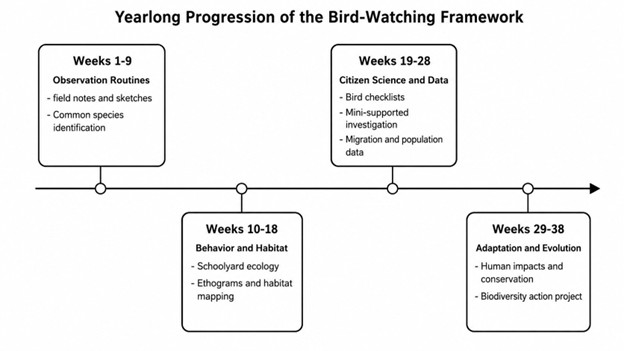
During the 2025–26 school year, I was assigned an elective course called Integrated Science, which gave me the opportunity to expand on the idea. Instead of using bird-watching as a one-time enrichment activity, I decided to integrate it throughout the entire year as a recurring instructional framework. The framework guided students from introductory bird identification and foundational observation skills toward learning about broader biological concepts such as ecology, habitat relationships, migration, biodiversity, place-based scientific inquiry, and environmental stewardship.
Using the Schoolyard as a Living Laboratory
One of the biggest advantages of bird-watching in the classroom is accessibility. Students do not need expensive laboratory equipment or access to remote field sites to participate in meaningful scientific observation. Many valuable learning experiences for my students came directly from observing common birds already present on campus, including pigeons, grackles, mockingbirds, doves, and ibises. As my students continued with this framework during the year, they began paying closer attention to organisms they had previously ignored while also developing stronger observation and questioning skills over time.
Integrating Citizen Science into Daily Learning
Throughout the year, students completed short bird surveys around campus, recorded behavioral observations, compared habitats, and discussed how environmental conditions influence bird activity. Students also used citizen science tools to practice species identification and examine migration and population patterns. These activities created opportunities for students to connect classroom biology concepts to real organisms they encountered daily.
Increasing Student Engagement Through Outdoor Observation
One valuable outcome was seeing how repeated outdoor observation changed student engagement. Students who were often hesitant during traditional classroom instruction became highly engaged when asked to identify birds, document behaviors, or explain ecological interactions they observed firsthand. The schoolyard gradually became more than just a space students walked through between classes—it became a living laboratory where they practiced scientific observation in real time.
Connecting Biology to Local Environments
The experience also reinforced the value of place-based learning in science education. Rather than separating biology from students’ daily environments, bird-watching helped connect scientific concepts directly to local ecosystems and community spaces. Even short observation sessions created opportunities for students to practice data collection, ask scientific questions, and discuss environmental relationships in authentic ways.
Conclusion: Science Beyond the Classroom Walls
What began as a small professional development project ultimately transformed the structure of my Integrated Science course. Bird-watching provided a simple but powerful framework for helping students experience science as an active process of observing, questioning, and interpreting the living systems around them every day.
 Christopher Morales is a high school science teacher in Southwest Florida and an adjunct biology instructor at Florida Southwestern State College. He is pursuing an EdD in Educational Leadership with research interests in environmental factors, student engagement, place-based learning, and science education. LinkedIn: https://www.linkedin.com/in/christopher-morales-ms-18a09418a/
The mission of NSTA is to transform science education to benefit all through professional learning, partnerships, and advocacy.