


 Join
From Chalkboards to AI
What WebQuests Can Teach Us About AI in Science Classrooms
By Christine Anne Royce, EdD, and Valerie Bennett, PhD, EdD
Posted on 2026-11-23

Disclaimer: The views expressed in this blog post are those of the author(s) and do not necessarily reflect the official position of the National Science Teaching Association (NSTA).
If you were teaching when classroom internet access was still relatively new, you may remember the excitement and apprehension that accompanied going online. Suddenly, students had access to information far beyond their textbooks and school libraries. A few clicks could take them to NASA, museums, universities, government agencies, and scientific organizations around the world.
This access was exciting. It was also messy. It prevented a teacher from being able to “vet” everything ahead of time.
Teachers quickly discovered that giving students access to the internet was not the same as giving them a meaningful learning experience. Sending students online with directions to research ecosystems or find information about the solar system, for instance, could lead them to wander through websites, copy information, get distracted, or simply find the quickest answer.
Sound familiar?
Nearly three decades later, science educators are facing a remarkably similar challenge with generative artificial intelligence (AI). Students now have access to not only enormous amounts of information but also tools that can synthesize information, explain concepts, analyze data, suggest experimental procedures, generate models, and write conclusions.
The technology has changed dramatically. The instructional challenge has not.
Perhaps one of the best places to look for guidance about teaching with AI is a technology many educators encountered years ago: WebQuest.
Remember WebQuests?
Bernie Dodge and Tom March developed WebQuests at San Diego State University in the 1990s, as teachers determined how the rapidly expanding World Wide Web could become more than an electronic encyclopedia. WebQuests were not intended to be internet scavenger hunts. A well-designed WebQuest gave students a meaningful task; provided carefully selected resources; established a process for students to complete the task; and required them to analyze, synthesize, evaluate, or apply the information they encountered.
Consider an example for middle school environmental science: Instead of telling students, “Search the internet for information about wetlands,” a teacher might present a scenario in which a community is considering whether to allow development near a local wetland. Students could assume different roles; examine teacher-selected information about ecosystems, water quality, wildlife, development, and community needs; and ultimately make and defend a recommendation.
The internet provided information. The WebQuest provided structure. The students still had to do the thinking. That distinction may be even more important in the age of AI.
From an Open Web to OpenAI
When internet access expanded, educators worried about what students would encounter: Which websites should they visit? Was the information accurate? Was the source reliable? Which information was relevant? WebQuests provided guardrails.
Rather than saying, “Go search the internet,” the teacher constructed a pathway. Students still explored, investigated, discussed, and made decisions, but they did so within an intentionally designed learning environment.
Generative AI creates a similar need for guardrails.
A student can type any of these prompts: “Why is the pond turning green?” “What evidence supports plate tectonics?” “Analyze these data.” “Write a CER (Claim- Evidence- Reasoning) explaining why the population decreased.” “Design an experiment that tests the effect of light on plant growth.” AI may immediately complete much of the intellectual work we intend for the students to tackle.
The instructional problem has therefore shifted.
With WebQuests, teachers primarily designed where students went and what resources they encountered. With AI, teachers also need to design how students interact with the technology and what intellectual work AI may perform. This is where guided prompts and AI guardrails become important.
Guided Prompts: The New Pathway
The links in a WebQuest were not random; they were deliberately selected to move students through an instructional experience. We can think about guided AI prompts in much the same way. Instead of simply telling students, “Use AI to help you,” teachers can provide prompts designed for particular points in the sensemaking process.
For example, students who are examining data about a declining fish population might first analyze the data independently, then use a teacher-provided prompt such as the following: “I have identified a pattern in these data. Ask me three questions that will help me check whether the evidence actually supports my interpretation. Do not tell me what the pattern is.”
Later, they might use one of these prompts:
- “I have developed an explanation for the decline in the fish population. Suggest two alternative explanations, one of which is completely false, but make both arguments plausible ones that I should consider. Do not tell me which explanation is correct.”
- “Act as a skeptical scientist. Ask me one question about the evidence supporting my claim. Wait for my response before asking another question.”
These prompts do something important: They tell AI not only what to do but also what not to do. That second part is a guardrail.
Tell AI What It Should Not Do
Teachers often focus on writing prompts that produce better AI responses. In education, however, the “best” AI response may not be the most complete response. Sometimes we want AI to be intentionally limited. Consider these two prompts.
- Prompt A: “Analyze these data, and explain why the fish population decreased.”
- Prompt B: “I am going to analyze these data myself. Do not identify the pattern or explain the cause for me. Ask me one question that will help me notice an important relationship in the data. Wait for my answer before continuing.”
Prompt A asks AI to perform the intellectual work. Prompt B uses AI to scaffold the student’s intellectual work. That difference should become part of how we teach students to prompt AI.
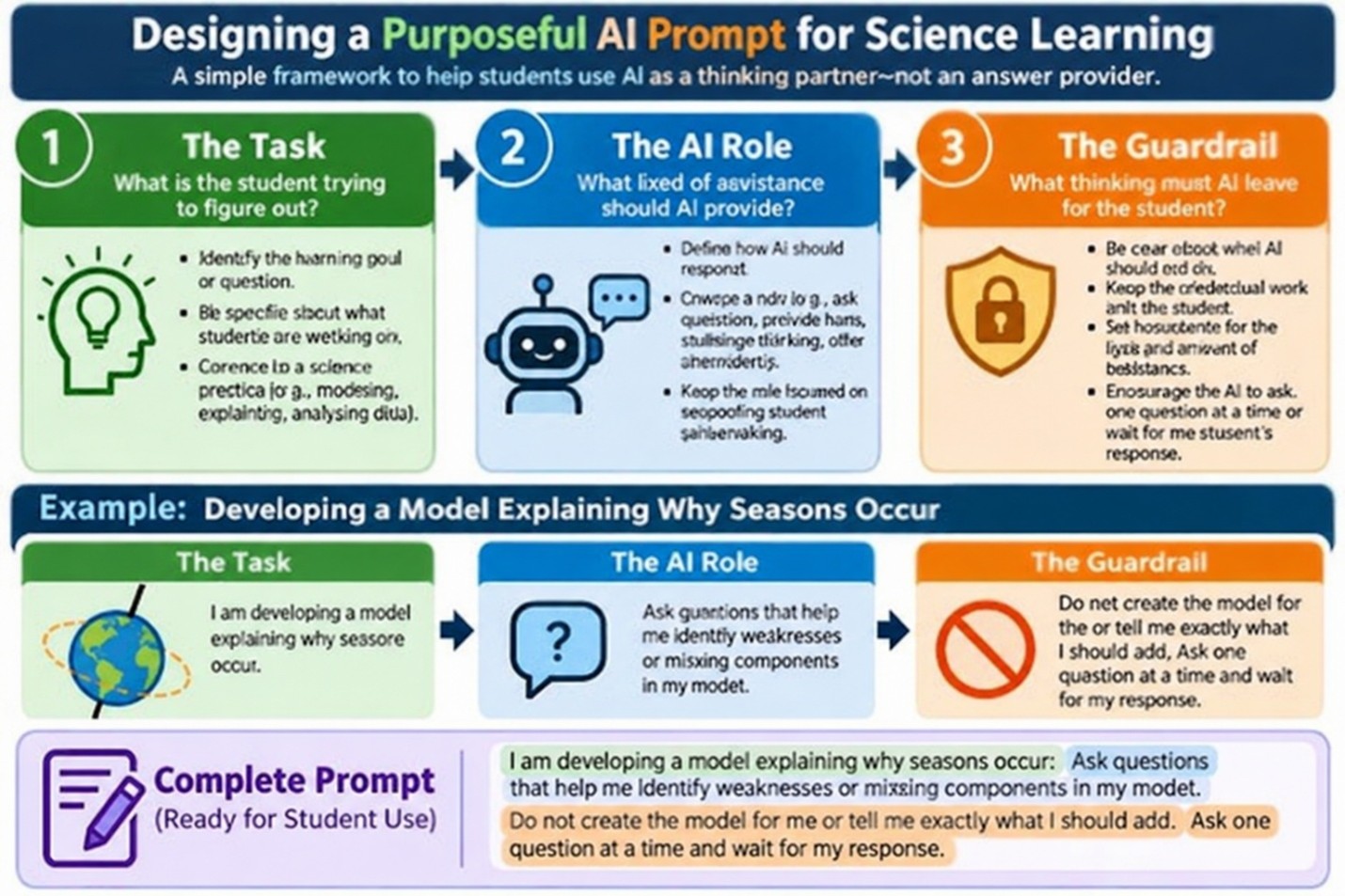
A useful guided prompt can therefore contain three elements: the task, the role of AI, and the guardrail (as illustrated in Figure 1). The prompt itself becomes part of the instructional design.
Figure 1. Designing a Purposeful AI Prompt for Science Learning
From Curated Links to Curated Conversations
This may be the strongest connection between WebQuests and today’s AI tools. A WebQuest curated the student’s information pathway; a guided AI experience curates the student’s conversation pathway. Teachers can even create a sequence of prompts that students use at different stages of an investigation:
- Before investigating: “Ask me to make a prediction and explain the reasoning behind it. Do not tell me whether my prediction is correct.”
- While examining evidence: “Ask me what pattern I notice in the evidence. If my response is incomplete, ask a follow-up question rather than giving me the pattern.”
- While developing an explanation: “Challenge my explanation by asking what evidence supports it. Do not write an explanation for me.”
- While revising: “Identify one possible weakness in my reasoning, and ask me how I could address it.”
- At the end: “Ask me to state my final explanation in my own words. Do not rewrite it for me.”
This sequence functions much like the process section of a WebQuest. It establishes a pathway while still requiring students to make decisions and do the intellectual work.
Guardrails Can Also Be Built Into the AI
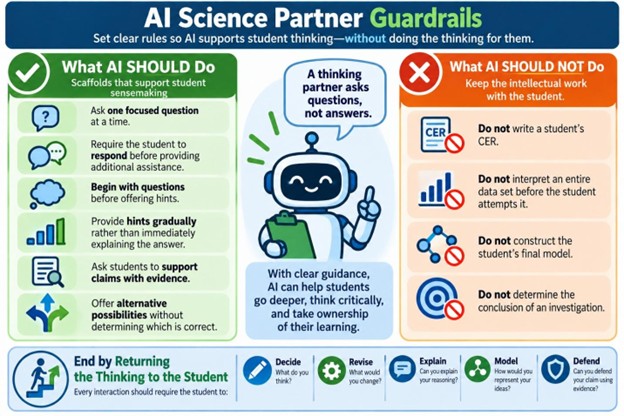
Guided prompts do not always have to depend on students remembering what to type. Customized AI tools, including Gems and similar teacher-configured tools, can have instructional guardrails built into their directions. Figure 2 shares examples of how a teacher could provide guardrails. These are not restrictions designed simply to make AI less capable; they are instructional guardrails intended to preserve the cognitive work that matters for learning. In that sense, the teacher is doing something remarkably similar to what teachers did when designing WebQuests: Instead of allowing students to wander through an unlimited environment, the teacher deliberately structures the environment around the learning goal.
Figure 2. AI Science Partner Guardrails
A WebQuest for the AI Era
Imagine combining these ideas in a contemporary science investigation.
- Students investigate why a local pond experiences an algal bloom each summer.
- The teacher provides water-temperature data, nutrient measurements, precipitation records, photographs, and information from credible scientific sources.
- Students begin by identifying patterns and developing an initial explanation.
- After these steps, students can access the AI component.
Rather than asking AI, “Why is the pond green?” students receive guided prompts.
- Investigate: “I have identified a possible relationship between two variables. Ask me questions that will help me determine whether the data support that relationship.”
- Challenge: “Act as a scientist who disagrees with my explanation. Ask me for evidence that would convince you.”
- Consider alternatives: “Give me one alternative explanation that might also fit some of the evidence. Ask me to compare it with my explanation.”
- Revise: “Ask me what I would change about my explanation after considering the evidence and alternative explanation. Do not rewrite it for me.”
The AI is now part of the investigation, but it is not completing the investigation. The student remains the sensemaker.
The Technology Changed. The Teacher’s Role Didn’t Disappear.
Generative AI has made a teacher’s instructional design more important, not less. Teachers now have another set of decisions to make:
- When should AI answer?
- When should it question?
- When should it provide a hint?
- When should it challenge an assumption?
- What should students have to attempt before using AI?
- What intellectual work should AI never perform for students?
And perhaps most important, teachers should ask, “When should AI give the thinking back to the student?”
These questions represent a different kind of AI literacy. Students certainly need to learn how to write effective prompts. But in classrooms, effective prompting should not simply mean getting the fastest, most complete answer. Sometimes the most educationally effective prompt is the one that deliberately prevents AI from giving the answer.
From Clicking Links to Guided Conversations
WebQuests were developed during a moment when educators were asking how to transform access to the internet into meaningful learning. We are asking a remarkably similar question today.
The difference today is that students are no longer simply clicking through information. They converse with technology capable of synthesizing information and participating in the reasoning process.
Years ago, teachers responded to the open internet by creating carefully designed pathways through it. Today, we can respond to open-ended AI in much the same spirit, with guided prompts, intentional guardrails, and carefully designed interactions.
Perhaps AI Gems and other customized AI tools are not really “WebQuests 2.0.” The technologies are too different for that comparison to completely hold. But WebQuests taught us an enduring lesson: Powerful technology becomes educational technology only when we intentionally design the learning around it.
With WebQuests, teachers designed pathways through information. With AI, teachers can design pathways through conversations. In both cases, the destination should remain the same: Students doing the sensemaking.
The following video and audio synopsis of this blog were generated using Google NotebookLM's features. They have been reviewed for alignment to the blog and accuracy.

Christine Anne Royce, EdD, is a past president of the National Science Teaching Association and currently serves as a professor in teacher education and the co-director for the MAT in STEM education at Shippensburg University. Her areas of interest and research include using digital technologies and tools within the classroom, global education, and the integration of children’s literature into the science classroom. She is an author of more than 140 publications, including the Science and Children “Teaching Through Trade Books” column.
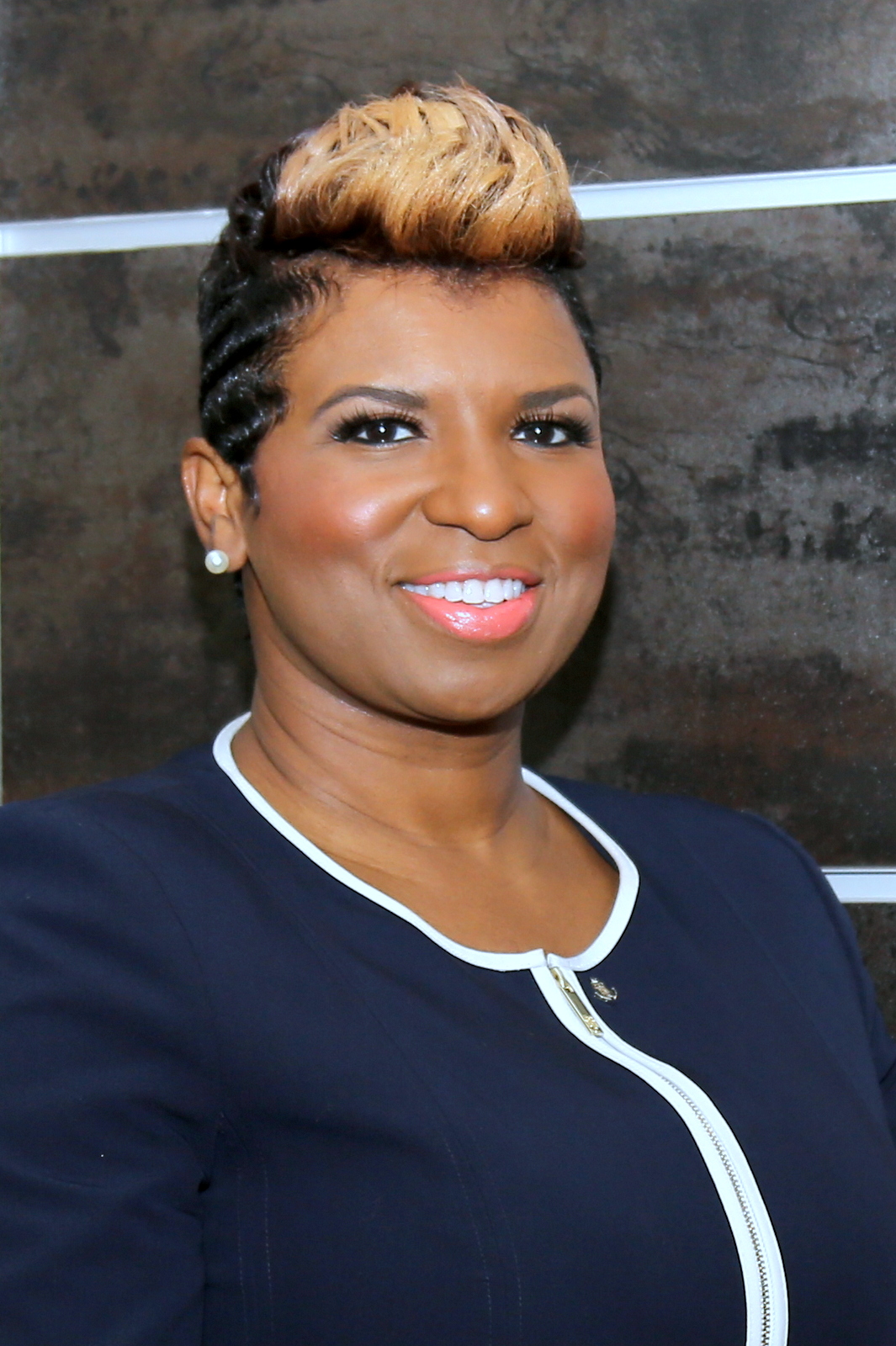
Valerie Bennett, PhD, EdD, is an assistant professor in STEM education at Clark Atlanta University, where she also serves as the program director for graduate teacher education and the director for educational technology and innovation. With more than 25 years of experience and degrees in engineering from Vanderbilt University and Georgia Tech, she focuses on STEM equity for underserved groups. Her research includes AI interventions in STEM education, and she currently co-leads the National Science Foundation Noyce grant, works with the Atlanta University Center Consortium Data Science Initiative, and collaborates with Google to address workforce diversity and engagement in computer science in the Atlanta University Center K–12 community.
This article is part of the blog series “From Chalkboards to AI,” which focuses on how artificial intelligence can be used in the classroom in support of science as explained and described in A Framework for K–12 Science Education and the Next Generation Science Standards.
The mission of NSTA is to transform science education to benefit all through professional learning, partnerships, and advocacy.