

 Join
JoinThe Next Generation Science Standards: a transformational opportunity
By Guest Blogger
Posted on 2015-01-15
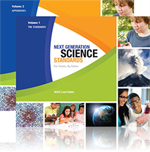 The Next Generation Science Standards (NGSS) and A Framework for K–12 Science Education articulate a beautiful vision for students. The overarching goal of the standards is a coherent and rigorous science education for all students, enabling them to be critical consumers of science and attain the scientific literacy necessary to be informed citizens able to engage in public discourse and decision making on issues of science, engineering, and technology. For those who are so inspired, attaining proficiency in the standards provides students with the foundation needed to pursue STEM careers (a much-needed cohort in our society). Whereas the vision is clear, there is no single path teachers can follow to implement the Next Generation Science Standards. K–12 teachers who want to play a central role in transforming science teaching and learning need guidance in creating paths along which they can translate the NGSS into strong curricula and inspired instruction.
So, how can teachers build aligned NGSS curricula and instruction? Through individual reflection and productive struggle; conversation and collaboration with science educators nationwide; and partnerships with national, state, and local supporters, teachers can develop and implement a shared vision for classroom teaching and learning in science.
Reflection
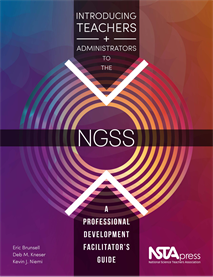 Groups of teachers all over the United States are finding the path to NGSS less daunting when they actively engage in adult learning through reflection on how their new approaches to science teaching are working and are mindful when reviewing resources for implementation. There is always that temptation to look for the easy answers about “How to do the NGSS.” But following someone else’s plans without thoughtful reflection, analysis, and debate will not enable us to reach our own understanding. Without our own deep understanding, we cannot truly shift our classrooms in a sustained way to the deep thinking and critical perspectives required in NGSS. As authors Eric Brunsell, Deb M. Kneser, and Kevin J. Niemi so effectively state in one of my favorite new resources, Introducing Teachers and Administrators to the NGSS, “the NGSS represents an evolution of our understanding of the standards, not a complete break with the past.”
If we develop a deep understanding of the NGSS and build our capacity as teachers to coach students toward independent thinking and lifelong learning, we will be able to use many of our own resources by making revisions and shifts in design, and we will be able to develop our own skills as critical consumers of new resources. The productive struggle of “figuring it out” for ourselves with support from others is what leads to deep understanding. We already know this to be true for our students, so shouldn’t we apply the same principles to our own learning? What could we build together if we applied this thinking to ourselves when it comes to NGSS?
Conversation and Collaboration
 The NGSS is an opportunity for us to collaborate and have conversations around a national common language. One place I like to find support for my own reflection is the NGSSblogs Project. We started this to elevate the collective conversation, so teachers can build paths to NGSS implementation resulting in empowerment for both teachers and students. Just as we witness in our own classrooms, discourse moves understanding forward. I urge you to share your NGSS experiences, have conversations with the teacher down the hall, in the next district, on the other side of the state. Collaborate with those teachers by sharing your best lesson and work together to braid it into the NGSS. Learn from each other and together. The reflection required for sharing powers your own growth while making your reflections public moves the thinking and learning of others. Imagine the resources we could compile if teachers shared what was working (and not working) with NGSS implementation in their own classrooms? By building together, we can assemble an ever-evolving resource bank of NGSS support. Here are some opportunities for conversation, collaboration, and sharing:
- NGSS Multi Tools Online Community of Teachers
- NGSSPeer Learning Network on Google Plus
- #NGSSchat on Twitter
Partnerships with Classroom Supporters
If the reflection and collaboration supports our deep understanding of the NGSS and opportunities to learn and share together, how can we collectively determine a sense of what is “good enough”? How can we ensure we have quality resources, models, and unit progressions for NGSS teaching and learning? Through partnerships and community support, we can work together to create models of great classroom teaching and learning. The National Science Teachers Association (NSTA) has been a leader in supporting teachers first in understanding the Next Generation Science Standards themselves and then in understanding how to use the NGSS to transform their science classrooms.
 To help science teachers, NSTA has created the NGSS@NSTA Hub—a one-stop shop for a multitude of resources for teachers to design NGSS instruction for classroom learning. Resources include articles, webinars, videos, models—and coming soon, an interactive database to support teacher collaboration. Tools and resources like these provide support for teachers to collaborate and build instruction and curriculum.
Another national supporter, Achieve, Inc., has facilitated work among the 26 lead states in developing the Next Generation Science Standards from the beginning. They continue to support teachers by providing resources and guidance during NGSS implementation. The EQuIP rubric developed by Achieve in a partnership with NSTA, for example, is a tool for determining how closely instructional materials align with the NGSS. An excellent overview on how to use the EQuIP rubric was recently written and gives great advice on How to Select and Design Materials that Align to the Next Generation Science Standards.
Another set of useful tools from Achieve are Evidence Statements. They are a sort of a way to do backwards math—they allow you to visualize the incremental captures of student learning on the path to demonstrating proficiency in performance expectations (PEs). They identify what your lesson is building toward and what still needs to be covered. They provide examples of 3D learning with details on what students should know and be able to do to meet performance expectations. The high school evidence statements have just been released, and middle school and elementary evidence statements are coming soon.
Equipped with all this information and resources, I urge science teachers to remember that they themselves are the most important part of the picture. To reimagine science education, we need more than a set of standards that capture a vision. Teachers are the catalysts for transforming science education; teachers have the practical experience and the day-to-day connections with students to make this happen. National partners like NSTA and Achieve are ready to support us. It is the work of classroom teachers and those who support classroom learning that makes the vision come to fruition. Please become part of the work of building the kind of classroom experience that originally inspired us to become teachers—make your classroom a place of discovery and wonder that leads to investigating the world and building students understanding of the world. The NGSS gives us an opportunity to share our voice, passion, and gifts on a state and national level to help transform science education. What can you contribute to transform science classrooms to support science literacy so we can ensure those we teach today are ready for tomorrow?
Visit www.NGSSPLN.com for more information about a virtual community that is powered by teachers for teachers and allows you to share your talents by becoming part of the conversation.
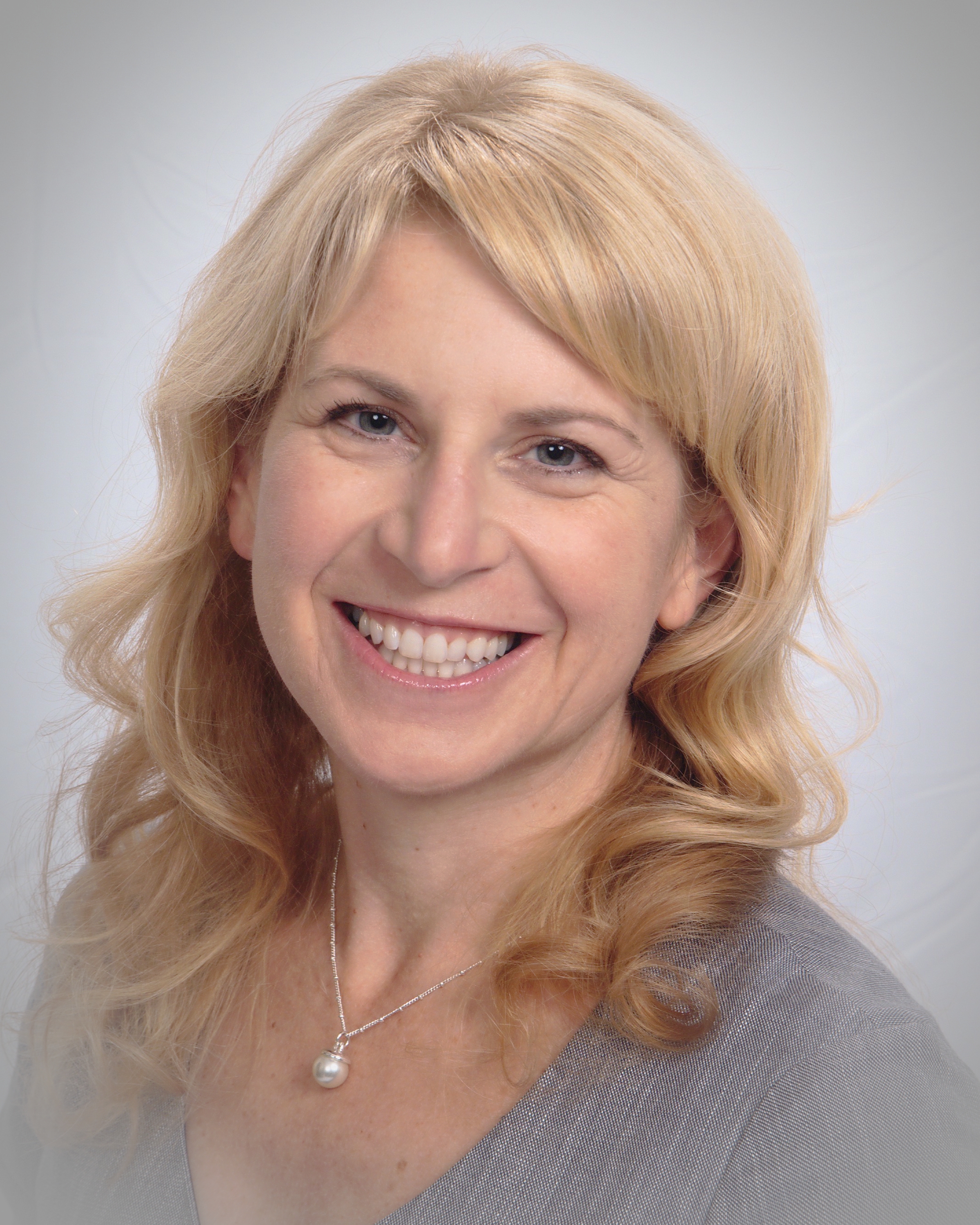 Tricia Shelton is a High Science Teacher and Teacher Leader with a BS in Biology and MA in Teaching, who has worked for 19 years in Kentucky driven by a passion to help students develop critical and creative thinking skills. Tricia is a 2014 NSTA Distinguished Teaching Award winner for her contributions to and demonstrated excellence in Science Teaching. As a Professional Learning Facilitator and NGSS Implementation Team Leader, Tricia has worked with educators across the United States to develop Best Practices in the Science and Engineering classroom through conference presentations, webinars, coordinating and co- moderating #NGSSchat on Twitter, and virtual and face to face PLC work. Tricia’s current Professional Learning Facilitation includes work around the Next Generation Science Standards and helping STEM students develop the 21st Century Skills of critical and creative thinking, collaboration and communication (including Social media and Video) and Project-Based Learning. Since 2011, she has conducted action research in her classroom to develop effective and accessible instructional and assessment strategies incorporating Best Practice in the STEM classroom, including work for the Marzano Research Laboratory. Through a partnership with BenchFly, the premier science video production platform, she works with CEO, Dr. Alan Marnett, to reinvent scientific education and communication with video. Find Shelton on Twitter @TdiShelton.
The mission of NSTA is to promote excellence and innovation in science teaching and learning for all.
Follow NSTA
 |
 |
 |
 |
The Next Generation Science Standards (NGSS) and A Framework for K–12 Science Education articulate a beautiful vision for students.
Supplementing a budget decrease
By Mary Bigelow
Posted on 2015-01-14
 Our principal just informed us that the science department budget will be decreased for next year. It’s already bare bones, so my colleagues and I are interested in finding other funding sources such as grants. What do we need to know to get started? — G., Oregon
In a perfect world, schools and teachers would all be funded adequately to provide the highest quality education for our students. As we wait for this to happen, you won’t be the only one looking for external funds to supplement a shrinking budget, and many agencies and organizations are themselves facing reduced resources.
You and your colleagues should discuss your needs and make some decisions as you begin the process. Your needs may include “everything,” so you should prioritize them into categories such as equipment, safety, instructional materials, professional development (including conferences), field trips, technology, and more. Discuss your needs assessment and how meeting those needs will improve student learning. Very few organizations or agencies will write blank checks, so this will help you match your needs with the missions of potential funders.
Differentiate between donations and grants. Donations are straightforward gifts, often very modest, with few strings attached, and often from more local organizations. Grants from large foundations or government agencies usually focus on projects for a particular purpose or audience and have requirements spelled out in a formal contract that must be signed by a school official. These requirements may include periodic progress reports, a formal evaluation component, student learning data, and an itemized budget. They are usually competitive. As a grantwriter, I found that the larger the grant, the more strings are attached.
Finding potential sources is another challenge.
If your school or district has a grantwriter or special projects coordinator, he or she may be able to assist. Check the high school yearbook or sports program to see what local businesses, individuals, or agencies are willing to support the schools through donations. Some parents may have ideas, too.
Colleagues on the NSTA e-mail lists have used Donors Choose to post online requests for project funds. You may want to look at the Science category to see how others are framing their requests.
Pore over a copy of the Science Teachers’ Grab Bag from NSTA Reports at your department meetings. This pull-out section includes Freebies for Science Teachers, What’s New from U.S. government sources (such as National Oceanic and Atmospheric Administration, U.S. Geological Survey, and the National Science Foundation), and the In Your Pocket section (with information on grants, awards, fellowships, and competitions). You can refer to the Science Education Events and Programs calendar on the NSTA Website . NSTA conferences usually include sessions on grants, too.
If you decide to seek grant funding, you may have to define and refine your goals and needs to meet the grant description. Few grants will fund “brick and mortar” projects (construction or remodeling), basic items that schools/districts should provide such as classroom furniture or consumables (unless they are part of a more comprehensive project), or items that are not related to student learning.
Depending on the funding source, you may need to describe your needs more comprehensively. For example, “We want to include more hands-on learning in science to help students attain the Next Generation Science Standards” rather than simply stating “We need microscopes.” The broader statement puts the microscopes into a larger context and can be used in other proposals in a coordinated effort. Too often I’ve seen schools take a patchwork approach to grants, with no focus or master plan. Their projects may even be at cross-purposes and create extra work for teachers. If you align your proposed activities with the school/district/department strategic plan, you’ll have a coordinated rationale for further proposals.
Give yourself enough time to gather data, create a budget, assemble supporting documents (if required), and get the correct signatures on the forms (in some districts, requests must be sent or approved by the central office). Ask someone to proofread the proposal or request and follow any guidelines on length, formatting, the submission date, and the inclusion of extra materials.
If you receive a donation, be sure to write a thank-you letter (or better yet have the students write letters) and include photos of how the funds are affecting your classes.
Above all, don’t be discouraged if some of your proposals are “rejected.” (I have a whole collection of unfunded proposals.) You’ll have a lot of competition, but when your request is funded and your work pays off in good things for students, it’s a great feeling!
Photo: https://flic.kr/p/aFAEHR
Our principal just informed us that the science department budget will be decreased for next year. It’s already bare bones, so my colleagues and I are interested in finding other funding sources such as grants. What do we need to know to get started? — G., Oregon
System exploration in early childhood
By Peggy Ashbrook
Posted on 2015-01-14
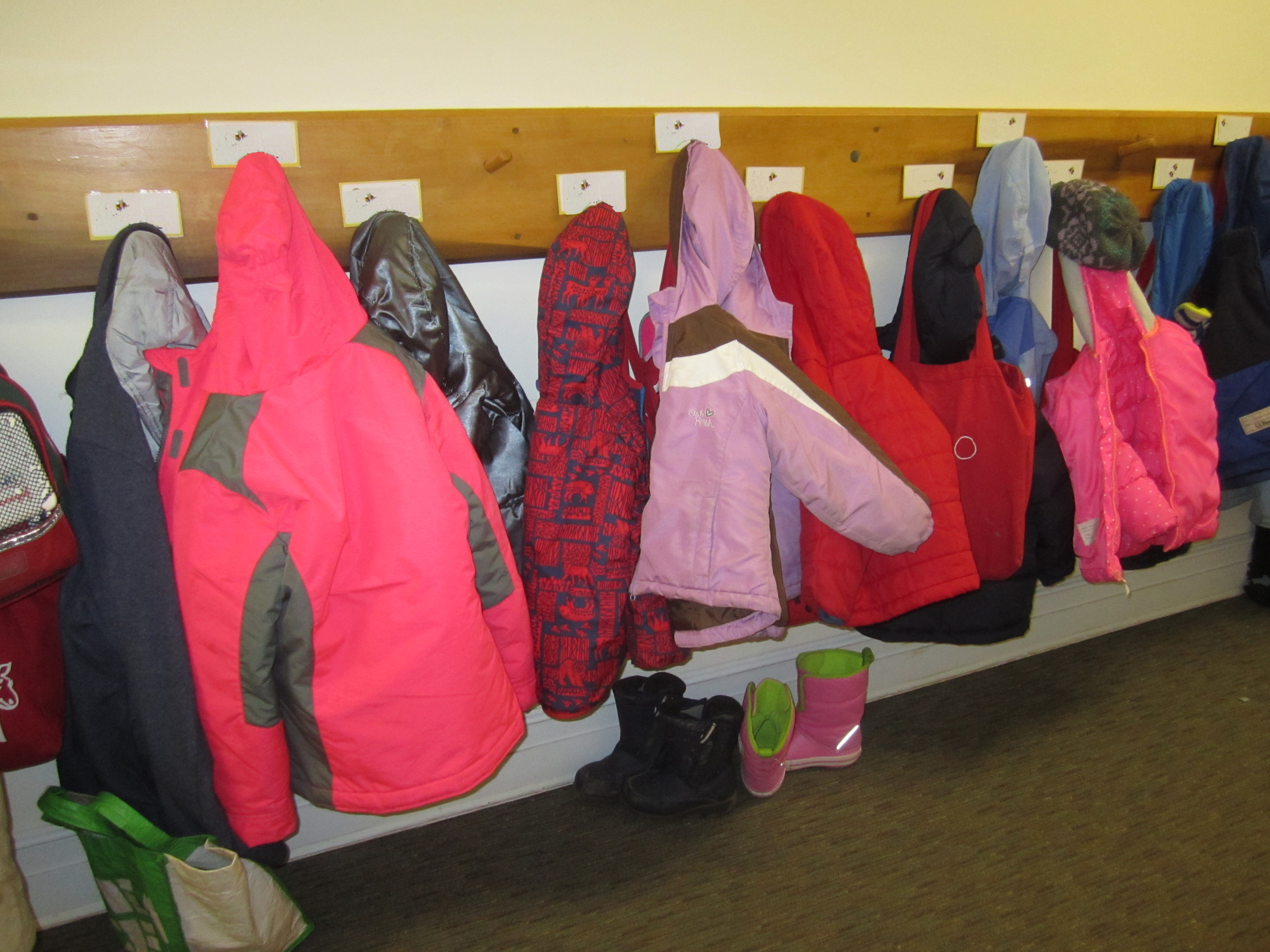 When winter sets in, teachers set aside time in the schedule for children to remove and store their winter outwear. Such a variety of clothing systems appear! Coats and jackets with zippers, hoods, snaps and Velcro, mittens and gloves, hats that pull on or strap on, snow pants and overalls, scarves and boots! These items are the parts of the system that keeps children warm outside.
Children master the skill of putting on and fastening these items over time as their fine motor skills develop and they have repeated opportunities to practice. Some children get undressed or dressed faster than their classmates. Instead of waiting, they can collect data. On a tally chart with pictures of each kind of clothing, they can make a tally mark for each item they observe. Some questions to investigate include, “Does the number of _____ change with changing weather?” “What kind of hat do children find easiest to put on? What kind of jacket do children find easiest to fasten? Which kinds of fastening do children prefer?
 In the January 2015 issue of Science and Children, I wrote about children investigating coats as systems, examining the parts of various coats and measuring and recording data. What systems are the children in your program investigating?
Although children experience a world where complex systems, such as atomic structure, operate, they may have not reached a developmental age where they understand these systems, forces and particles. We know this because researchers who investigate how children learn have discovered the age ranges when children can use their information to demonstrate or model these concepts (Michaels and others). Ready Set SCIENCE! (Michaels), particularly Chapter 3, discusses conceptual change in children’s thinking “as a result of instruction, experience, and maturation.” The authors state, “A key challenge for teachers is to build on students’ embodied knowledge and understanding of the world and to help them confront their misconceptions productively in order to develop new understanding” (pg 38).
Beginning with systems common in the lives of young children, early childhood educators can lay the foundation for later learning.
Michaels Sarah, and Andrew W. Shouse, Heidi A. Schweingruber. 2007. Ready, Set, Science!: Putting Research to Work in K-8 Science Classrooms. National Research Council
When winter sets in, teachers set aside time in the schedule for children to remove and store their winter outwear. Such a variety of clothing systems appear! Coats and jackets with zippers, hoods, snaps and Velcro, mittens and gloves, hats that pull on or strap on, snow pants and overalls, scarves and boots!
NSTA encourages West Virginia Board of Education to maintain fidelity to the Next Generation Science Standards
By Lauren Jonas, NSTA Assistant Executive Director
Posted on 2015-01-13
In a letter to the West Virginia Board of Education, the National Science Teachers Association (NSTA) encourages the members of the Board to eliminate changes that were made to the Next Generation Content Standards and Objectives for Science in West Virginia Schools and revert back to the original published text. The West Virginia standards are based on the Next Generation Science Standards (NGSS), but changes were made to two performance expectations prior to adoption that do not reflect the intent of the original published NGSS document. The letter is below, and readers can download a copy as a pdf here.
January 13, 2015
West Virginia State Board of Education
1900 Kanawha Boulevard East
Charleston, WV 25305
Dear Members of the Board,
On behalf of the Board, Council, and 55,000 members of the National Science Teachers Association (NSTA), we strongly encourage you to eliminate changes that were made to the Next Generation Content Standards and Objectives for Science in West Virginia Schools prior to adoption in December and revert back to the original published text.
While West Virginia standards are based on the Next Generation Science Standards (NGSS), changes made to two performance expectations do not reflect the intent of the original published NGSS document or the Framework for K-12 Science Education.
The first change focuses on S.6.ESS.6. The original NGSS text states, “Ask questions to clarify evidence of the factors that have caused the rise in global temperatures over the past century,” but it was changed to read, “Ask questions to clarify evidence of the factors that have caused the rise and fall in global temperatures over the past century.” Adding the words “and fall” to S.6.ESS.6 risks confusion among students between the concepts of weather and climate.
The second change focuses on S.9.ESS.14. The original NGSS text states, “Analyze geoscience data and the results from global climate models to make an evidence-based forecast of the current rate of global or regional climate change and associated future impacts to Earth systems.” This text was replaced with, “Analyze geoscience data and the predictions made by computer climate models to assess their creditability for predicting future impacts on the Earth System.” The original wording asks students to use data and models to forecast the rate of climate change and future impacts on the Earth System. The revised wording asks students to assess the credibility of computer climate models to predict future impacts on the Earth System. This substantially changes the intent of this learning goal.
We are pleased that West Virginia state leaders have been at the forefront of developing the NGSS, and we will continue to support West Virginia science teachers as they bring high-quality science to all students. NSTA supports the NGSS the way the writers wrote it because it reflects the best research in science and on how students learn science. It is our hope that you will reverse the changes indicated above so as not to compromise the work of so many science and education experts, including many science teachers in West Virginia.
Sincerely,
Dr. David L. Evans
Executive Director
National Science Teachers Association
1840 Wilson Boulevard
Arlington, VA 22201
In a letter to the West Virginia Board of Education, the National Science Teachers Association (NSTA) encourages the members of the Board to eliminate changes that were made to the Next Generation Content Standards and Objectives for Science in West Virginia Schools and revert back to the original published text.
The Pasco Wireless Dissolved Oxygen Probe VS. Winter Water
By Martin Horejsi
Posted on 2015-01-12
The power of a Bluetooth-connected Dissolved Oxygen probe is not only from the DO data, but the places the data can be collected, and the ways the data is presented. Over the holidays I took the Pasco wireless DO probe up in the mountains to generate some data and answer some questions. Since my winter/spring lesson plans will address the use of the probe outdoors, I needed to be more than a little familiar with it, and ensure that any limits or barriers of the technology were of my choosing or creation.
Three sites were chosen in which to measure the DO; a ice-covered pond, a small creek, and a rushing mountain stream. The DO probe connected to a Bluetooth transmitter called a SPARKlink Air to my iPad Air protected by both a UZBL Shockwave case and a Ziploc® bag.
Needless to say, the DO Probe, the Bluetooth basestation, and the iPad worked flawlessly. The biggest hurdle was simply trying to view the iPad screen though a soggy plastic bag and against the glare of a snow-covered landscape.
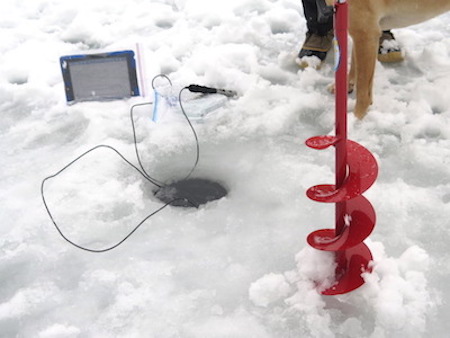
The durability of the Pasco DO probe was obvious, and while I don’t recommend any abuse, I do encourage data collectors to push the envelope.
As you can see in the pictures, the weather was a bit of a challenge, but nothing that a pair of Ziploc® bags couldn’t fix. I’ve used the iPad in temperatures so low that only a few minutes of touch-display would work before the iPad had to be warmed up again before responding to a fingertip. Battery life was not a problem, but it was definitely less than under optimum conditions according to the battery-life indicators.
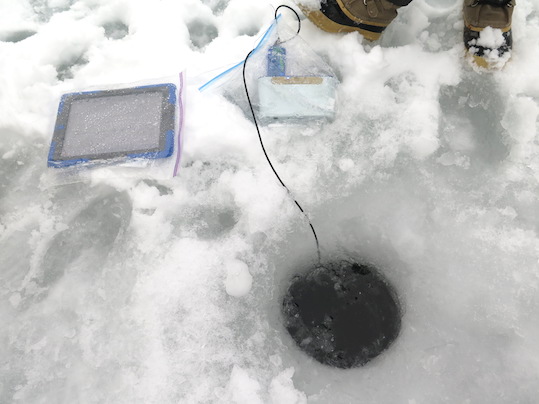
The Pasco DO Probe was lowered half-meter by half-meter with pauses at each interval until it reached its full 3m length.
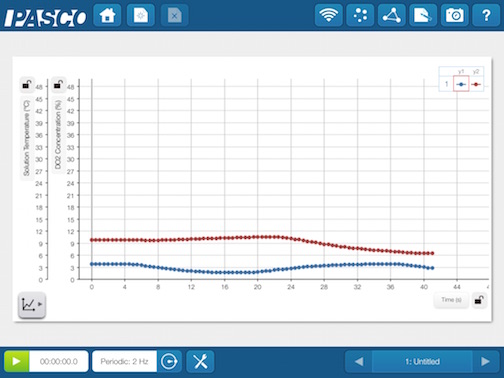
The data from the pond shows changes in both DO and Temp during the probes decent. The probe was paused for about five seconds every half-meter. The inverse relationship between DO and Temp is clearly presented in the graph, and occurred at approximately the middle depth of the pond which from summer measurements is slightly less than 3m deep. A joy in data such as this is found in the inspection of either DO or Temp across depth in isolation, and in relation to each other across depth.
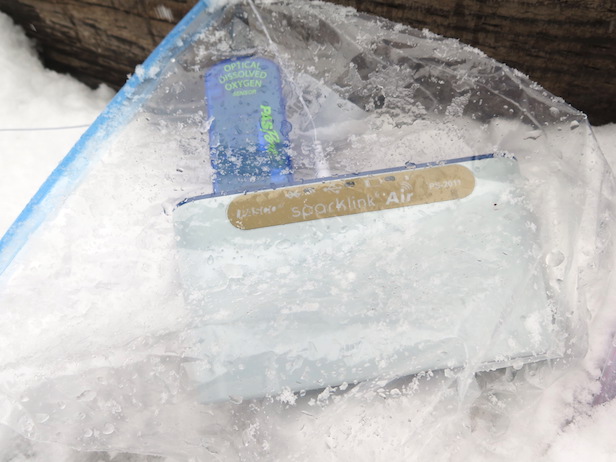
A plastic bag stopped the snow, but not the Bluetooth radio signal from the Pasco SPARKlink Air. I intended to use both Bluetooth ports to collect windspeed as well, but the heavy snowfall changed my plans.
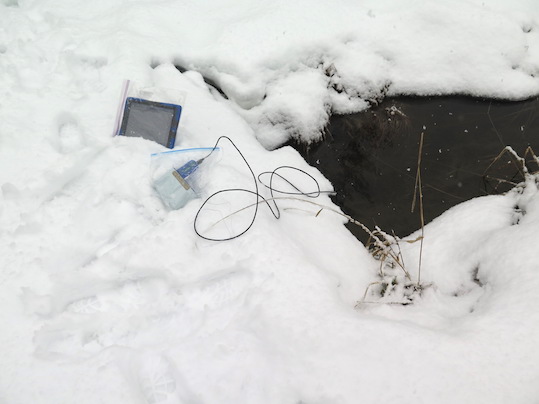
The next stop was a slow-moving creek wandering though a snow-covered meadow.
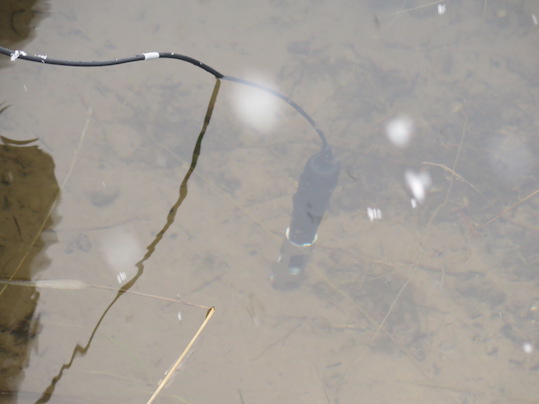
The probe sat on the bottom of the creek for the entire data collection. The steel cover-weight made positioning and stabilizing the probe underwater much easier. Ice chunks are visible in the flow visually documenting the water temperature.
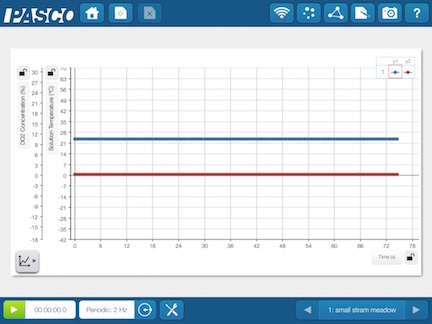
The data shows a stable temperature just above 0 degrees C as well as a healthy DO level.
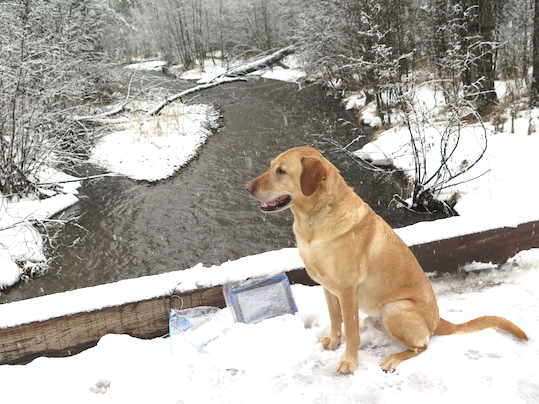
A bridge above a small stream provided an excellent basecamp to collect DO measurements in the center of the flow. The 3m cable length was just enough to reach the water. The beefy UZBL case provided plenty of grip even while wearing gloves to make working ten feet above the water of less concern then slipping around in my own boots.
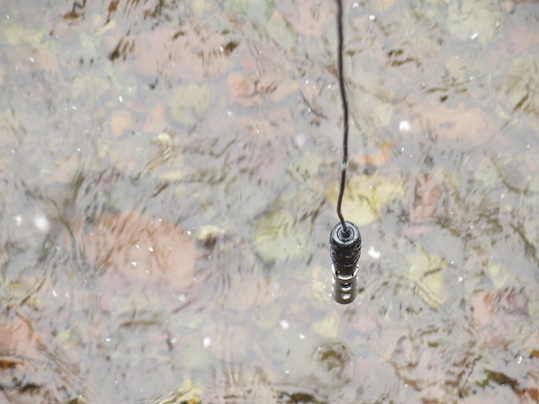
The Pasco DO probe was lowered into the flow, but because of the current, the probe remained near the surface just as a fishing lure approaches the surface when in motion.
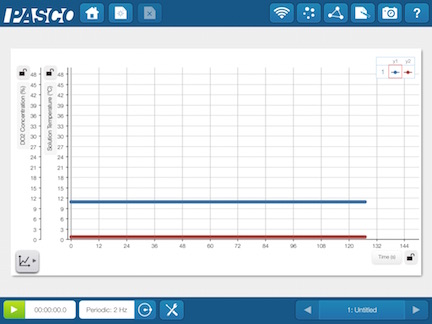
The river DO data was very similar to the meadow numbers, but with a slightly higher temperature and a surprisingly lower DO concentration.
The slow moving meadow water often had chunks of ice in it testifying to its transitional temperature where water straddles two of its physical states.
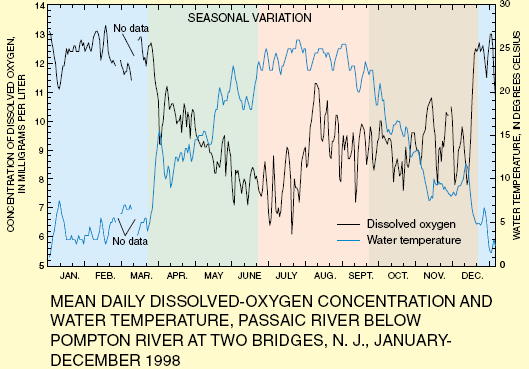
Using a DO/Temp graph provided by USGS Water Quality website, it is clear that the data collected was well within expectations based on water type and seasonal temperature.
The power of a Bluetooth-connected Dissolved Oxygen probe is not only from the DO data, but the places the data can be collected, and the ways the data is presented. Over the holidays I took the Pasco wireless DO probe up in the mountains to generate some data and answer some questions.
Science "home"work for interested students
By Mary Bigelow
Posted on 2015-01-07
 I have several students this year who are really into science. I’d like to provide or suggest some elementary-level projects or activities that parents can do with them at home to encourage this interest. Do you have any ideas beyond book lists and activity sheets? —M. from Maryland
Your desire to foster student interest in science through science activities with their families is commendable. Creating formal projects for this group of students would require time on your part to organize and could be a burden for families in terms of time and resources. But there are many ways to involve students and parents with informal and enjoyable science-related activities.
In your school or class newsletter, website, or blog, include information about free events at local parks, nature centers, libraries, or museums. Encourage students who attend these events to share their experiences and photographs. NSTA’s SciLinks can help you create a list of appropriate websites related to your unit topics that you could share with parents.
Annotate the school or class calendar with prompts for family conversations (What is your first memory of being outdoors? How have inventions and technology changed over the years? Play I Spy at home and find objects made of metal, plastic, glass, wood. Talk about where food comes from.) If you involve other subject areas, every day on the calendar can have a conversation-starter. Encourage children and their parents/caregivers to build with blocks, walk and play outside if possible, grow a garden or even a few house plants, observe a pet’s behavior, or cook together (reinforcing measurement, nutrition). If your students and their parents speak another language at home, it would be helpful to have several versions of your suggestions.
I worked with an elementary school that had take-home “kits” in plastic bags, created by volunteers from a high school service group (backpacks or pizza boxes could also be used to organize the kits). The student- and parent-friendly materials were donated or bought at a dollar store or flea market. For science, these kits included CDs or DVDs with podcasts of science programs, trade books to read at home with suggested discussion questions, small collections (such as leaves, seashells, rocks, or pictures) with directions on sorting or identifying, a plastic ruler and a magnifying glass with some simple directions for observing and collecting data, maps of the night sky for star gazing, an inexpensive pair of binoculars and a field guide on birds, and sets of building blocks. Students signed out a kit to take home, and they were not “graded” on the use of the kits. Of course, some kits never made it back to the classroom, but that didn’t discourage the teachers from continuing the project. A project such as this would require your time or a group of volunteers to create, sign out, inventory, and replenish the kits.
Students could make small journals to take home with suggestions on each page for something to observe, illustrate, and write about (e.g., the weather, phases of the moon, insects, clouds). If you have a class website, students and parents could send photographs or writing to include (you would want to monitor and moderate this process, however, and provide guidelines and examples).
You could suggest citizen-science or collaborative research in which students, parents, and teachers participate in existing projects with science institutions and organizations. SciStarter is a searchable collection of these projects–regional, national, and international. There are projects appropriate for all grade levels and on a variety of topics. It’s a win-win scenario for all involved—the sponsor gets additional observers and data-collectors, parents and their children can work together on them, and the students get experiences that can extend into careers or lifelong learning. Follow SciStarter on Faceboook or Twitter for the latest projects.
Some parents may feel that they don’t have enough background in science, but how you introduce and promote the activities can encourage them to learn with their children. You’re giving “home” work a whole new life!
Additional resources and suggestions from NSTA:
- This Earth Day, Engage Kids in Citizen Science!
- Citizen science: Collaborative projects for teachers and their class
- Community-based science
- Citizen Science: Engaging Students Through Public Collaboration in Scientific Research
- Citizen Science (December 2012, The Science Teacher)
- Community-Based Science (March 2010, Science Scope)
- Getting Families Involved (February 2012, Science & Children)
- Informal science is one of NSTA’s online discussion forums
- Peggy Ashbrook, author of the monthly Early Years Column in Science and Children and the Early Years blog has been an advocate of citizen science for our youngest scientists.
Photo: http://www.flickr.com/photos/glaciernps/4427417055/in/photostream/
I have several students this year who are really into science. I’d like to provide or suggest some elementary-level projects or activities that parents can do with them at home to encourage this interest. Do you have any ideas beyond book lists and activity sheets? —M. from Maryland
NSTA’s K–College Science Education Journals: January 2015 Issues Online
By Lauren Jonas, NSTA Assistant Executive Director
Posted on 2015-01-07
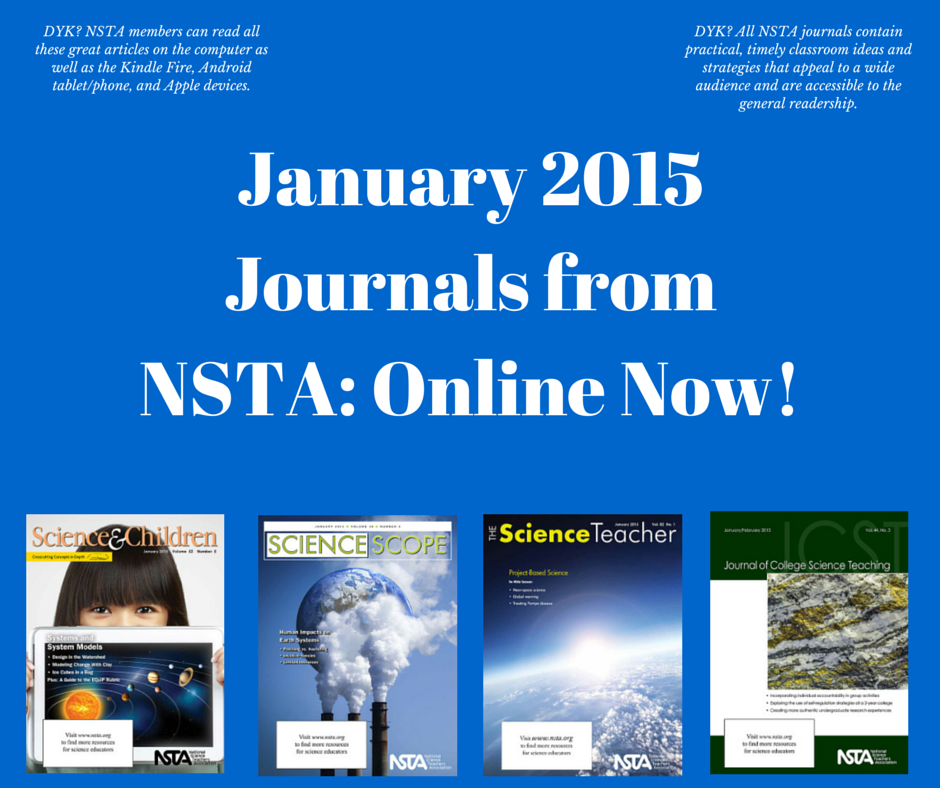 Is your science classroom equipped for success? Or are you teaching with limited resources? Either way, the K–College journals from the National Science Teachers Association (NSTA) have the answers you need. Written by science teachers for science teachers, these peer-reviewed journals are targeted to your teaching level and are packed with lesson plans, expert advice, and ideas for using whatever time/space you have available. Browse the January issues; they are online (see below), in members’ mailboxes, and ready to inspire teachers!
 Science and Children
An interaction of two or more things can be considered a system, and the resulting system can help us understand phenomena. This issue explores systems and the models used to understand them.
Featured articles (please note, only those marked “free” are available to nonmembers without a fee):
- Design in the Watershed
- Free – Editor’s Note: Systems and System Models
- EQuIP-ped for Success
- In the Watery World
- Modeling Change With Clay
- Printing the Playground
- Free – Virtual Modeling
- Full Table of Contents
 Science Scope
Many of us have probably witnessed our footprints in the sand being washed away by the incoming tide. Unfortunately, the cumulative weight of our species footprint on our planet grows each day and is not so easily erased. To explore the ever-threatening human impact on Earth systems, check out the articles in this issue.
Featured articles (please note, only those marked “free” are available to nonmembers without a fee):
- Aliens Invade and Drop Off Litter
- Free – Editor’s Roundtable: Branching Out on the Family Tree
- Free – EQuiP-ped for Success: A Rubric to Help Implement the Next Generation Science Standards
- Life With Limited Resources: Using Aquatic Plants to Study Resource Consumption
- No Space? Little Money? No Garden? Not So Fast!
- Plotting Plants: Tracking Invasive Species in the Local Community
- The Human Impact on Earthquakes: Natural Fracturing Versus Fracking
- Full Table of Contents
 The Science Teacher
Project-based learning can be an important instructional model for meeting the three-dimensional learning goals of the Next Generation Science Standards. Complex, real-world projects provide opportunities for students to deeply engage in multiple science and engineering practices—like developing and using models, constructing explanations, and engaging in argument from evidence—while learning specific disciplinary core ideas and crosscutting concepts that can be used to make sense of phenomena and design solutions to relevant problems. This issue offers a variety of examples that may inspire you to try project-based science in your own classroom.
Featured articles (please note, only those marked “free” are available to nonmembers without a fee):
- Free – Editor’s Corner: Project-Based Science Learning
- EQuIP-ped for Success
- Global Warning
- Near-Space Science
- Free – Project-Based Science
- The Community Connection
- Treating Pompe Disease
- Full Table of Contents
 Journal of College Science Teaching
Can online homework assignments predict the development of problem-solving skills for students taking an introductory physics course? See “The Role of Online Homework” to find out. Read about an innovative student-centered program with a focus on research designed to increase STEM retention rates of underrepresented students. Also, don’t miss the study that examines the teaching beliefs and practices of science faculty with education specialties and how these beliefs and practices relate to national pedagogical reform efforts.
Featured articles (please note, only those marked “free” are available to nonmembers without a fee):
- Case Study: Grandma’s TUM-my Trouble: A Case Study in Renal Physiology and Acid-Base Balance
- Changing College Majors: Does It Happen More in STEM and Do Grades Matter?
- Developing University and Community Partnerships: A Critical Piece of Successful Service Learning
- Incorporating More Individual Accountability in Group Activities in General Chemistry
- It Takes a Village to Make a Scientist: Reflections of a Faculty Learning Community
- Planning and Implementing a Comprehensive Student-Centered Research Program for First-Year STEM Undergraduates
- Research and Teaching: A New “Class” of Undergraduate Professors: Examining Teaching Beliefs and Practices of Science Faculty With Education Specialties
- Research and Teaching: Effects of a Science Content Course on Elementary Preservice Teachers’ Self-Efficacy of Teaching Science
- Research and Teaching: Implementing Comprehensive Reform of Introductory Physics at a Primarily Undergraduate Institution: A Longitudinal Case Study
- Free – The Role of Online Homework in Low-Enrollment College Introductory Physics Courses
- Two-Year Community: Learning How Students Learn: An Exploration of Self-Regulation Strategies in a Two-Year College General Chemistry Class
- Full Table of Contents
Get these journals in your mailbox as well as your inbox—become an NSTA member!
The mission of NSTA is to promote excellence and innovation in science teaching and learning for all.
Follow NSTA
| |
|
|
|
Is your science classroom equipped for success? Or are you teaching with limited resources?
Natural Resources, Natural Partnerships: Featured Strand at NSTA’s 2015 National Conference on Science Education in Chicago, IL, March 12-15
By Lauren Jonas, NSTA Assistant Executive Director
Posted on 2015-01-06
 This March, the National Science Teachers Association (NSTA) will feature a special strand “Natural Resources, Natural Partnerships” at our 2015 National Conference on Science Education, in Chicago, March 12–15. Sustaining natural resources requires collaborative partnerships among many stakeholders, and science is the key to making smart decisions about resources. Educators and students can engage with environmental groups, agencies, and businesses to build and support a sustainable future. This strand will help teachers identify possibilities and potential partnerships.
 Sessions organized around this strand include a featured presentation on Friday March 13, 11:00 a.m. to 12:00 PM (“Beasts at Bedtime: Revealing the Embedded Environmental Curriculum in Classic Children’s Literature”) by Liam Heneghan (DePaul University: Chicago, IL). Not familiar with Heneghan? This blog on The Ecology of Pooh will give you a fun glimpse into his style! And there will be hundreds more sessions in Chicago to inspire teachers who love Natural Resources and see the wisdom of forming Natural Partnerships; below is a small sampling so you see what’s in store:
 Creating a Culture of Conservation Using the NGSS Practices
- Developing Partnerships: A Model of Outdoor Education
- Special Pathway Session: Building K–6 Integrative STEM Through Technology, Engineering, Environment, Mathematics, and Science (TEEMS): A Project-based Student-centered Approach
- Collaborative Conservation Through Birds and Citizen Science
- Sharing the Night Sky with Your Students
- Student Choice, Student Voice: Empowering the Next Generation of Environmental Stewards
- NASA and GLOBE Connect K–12 Students to NGSS with Big-Data Applications
- Making STEM Meaningful with Sea Turtles
- Watering the Grassroots of Change: Integrated Outdoor Science and Community-based Water Resource Education
- On-the-Ground Stewardship + Great Lakes Science = A Five Star Place-based Education Program
Want more? Check out more sessions and other events with the Chicago Session Browser/Personal Scheduler, or take a peek at the online conference preview (pdf). Follow all our conference tweets using #NSTA15, and if you tweet, please feel free to tag us @NSTA so we see it!
The mission of NSTA is to promote excellence and innovation in science teaching and learning for all.
Follow NSTA
| |
|
|
|
This March, the National Science Teachers Association (NSTA) will feature a special strand “Natural Resources, Natural Partnerships” at our 2015 National Conference on Science Education, in Chicago, March 12–15.
National Bird Day Resources from NSTA Press
By Lauren Jonas, NSTA Assistant Executive Director
Posted on 2015-01-05
Today is National Bird Day, and the National Science Teachers Association (NSTA) has some great resources you can use to celebrate! Enjoy these free chapters from NSTA Press—they will ease you into the new year and help you look forward to spring.
 Birds, Bugs, and Butterflies: Science Lessons for Your Outdoor Classroom | From the book Outdoor Science: A Practical Guide and geared toward elementary/middle school science teachers. Among the wild animals that may travel through a school yard, birds, bugs, and butterflies are the most common—and they are the focus of most of the lessons in this chapter. It offers a variety of activities to allow you to “tame” the wildlife to help you teach. Instructions for each lesson are presented first to help you make the most of each handout.
 Classifying Birds in the United States | From the book Scientific Argumentation in Biology: 30 Classroom Activities and geared toward middle/high school science teachers. The purpose of the activity in this chapter is to help students understand (1) what counts as a species in the field of biology, (2) some of the various definitions for species that can be used by biologists, and (3) the challenges associated with biological classification. This activity also helps students learn how to engage in practices such as constructing explanations, arguing from evidence, and communicating information. This activity is also designed to give students an opportunity to learn how to write in science and develop their speaking and listening skills, which are important goals for literacy in science.
The mission of NSTA is to promote excellence and innovation in science teaching and learning for all.
Follow NSTA
| |
|
|
|
Today is National Bird Day, and the National Science Teachers Association (NSTA) has some great resources you can use to celebrate! Enjoy these free chapters from NSTA Press—they will ease you into the new year and help you look forward to spring.
Movie Magic Can Jump Start Your Science, Math, and Technology Lessons
By Carole Hayward
Posted on 2015-01-02

 Astrophysicist Neil deGrasse Tyson recently said: “I am enchanted that, of late, science as a topic and scientists as characters have peaked the interests of storytellers.” As the host of the hit documentary series Cosmos: A Spacetime Odyssey, Tyson is not shy about commenting and reviewing science-related media programming.
Neither is Jacob Clark Blickenstaff, PhD, who has helped NSTA members sort the good science from the bad in movies and other visual media for almost six years. Each month in NSTA Reports and on the NSTA website, he provides expert commentary in his Blicks on Flicks column, pointing out where the physics is stretched, the chemistry fudged, or the biology twisted on behalf of the story—without losing sight of the fact that movies are meant to entertain.
In just 15 minutes, NSTA members can enjoy thoughtful and entertaining reviews from a science educator—and a movie fan. Blickenstaff also knows that substituting movie magic for actual science can help highlight truth—and engage students on their level. He makes a point to help turn “bad science” in movies into teachable science for middle level and high school educators.
- Interstellar (2014) – Still in theaters, Blickenstaff points out how science teachers could use this film to talk about some of the more counterintuitive consequences of general relativity, to discuss nitrogen cycling, or even to partner with a literature teacher to explore 20th-century poet Dylan Thomas.
- Gravity (2013) – No doubt one of the most thrilling rides in space from the safety of the movie house, the movie inspired Blickenstaff to interview George “Pinky” Nelson, one of only six people who has flown the Manned Maneuvering Unit (MMU) worn by George Clooney in the movie.
- Frozen (2013) –Who doesn’t like “frozen fractals all around?” Perhaps not in a snowball fight. Although Blickenstaff can’t give a thumbs up to all the crystallization in this animated blockbuster, he knows that the lesson in geometry—and earworms—could have inspire budding mathematicians in the classroom.
- Skyfall (2012) – One of the all-time biggest blockbuster franchises gets a couple punches from Blickenstaff on the plausibility of surviving (and thriving the 007 way) through epic free falls and depleted uranium shrapnel. But never has a better movie overestimated “the lethality of a lizard.”
- The Avengers (2012) –Blickenstaff proves that Marvel superheroes can delve into complex math and physics—as well as alien invasions. Not only does he discuss the math behind the real concept of the movie’s core plot device (a tesseract or four-dimensional cube), but also connects the realities of gamma radiation with the 1961 Nobel Prize.
Next time you show your class a movie, choose one with specific science implications and relevance. What’s next? Perhaps Blickenstaff will take on one of the two current movies characterizing the amazing life stories of theoretical physicist Stephen Hawking and WWII mathematician Alan Turing.
More Time?
Don’t miss the addicting power of the web videos in Blick’s Picks, a collection of science-related shorts. Watch drone footage from Chernobyl, analyze momentum during a tennis trick, or simply watch real stories from real scientists.
Not a member of NSTA? Learn more about how to join.
Laura Berry of Cogberry Creative is our guest blogger for this series. Laura is a communications professional for the education community.