The Pasco Wireless Dissolved Oxygen Probe VS. Winter Water

By Martin Horejsi

Posted on 2015-01-12

The power of a Bluetooth-connected Dissolved Oxygen probe is not only from the DO data, but the places the data can be collected, and the ways the data is presented. Over the holidays I took the Pasco wireless DO probe up in the mountains to generate some data and answer some questions. Since my winter/spring lesson plans will address the use of the probe outdoors, I needed to be more than a little familiar with it, and ensure that any limits or barriers of the technology were of my choosing or creation. 

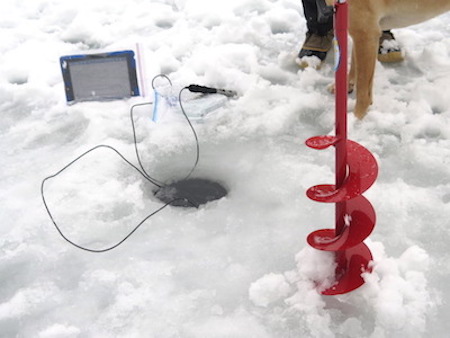
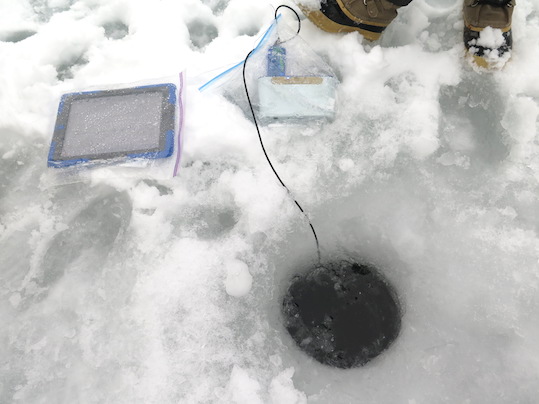
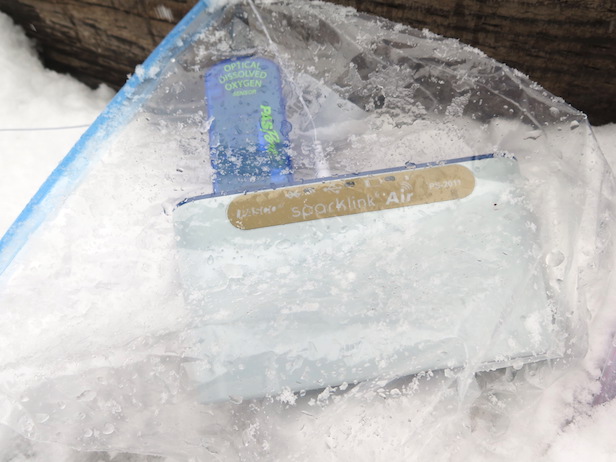
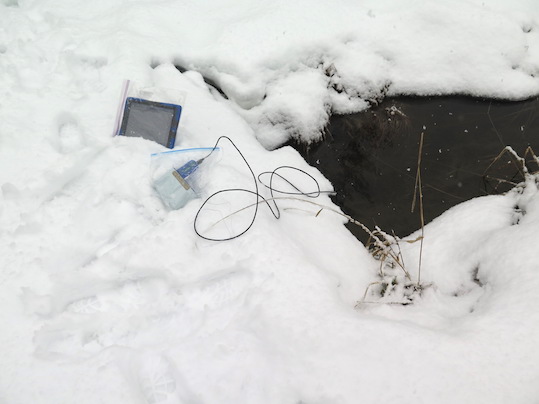
Three sites were chosen in which to measure the DO; a ice-covered pond, a small creek, and a rushing mountain stream. The DO probe connected to a Bluetooth transmitter called a SPARKlink Air to my iPad Air protected by both a UZBL Shockwave case and a Ziploc® bag.

Needless to say, the DO Probe, the Bluetooth basestation, and the iPad worked flawlessly. The biggest hurdle was simply trying to view the iPad screen though a soggy plastic bag and against the glare of a snow-covered landscape.

Pasco DO Probe

The durability of the Pasco DO probe was obvious, and while I don’t recommend any abuse, I do encourage data collectors to push the envelope.

As you can see in the pictures, the weather was a bit of a challenge, but nothing that a pair of Ziploc® bags couldn’t fix. I’ve used the iPad in temperatures so low that only a few minutes of touch-display would work before the iPad had to be warmed up again before responding to a fingertip. Battery life was not a problem, but it was definitely less than under optimum conditions according to the battery-life indicators.

Pasco DO Probe

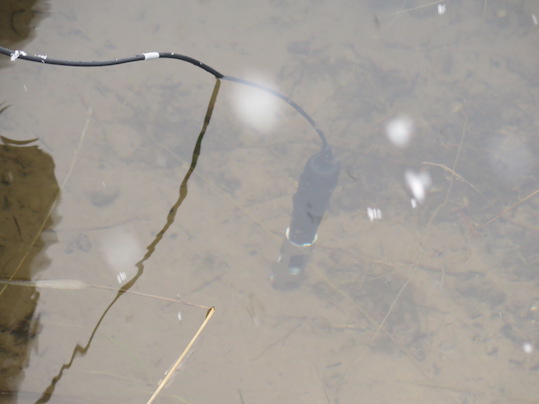
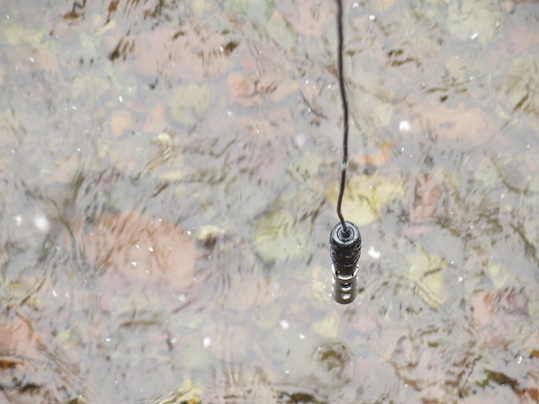
The Pasco DO Probe was lowered half-meter by half-meter with pauses at each interval until it reached its full 3m length.

 
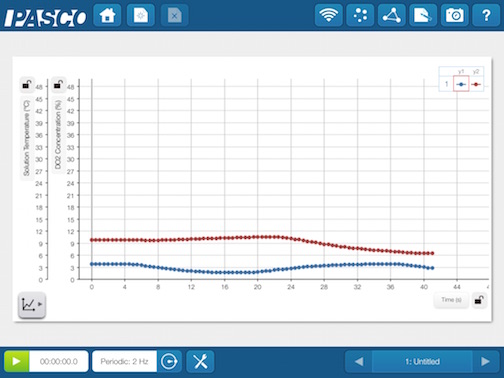
The Pasco wireless Dissolved Oxygen sensor recorded both DO percentage and temperature. Some observations about the data are noted in the photo captions, but in a nutshell, the information was both predictable and surprising. In the end, not only was the data collection an enjoyable mini-expedition, but also plenty of food for thought that makes hands-on science oh-so much fun!

 
Pasco DO Probe

The data from the pond shows changes in both DO and Temp during the probes decent. The probe was paused for about five seconds every half-meter. The inverse relationship between DO and Temp is clearly presented in the graph, and occurred at approximately the middle depth of the pond which from summer measurements is slightly less than 3m deep. A joy in data such as this is found in the inspection of either DO or Temp  across depth in isolation, and in relation to each other across depth.

 
Pasco AirLink2

A plastic bag stopped the snow, but not the Bluetooth radio signal from the Pasco SPARKlink Air. I intended to use both Bluetooth ports to collect windspeed as well, but the heavy snowfall changed my plans.

 
Pasco DO probe

The next stop was a slow-moving creek wandering though a snow-covered meadow.

 
Pasco DO Probe

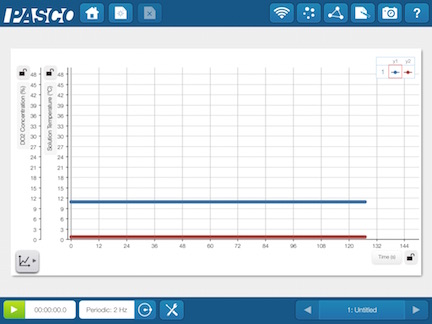
The probe sat on the bottom of the creek for the entire data collection. The steel cover-weight made positioning and stabilizing the probe underwater much easier. Ice chunks are visible in the flow visually documenting the water temperature.

Pasco DO probe

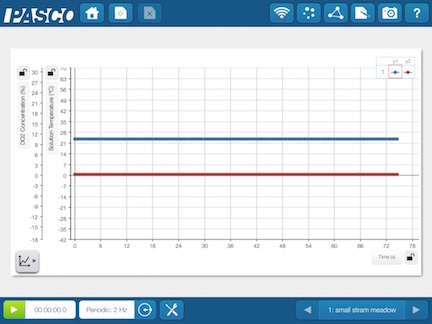
The data shows a stable temperature just above 0 degrees C as well as a healthy DO level.

 
Pasco DO Probe

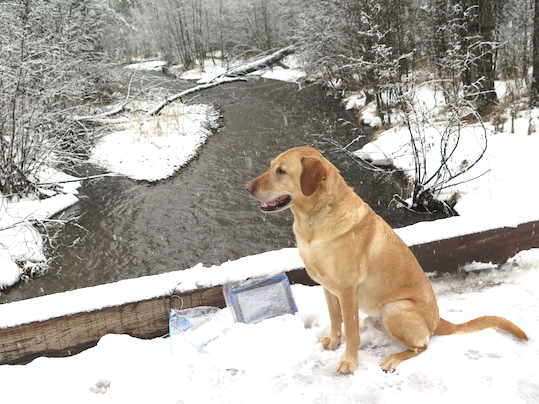
A bridge above a small stream provided an excellent basecamp to collect DO measurements in the center of the flow. The 3m cable length was just enough to reach the water. The beefy UZBL case provided plenty of grip even while wearing gloves to make working ten feet above the water of less concern then slipping around in my own boots.

 
Pasco DO Probe

The Pasco DO probe was lowered into the flow, but because of the current, the probe remained near the surface just as a fishing lure approaches the surface when in motion.

 
Pasco DO Probe

The river DO data was very similar to the meadow numbers, but with a slightly higher temperature and a surprisingly lower DO concentration.
The slow moving meadow water often had chunks of ice in it testifying to its transitional temperature where water straddles two of its physical states.

 
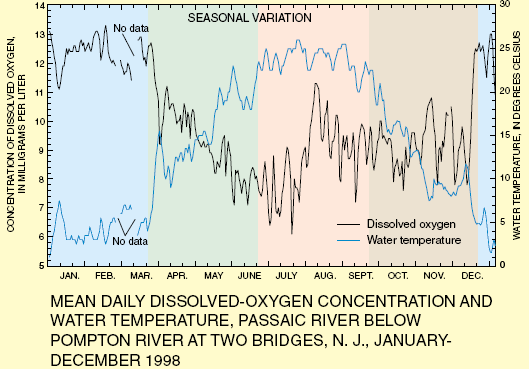
Using a DO/Temp graph provided by USGS Water Quality website, it is clear that the data collected was well within expectations based on water type and seasonal temperature.

Using a DO/Temp graph provided by USGS Water Quality website, it is clear that the data collected was well within expectations based on water type and seasonal temperature.

 Last year over the holidays on a lake near where I did this DO work was a rather magical situation where the ice froze so clearly that the surface of the lake was truly like glass. Here is a video of that adventure for enjoyment purposes only (although there is some great atmospheric science behind the phenomena if you want to pursue that avenue.
 
 [youtube]http://youtu.be/nXjTMvbcPHI[/youtube]

The power of a Bluetooth-connected Dissolved Oxygen probe is not only from the DO data, but the places the data can be collected, and the ways the data is presented. Over the holidays I took the Pasco wireless DO probe up in the mountains to generate some data and answer some questions.


Science "home"work for interested students

By Mary Bigelow

Posted on 2015-01-07

4427417055_18a59e8b68_mI have several students this year who are really into science. I’d like to provide or suggest some elementary-level projects or activities that parents can do with them at home to encourage this interest. Do you have any ideas beyond book lists and activity sheets?    —M. from Maryland

Your desire to foster student interest in science through science activities with their families is commendable. Creating formal projects for this group of students would require time on your part to organize and could be a burden for families in terms of time and resources. But there are many ways to involve students and parents with informal and enjoyable science-related activities.

In your school or class newsletter, website, or blog, include information about free events at local parks, nature centers, libraries, or museums. Encourage students who attend these events to share their experiences and photographs. NSTA’s SciLinks can help you create a list of appropriate websites related to your unit topics that you could share with parents.

Annotate the school or class calendar with prompts for family conversations (What is your first memory of being outdoors? How have inventions and technology changed over the years? Play I Spy at home and find objects made of metal, plastic, glass, wood. Talk about where food comes from.) If you involve other subject areas, every day on the calendar can have a conversation-starter. Encourage children and their parents/caregivers to build with blocks, walk and play outside if possible, grow a garden or even a few house plants, observe a pet’s behavior, or cook together (reinforcing measurement, nutrition). If your students and their parents speak another language at home, it would be helpful to have several versions of your suggestions.

I worked with an elementary school that had take-home “kits” in plastic bags, created by volunteers from a high school service group (backpacks or pizza boxes could also be used to organize the kits). The student- and parent-friendly materials were donated or bought at a dollar store or flea market. For science, these kits included CDs or DVDs with podcasts of science programs, trade books to read at home with suggested discussion questions, small collections (such as leaves, seashells, rocks, or pictures) with directions on sorting or identifying, a plastic ruler and a magnifying glass with some simple directions for observing and collecting data, maps of the night sky for star gazing, an inexpensive pair of binoculars and a field guide on birds, and sets of building blocks. Students signed out a kit to take home, and they were not “graded” on the use of the kits. Of course, some kits never made it back to the classroom, but that didn’t discourage the teachers from continuing the project. A project such as this would require your time or a group of volunteers to create, sign out, inventory, and replenish the kits.

Students could make small journals to take home with suggestions on each page for something to observe, illustrate, and write about (e.g., the weather, phases of the moon, insects, clouds). If you have a class website, students and parents could send photographs or writing to include (you would want to monitor and moderate this process, however, and provide guidelines and examples).

You could suggest citizen-science or collaborative research in which students, parents, and teachers participate in existing projects with science institutions and organizations. SciStarter is a searchable collection of these projects–regional, national, and international. There are projects appropriate for all grade levels and on a variety of topics. It’s a win-win scenario for all involved—the sponsor gets additional observers and data-collectors, parents and their children can work together on them, and the students get experiences that can extend into careers or lifelong learning. Follow SciStarter on Faceboook or Twitter for the latest projects.

Some parents may feel that they don’t have enough background in science, but how you introduce and promote the activities can encourage them to learn with their children. You’re giving “home” work a whole new life!

Additional resources and suggestions from NSTA:


Photo: http://www.flickr.com/photos/glaciernps/4427417055/in/photostream/


4427417055_18a59e8b68_mI have several students this year who are really into science. I’d like to provide or suggest some elementary-level projects or activities that parents can do with them at home to encourage this interest. Do you have any ideas beyond book lists and activity sheets?    —M. from Maryland


NSTA’s K–College Science Education Journals: January 2015 Issues Online

By Lauren Jonas, NSTA Assistant Executive Director

Posted on 2015-01-07

graphic showing the 4 journal covers and saying that the January 2015 journals are onlineIs your science classroom equipped for success? Or are you teaching with limited resources? Either way, the K–College journals from the National Science Teachers Association (NSTA) have the answers you need. Written by science teachers for science teachers, these peer-reviewed journals are targeted to your teaching level and are packed with lesson plans, expert advice, and ideas for using whatever time/space you have available. Browse the January issues; they are online (see below), in members’ mailboxes, and ready to inspire teachers!

2015JanCoverSandC110Science and Children

An interaction of two or more things can be considered a system, and the resulting system can help us understand phenomena. This issue explores systems and the models used to understand them.

Featured articles (please note, only those marked “free” are available to nonmembers without a fee):

2015JanCoverScope110Science Scope

Many of us have probably witnessed our footprints in the sand being washed away by the incoming tide. Unfortunately, the cumulative weight of our species footprint on our planet grows each day and is not so easily erased. To explore the ever-threatening human impact on Earth systems, check out the articles in this issue.

Featured articles (please note, only those marked “free” are available to nonmembers without a fee):

2015JanCoverTST110The Science Teacher

Project-based learning can be an important instructional model for meeting the three-dimensional learning goals of the Next Generation Science Standards. Complex, real-world projects provide opportunities for students to deeply engage in multiple science and engineering practices—like developing and using models, constructing explanations, and engaging in argument from evidence—while learning specific disciplinary core ideas and crosscutting concepts that can be used to make sense of phenomena and design solutions to relevant problems. This issue offers a variety of examples that may inspire you to try project-based science in your own classroom.

Featured articles (please note, only those marked “free” are available to nonmembers without a fee):

2015JanCoverJCST110Journal of College Science Teaching

Can online homework assignments predict the development of problem-solving skills for students taking an introductory physics course? See “The Role of Online Homework” to find out. Read about an innovative student-centered program with a focus on research designed to increase STEM retention rates of underrepresented students. Also, don’t miss the study that examines the teaching beliefs and practices of science faculty with education specialties and how these beliefs and practices relate to national pedagogical reform efforts.

Featured articles (please note, only those marked “free” are available to nonmembers without a fee):

Get these journals in your mailbox as well as your inbox—become an NSTA member!

The mission of NSTA is to promote excellence and innovation in science teaching and learning for all.

Follow NSTA

Twitter Linkedin Facebook Facebook


graphic showing the 4 journal covers and saying that the January 2015 journals are onlineIs your science classroom equipped for success? Or are you teaching with limited resources?


Natural Resources, Natural Partnerships: Featured Strand at NSTA’s 2015 National Conference on Science Education in Chicago, IL, March 12-15

By Lauren Jonas, NSTA Assistant Executive Director

Posted on 2015-01-06

Chicago conference graphicThis March, the National Science Teachers Association (NSTA) will feature a special strand “Natural Resources, Natural Partnerships” at our 2015 National Conference on Science Education, in Chicago, March 12–15. Sustaining natural resources requires collaborative partnerships among many stakeholders, and science is the key to making smart decisions about resources. Educators and students can engage with environmental groups, agencies, and businesses to build and support a sustainable future. This strand will help teachers identify possibilities and potential partnerships.

Liam HeneghanSessions organized around this strand include a featured presentation on Friday March 13, 11:00 a.m. to 12:00 PM (“Beasts at Bedtime: Revealing the Embedded Environmental Curriculum in Classic Children’s Literature”) by Liam Heneghan (DePaul University: Chicago, IL). Not familiar with Heneghan? This blog on The Ecology of Pooh will give you a fun glimpse into his style! And there will be hundreds more sessions in Chicago to inspire teachers who love Natural Resources and see the wisdom of forming Natural Partnerships; below is a small sampling so you see what’s in store:

  • Chicago conference preview coverCreating a Culture of Conservation Using the NGSS Practices
  • Developing Partnerships: A Model of Outdoor Education
  • Special Pathway Session: Building K–6 Integrative STEM Through Technology, Engineering, Environment, Mathematics, and Science (TEEMS): A Project-based Student-centered Approach
  • Collaborative Conservation Through Birds and Citizen Science
  • Sharing the Night Sky with Your Students
  • Student Choice, Student Voice: Empowering the Next Generation of Environmental Stewards
  • NASA and GLOBE Connect K–12 Students to NGSS with Big-Data Applications
  • Making STEM Meaningful with Sea Turtles
  • Watering the Grassroots of Change:  Integrated Outdoor Science and Community-based Water Resource Education
  • On-the-Ground Stewardship + Great Lakes Science = A Five Star Place-based Education Program

Want more? Check out more sessions and other events with the Chicago Session Browser/Personal Scheduler, or take a peek at the online conference preview (pdf). Follow all our conference tweets using #NSTA15, and if you tweet, please feel free to tag us @NSTA so we see it!

The mission of NSTA is to promote excellence and innovation in science teaching and learning for all.

Follow NSTA

Twitter Linkedin Facebook Facebook


Chicago conference graphicThis March, the National Science Teachers Association (NSTA) will feature a special strand “Natural Resources, Natural Partnerships” at our 2015 National Conference on Science Education, in Chicago, March 12–15.


National Bird Day Resources from NSTA Press

By Lauren Jonas, NSTA Assistant Executive Director

Posted on 2015-01-05

Today is National Bird Day, and the National Science Teachers Association (NSTA) has some great resources you can use to celebrate! Enjoy these free chapters from NSTA Press—they will ease you into the new year and help you look forward to spring.

Outdoor Science book coverBirds, Bugs, and Butterflies: Science Lessons for Your Outdoor Classroom | From the book Outdoor Science: A Practical Guide and geared toward elementary/middle school science teachers. Among the wild animals that may travel through a school yard, birds, bugs, and butterflies are the most common—and they are the focus of most of the lessons in this chapter. It offers a variety of activities to allow you to “tame” the wildlife to help you teach. Instructions for each lesson are presented first to help you make the most of each handout.

Scientific Argumentation book coverClassifying Birds in the United States | From the book Scientific Argumentation in Biology: 30 Classroom Activities and geared toward middle/high school science teachers. The purpose of the activity in this chapter is to help students understand (1) what counts as a species in the field of biology, (2) some of the various definitions for species that can be used by biologists, and (3) the challenges associated with biological classification. This activity also helps students learn how to engage in practices such as constructing explanations, arguing from evidence, and communicating information. This activity is also designed to give students an opportunity to learn how to write in science and develop their speaking and listening skills, which are important goals for literacy in science.

The mission of NSTA is to promote excellence and innovation in science teaching and learning for all.

Follow NSTA

Twitter Linkedin Facebook Facebook


Today is National Bird Day, and the National Science Teachers Association (NSTA) has some great resources you can use to celebrate! Enjoy these free chapters from NSTA Press—they will ease you into the new year and help you look forward to spring.


Movie Magic Can Jump Start Your Science, Math, and Technology Lessons

By Carole Hayward

Posted on 2015-01-02

MakingMostYourMembership_banner

MMYM_15minAstrophysicist Neil deGrasse Tyson recently said: “I am enchanted that, of late, science as a topic and scientists as characters have peaked the interests of storytellers.” As the host of the hit documentary series Cosmos: A Spacetime Odyssey, Tyson is not shy about commenting and reviewing science-related media programming.

Neither is Jacob Clark Blickenstaff, PhD, who has helped NSTA members sort the good science from the bad in movies and other visual media for almost six years. Each month in NSTA Reports and on the NSTA website, he provides expert commentary in his Blicks on Flicks column, pointing out where the physics is stretched, the chemistry fudged, or the biology twisted on behalf of the story—without losing sight of the fact that movies are meant to entertain.

In just 15 minutes, NSTA members can enjoy thoughtful and entertaining reviews from a science educator—and a movie fan. Blickenstaff also knows that substituting movie magic for actual science can help highlight truth—and engage students on their level. He makes a point to help turn “bad science” in movies into teachable science for middle level and high school educators.

  • Interstellar (2014) – Still in theaters, Blickenstaff points out how science teachers could use this film to talk about some of the more counterintuitive consequences of general relativity, to discuss nitrogen cycling, or even to partner with a literature teacher to explore 20th-century poet Dylan Thomas.
  • Gravity (2013) – No doubt one of the most thrilling rides in space from the safety of the movie house, the movie inspired Blickenstaff to interview George “Pinky” Nelson, one of only six people who has flown the Manned Maneuvering Unit (MMU) worn by George Clooney in the movie.
  • Frozen (2013) –Who doesn’t like “frozen fractals all around?” Perhaps not in a snowball fight. Although Blickenstaff can’t give a thumbs up to all the crystallization in this animated blockbuster, he knows that the lesson in geometry—and earworms—could have inspire budding mathematicians in the classroom.
  • Skyfall (2012) – One of the all-time biggest blockbuster franchises gets a couple punches from Blickenstaff on the plausibility of surviving (and thriving the 007 way) through epic free falls and depleted uranium shrapnel. But never has a better movie overestimated “the lethality of a lizard.”
  • The Avengers (2012) –Blickenstaff proves that Marvel superheroes can delve into complex math and physics—as well as alien invasions. Not only does he discuss the math behind the real concept of the movie’s core plot device (a tesseract or four-dimensional cube), but also connects the realities of gamma radiation with the 1961 Nobel Prize.

Next time you show your class a movie, choose one with specific science implications and relevance. What’s next? Perhaps Blickenstaff will take on one of the two current movies characterizing the amazing life stories of theoretical physicist Stephen Hawking and WWII mathematician Alan Turing.

More Time?

Don’t miss the addicting power of the web videos in Blick’s Picks, a collection of science-related shorts. Watch drone footage from Chernobyl, analyze momentum during a tennis trick, or simply watch real stories from real scientists.

Not a member of NSTA? Learn more about how to join.

Laura Berry of Cogberry Creative is our guest blogger for this series. Laura is a communications professional for the education community.

MakingMostYourMembership_banner


Problem solving and engineering in play

By Peggy Ashbrook

Posted on 2015-01-01

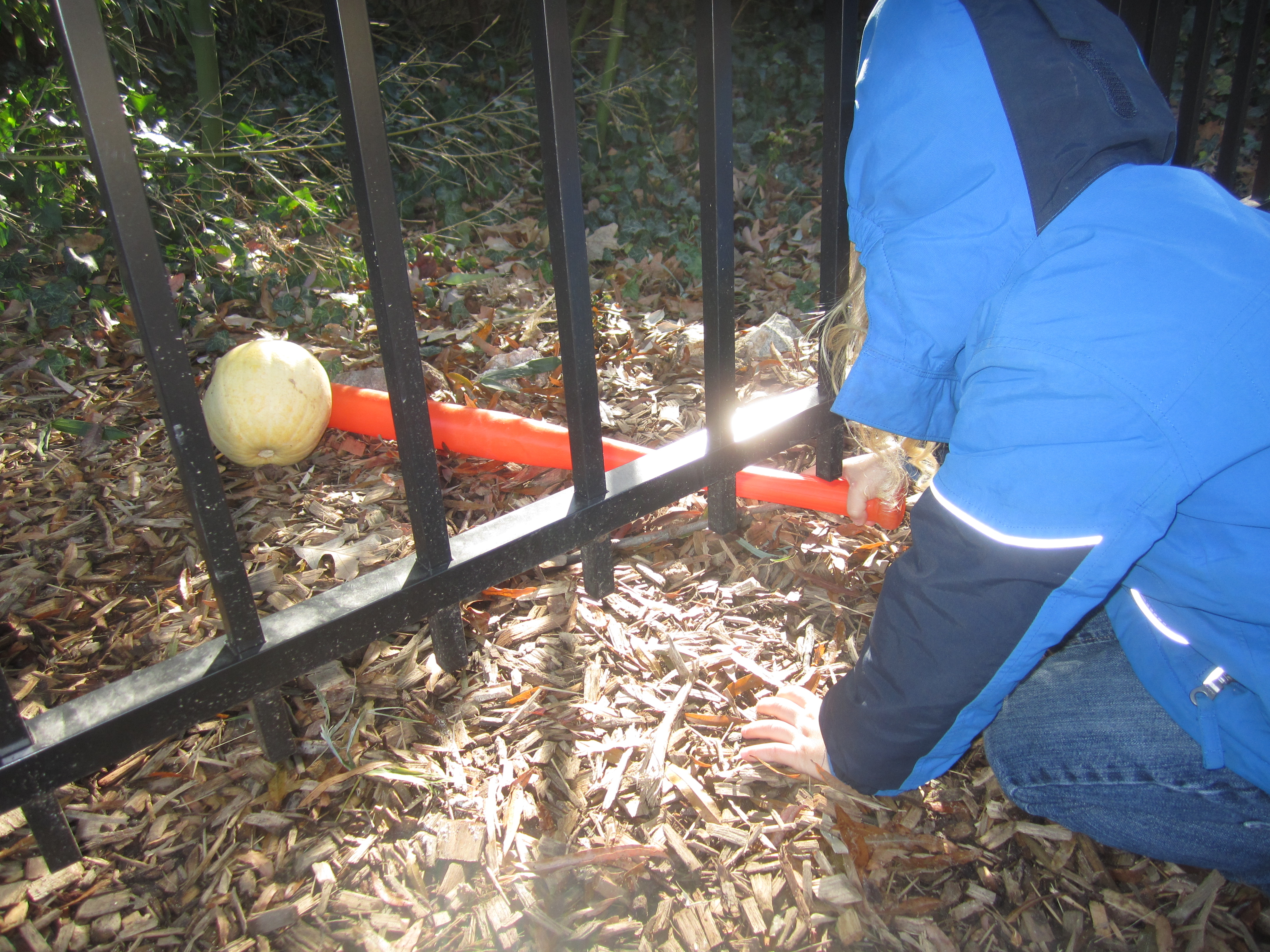
Child reaches under a fence for a ball, using a bat.Unless teachers and parents resist the urge to help as soon as we first see that a child has a problem, we might miss seeing how the child can solve it, possibly developing new skills in the process. (Of course, we use our knowledge of the individual child and the situation to judge when to step in.) A Framework for K-12 Science Education describes the practice of “Asking Questions and Defining Problems” in engineering: A basic practice of engineers is to ask questions to clarify the problem, determine criteria for a successful solution, and identify constraints.

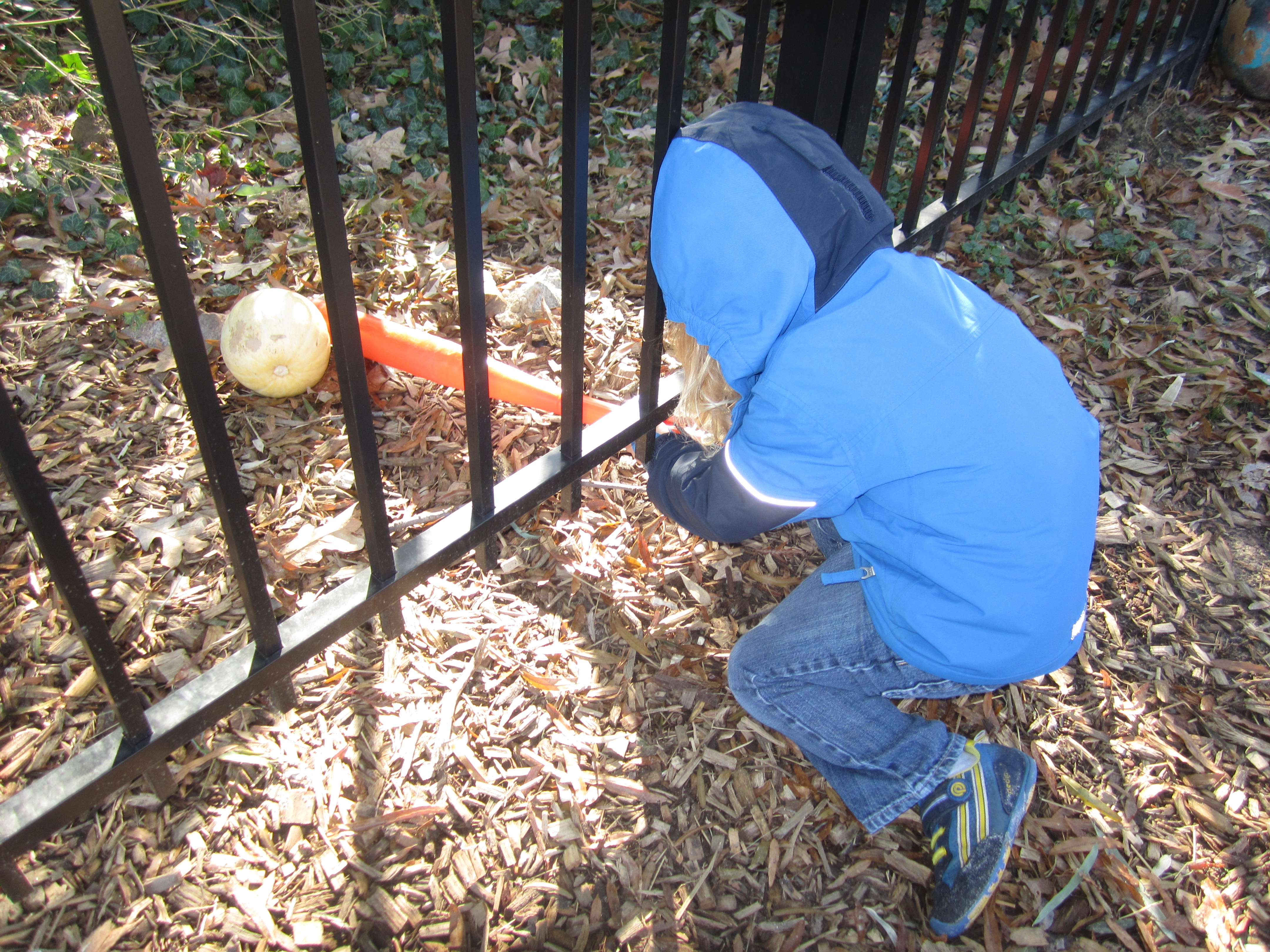
Child reaches farther under a fence for a ball, using a bat.Engineering learning in preschool can be part of emergent curriculum, encouraged whenever we see children using materials to create solutions to the problems they encounter in their play. Engineering design processes do not have to be taught through teacher-designed problems presented to children to solve. In solving an engineering problem, children (and adults) use the practices (described in the Framework) of defining problems, developing and using models, planning and carrying out investigations, analyzing and interpreting data, using mathematics and computational thinking, designing solutions, engaging in argument from evidence, and obtaining, evaluating, and communicating information. Milano cautions that “…engineering design core ideas are not designed to necessarily be sequential. Elementary students should be encouraged to use the phases fluidly, in order to avoid the misinterpretation that engineering design is a formulaic, rigid process” (pg 13). Appendix I of the Next Generation Science Standards (NGSS) also states that the component ideas of engineering design “…do not always follow in order…At any stage, a problem-solver can redefine the problem or generate new solutions to replace an idea that just isn’t working out.” Young children are famous for not always following in order and they can engineer solutions to problems they encounter. 

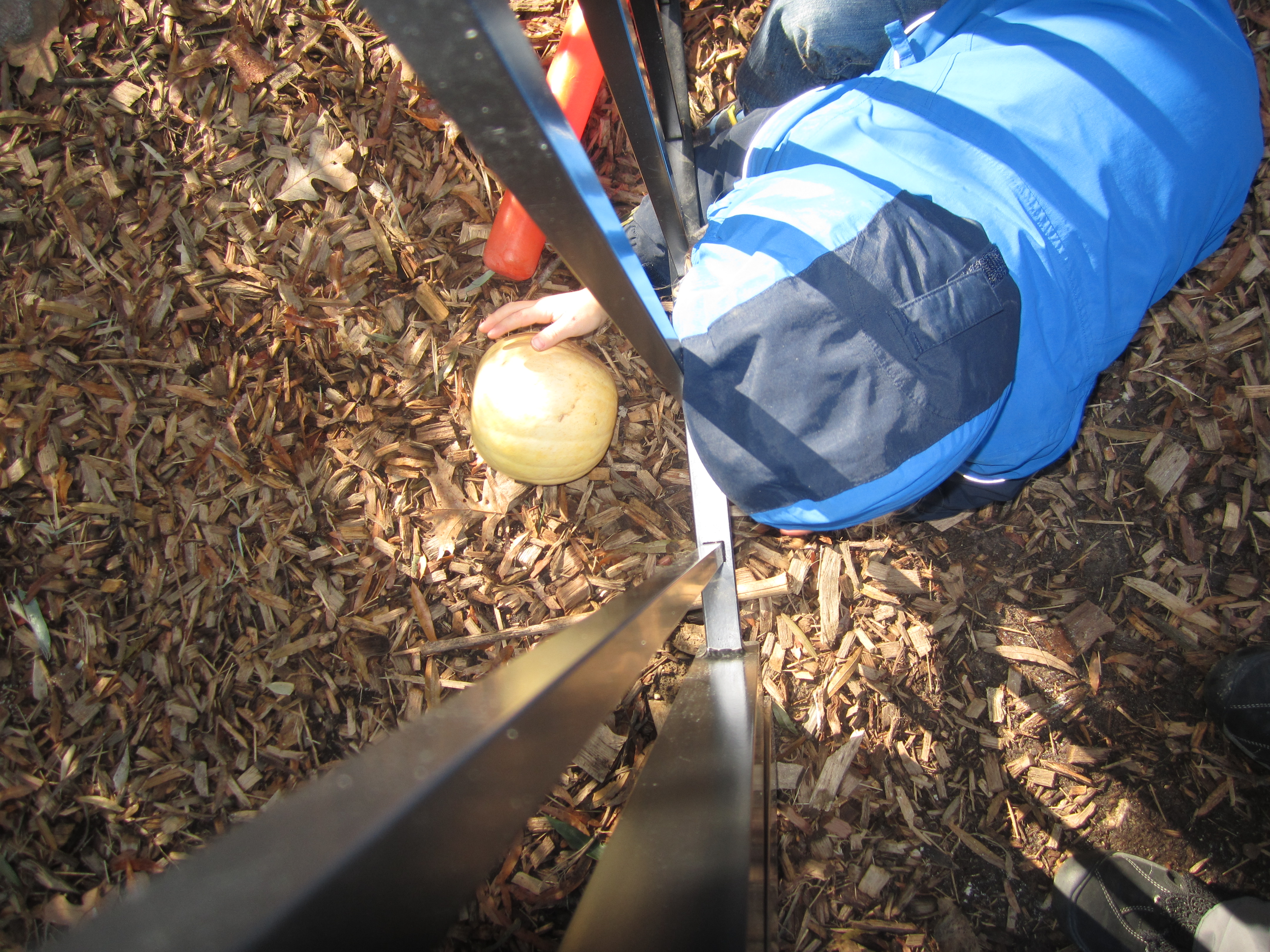
Child has moved the ball close enough to grab with hands.In the photos we see a three-year-old using engineering practices at a developmentally appropriate level to solve the problem of retrieving a ball that rolled outside a playground fence. He did not verbalize the question but by his actions he was asking, “How can I get the ball?” He began the investigation and clarified the problem when he reached with his arm to grab the ball and found his arm was too short (measurement). He determined he needed a tool that could reach farther than his arm. A constraint was that he only had the playground materials available to him. Using a bat, he tried again to reach the ball, succeeded but still had to try repeatedly to push the ball in various strokes before it slid towards him, close enough to reach under the fence. He was demonstrating an understanding of engineering design as described in the NGSS K-2-ETS1 Engineering Design. 

I hope that I can apply the same determination and creativeness to problem solving in the new year!


Milano, Mariel. 2013. The Next Generation Science Standards and Engineering for Young Learners: Beyond Bridges and Egg Drops. pg 10 Science and Children October 2013

National Research Council. 2012. A Framework for K-12 Science Education: Practices, Crosscutting Concepts, and Core Ideas. Washington, DC: The National Academies Press.

Next Generation Science Standard K-2-ETS-1 Engineering Design. Students who demonstrate understanding can: Ask questions, make observations, and gather information about a situation people want to change to define a simple problem that can be solved through the development of a new or improved object or tool.

Child reaches under a fence for a ball, using a bat.Unless teachers and parents resist the urge to help as soon as we first see that a child has a problem, we might miss seeing how the child can solve it, possibly developing new skills in the process.

Science Formative Assessment, Volume 2: 50 More Strategies for Linking Assessment, Instruction, and Learning

A Copublication of Corwin Press and NSTA Press

This book shows readers how to use assessment to inform instruction and learning in the science classroom. In the bestselling first volume, Page Keeley shared 75 techniques that help K-12 science teachers determine students' understanding of key concepts and design learning opportunities that will deepen students' mastery of content and standards. Volume 2 will present 50 new strategies linked to the Next Generation Science Standards. These flexible assessments can be used with any science curriculum.
A Copublication of Corwin Press and NSTA Press

This book shows readers how to use assessment to inform instruction and learning in the science classroom. In the bestselling first volume, Page Keeley shared 75 techniques that help K-12 science teachers determine students' understanding of key concepts and design learning opportunities that will deepen students' mastery of content and standards. Volume 2 will present 50 new strategies linked to the Next Generation Science Standards. These flexible assessments can be used with any science curriculum.
 

I'm an Instructional Science Advisor and Need Resources for the Teachers in my District. Can NSTA Help?

By Carole Hayward

Posted on 2014-12-31

WhyMembershipMatters_banner

LaToya Pugh knows firsthand how challenging it can be for busy teachers to find the resources they need. She previously was a classroom teacher, and now is an instructional science advisor. In her new role, Pugh is determined to provide science teachers in her district with tools to support them in effectively delivering science instruction.

Pugh: The NSTA Learning Center has become an asset to me as an instructional science advisor. I use the Learning Center to find science lesson plans for teachers in my district. In addition, I access the Learning Center to find articles for my teachers about best classroom strategies, whether that involves classroom management strategies or ways to teach content.

As a teacher you are engulfed with so much to do, you don’t have a lot of time to find resources. I use my NSTA membership and the Learning Center resources to increase my own pedagogy and to enhance the science instruction of science teachers in my district.

For example, I post questions on the NSTA community forums to get feedback. I’m trying to roll out Picture-Perfect Science Lessons with a small cohort of teachers in my district. I find it so helpful to be able to post a question to the NSTA discussion boards asking, “How is this being used in your district?” or “How successful has it been for your teachers?” Getting that feedback from other teachers has been beneficial to me in creating my implementation plan for this cohort. 

In addition, the NSTA webinars are so valuable, especially the ones centered on NGSS. Our state is in the process of creating science standards based on NGSS. The webinars have allowed our teachers to see what NGSS is and how our original standards will evolve in the next couple of years. I like being able to chat with the presenters and other participants during the webinar and get ideas and links to additional resources, which has made me a better instructional science advisor. The webinars help me learn what I need to do for my teachers and what information I need to take back to my district.

How else has your NSTA membership helped you in your position?

Pugh: Literacy is essential in our district, and I create collections of articles in the Learning Center focused on literacy in science education. I never realized that the NSTA journals include literacy lessons from Picture-Perfect Science Lessons and other trade books and authors. Now when a teacher says, “I need to incorporate more literacy in my classroom,” I can go into the Learning Center and pull out ideas for that teacher. I have multiple collections of articles in the Learning Center, ranging from “writing in science” to “inquiry-based lessons.” I created a collection of articles on STEM, as well, that I can provide to principals who want to learn more about STEM.

Creating those collections and being able to access these journals and all the activities and the webinars are great. NSTA is a huge support and is there for teachers, administrators, and science educators across the world.

Not a member of NSTA? Learn more about how to join.

Jennifer Henderson is our guest blogger for this series. Before launching her freelance career as a writer/editor, Jennifer was Managing Editor of The Science Teacher, NSTA’s peer-reviewed journal for high school science teachers.

WhyMembershipMatters_banner


What would YOUR End of the Year Recommendation (Resolution) be to the Business Community?

By Christine Royce

Posted on 2014-12-29

In 2007, Rising Above the Gathering Storm:  Energizing and Employing America for a Brighter Economic Future (RAGS) was released from the National Academies Press and heralded the need for improved performance in producing a STEM prepared workforce for the future  – the future including teaching, business, and policy.  It set forth four recommendations.

“The four recommendations focus on actions in K–12 education (10,000 Teachers, 10 Million Minds), research (Sowing the Seeds), higher education (Best and Brightest), and economic policy (Incentives for Innovation) that are set forth in the following sections. Also provided are a total of 20 implementation steps for reaching the goals set forth in the recommendations.

The committee’s recommendations are the fundamental actions the nation should take if it is to prosper in the 21st century. Just as “reading, writing, and arithmetic” are essential for any student to succeed—regardless of career—“education, research, and innovation” are essential if the nation is to succeed in providing jobs for its citizenry.”

While many of the action steps identified for the preparation of K-12 educators, investment in research by the federal government, and monetary support through new and strengthened legislative policies have definitely fallen short, there is no doubt that much of what the business community wanted, still states they need, and voices their concerns over nearly eight years later has not yet happened.

According to the most recent report, Solving the Skills Gap: CEOs Weigh In, where 120 CEOS completed a survey, there are troubling findings which are summarized in the report as:

  • CEOs say the skills gap hurts business. Nearly 98% of CEOs say that the skills gap is a problem for their companies;
  • most open jobs require STEM knowledge and skills. Approximately 60% of job openings require basic STEM literacy and 42% require advanced STEM knowledge. Nearly two-thirds of job openings that require STEM skills are in manufacturing and other services;
  • the biggest skills gaps are in advanced computer and quantitative knowledge. 62% of CEOs report problems finding qualified applicants for jobs requiring advanced computer/IT knowledge, and 41% report problems for jobs requiring advanced quantitative knowledge; and
  • many job candidates lack even basic STEM skills. 38% of CEOs say that at least half of their entry-level applicants lack basic STEM literacy. 28% say that at least half of their new entry-level hires lack basic STEM literacy.

The Business Roundtable did also convene a panel of the representative CEOs that discussed strategies to close this gap and highlight the fact that “by 2012, business organizations already were spending $164.2 billion to train their employees [and that] [i]n 2013, training budgets jumped by another 15 percent. Yet these efforts alone will not erase the skills deficit.” They went on to further purport that “[t]o build the workforce needed for 21st century jobs, more must be one now to strengthen the education and training pipeline serving youth and working adults.”

Needless to say, I am sure that all of these CEOs have conducted a SWOT analysis related the problems their individual companies are finding due to the shortage of STEM prepared workers. I can even surmise that one of the more periphery and less defined opportunities to meet their needs was to have better prepared workforce ready graduates who have the competencies, skills, and knowledge needed to fill these gaps. They Business Roundtable has even produced a reasonably sounding action plan that addresses the problem, vision and needed actions to remediate this gap. Even within the infographic that was released, they identified several ways that would help to develop STEM skills in potential future employees which included a 70% of the companies saying internships was one of the most effective ways to address shortages and 37% stating apprenticeship programs. They also felt that assisting educational institutions with curriculum development (54%) and classroom instruction (21%) were potential solutions. You can even check out their blog on the topic.

As stated in RAGS, “[t]he United States faces an enormous challenge because of the disparity it faces in labor costs. Science and technology provide the opportunity to overcome that disparity by creating scientists and engineers with the ability to create entire new industries—much as has been done in the past.”  Recommendations stated with RAGS attempted to demonstrate the need and build support for education, research and innovation.  And suffice it to say, the report did generate discussion around as well as some action for these four recommendation areas – but apparently not enough.  Why not enough one may ask?  Well eight years later the Business Roundtable’s report is stating that “[a] new vision is needed — along with concerted action — to close the skills gap, enhance education and training opportunities for America’s workers, and return our economy to its full promise.”

So the reality is that every so many years, there seems to be an outcry from the business community that focuses on their needs, I cannot denounce their attempts to bring to light what they need to be successful in business and honestly what we need to be a successful nation in order to compete in international and global circles in the fields encompassed by STEM. Is there perhaps a mismatch between what policy makers in the educational arena have recently deemed important (i.e. assessments) and college and career ready skills, my personal opinion is absolutely. So we are at a crossroads in the middle of the continuing storm.

One of the points of consideration at this crossroads, comes down to does education follow money, power, good intentions for the future or the needs of students? If the latter, who gets to determine what students need to be successful in the future–educators, businesses, policy makers? My personal opinion would be somewhere at the nexus of all three with give and take at all intersections. If businesses truly want to assist in this process, why do they not include educators in the discussion (in full disclosure there may have been, however there was no listing of participants in the Business Roundtable’s report, however the survey indicates that 120 CEOs completed the survey and the panel shown consisted only of CEOs at businesses). I’d personally suggest taking 10% (16.4 million dollars) of the money they needed to train their entry level workers and invest it in school based internships, educational programs, K-16 training for educators, and collaborative efforts for a period of eight years (with comparable increases each year of course) to determine if that has any ability to produce what they need. This amount is similar to one of their action plans noted but does not indicate it would be on a yearly basis.

While I am sure I could generate many more recommendations, recommendations are just that, recommendations – whereas the follow through, commitment to them, as well as overall “sweat equity” on the part of all stakeholders is what determines if they will be recommendations for, reactions to or resolutions of the situation.

So as the final days of 2014 comes to a close, what recommendation/resolution would you personally make to the business community that would bring both sides together to meet the needs of all of our students?



In 2007, Rising Above the Gathering Storm:  Energizing and Employing America for a Brighter Economic Future (RAGS) was released from the National Academies Press and heralded the need for improved performance in producing a STEM prepared workforce for the future  – the future including teaching, business, and policy.  It set forth four recommendations.

Subscribe to
Asset 2