Celebrate imagination! This NSTA Kids book has been selected for the Children’s Book Council #ImaginationCelebration Showcase! Full book list: Imagination Celebration Showcase
A friendly debate leads twins Bill and Mary to compare rubber balls, rafts, and gloves with glass marbles, greenhouses, and jars, objects that at first seem very different. A field trip teaches them that both rubber and glass can bend, bounce, stretch, and even melt. This lively story introduces the concept of properties. As scientists know, properties are characteristics that help us understand the traits of substances all around us if—like Bill and Mary—we observe closely.
While building a soapbox racing car, a pair of friends provide an easy-to-understand lesson in how simple machines are all around us, making our work more efficient. Michael and Luci show readers that a broom is a lever, nails are wedges, and a screwdriver is both a lever and a wheel and axle. The two also prove that curious children can be just like scientists, making observations and using how and what questions to explore physical science principles they encounter all the time.

Dark as a Shadow: I Wonder Why

Time for shadow play! After reading about how light and objects interact to create shadows, young children won’t be able to resist twisting, wiggling, bending, and shaking to see the phenomenon for themselves. To add to the enjoyment, Dark as a Shadow is written in lively rhymes, making it even more fun to learn the science behind why shadows change length through the day and disappear in the dark.

Light and Color: I Wonder Why

This book unfolds as a series of observations about light, including where it comes from, how it bounces off of people and objects, and what we mean when we say the colors of a rainbow are the colors in light. Throughout the text, informal experiments prompt young scientists to learn by doing, and impressionistic drawings bring the mysteries of light and color to life. By the book’s end, students will have a useful foundation for middle school and beyond, when they’ll learn about energy, wavelengths, and the electromagnetic spectrum.

Children's Choices Winner, Children's Book Council and International Literacy Association!
REVERE Award Finalist, PreK-12 Learning Group, Association of American Publishers!

Children's Choices Winner, Children's Book Council and International Literacy Association!
REVERE Award Finalist, PreK-12 Learning Group, Association of American Publishers!

Time for shadow play! After reading about how light and objects interact to create shadows, young children won’t be able to resist twisting, wiggling, bending, and shaking to see the phenomenon for themselves. To add to the enjoyment, Dark as a Shadow is written in lively rhymes, making it even more fun to learn the science behind why shadows change length through the day and disappear in the dark.
Here’s humorous proof of just how fun it is to observe with your ears. A whimsical introduction to pitch and volume, this book practically begs young scientists to read it aloud. And why not? It’s the best way to compare the differences among a telephone’s high ring, a cow’s low moo, a fire truck’s loud clang, and a flying string band’s plinkety plink plunk. Sounds Are High, Sounds Are Low is ideal for beginning readers and hilarious practice for future sound effects pros.
This book unfolds as a series of observations about light, including where it comes from, how it bounces off of people and objects, and what we mean when we say the colors of a rainbow are the colors in light. Throughout the text, informal experiments prompt young scientists to learn by doing, and impressionistic drawings bring the mysteries of light and color to life. By the book’s end, students will have a useful foundation for middle school and beyond, when they’ll learn about energy, wavelengths, and the electromagnetic spectrum.
 

Reflection on Receiving the Robert H. Carleton Award

By Guest Blogger

Posted on 2014-06-26
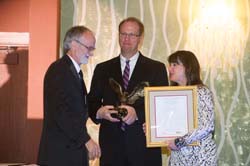
Jack Rhoton accepting the Robert H. Carleton Award

To be recognized as a recipient of the Robert H. Carleton Award from the National Science Teachers Association (NSTA) was truly the capstone of my professional life. To be noticed at all for one’s passion is always appreciated, but to be named an NSTA Carleton Award recipient is an especially high honor, one for which I am abundantly thankful. I have always valued the opportunities to be so closely involved with NSTA for nearly four decades. Not only has NSTA allowed me to serve in a variety of leadership roles, it has also provided a forum for me to network and learn from others in our nation and, indeed, throughout the world. I have made so many dear friends here. I have learned so much from my colleagues, and I hope my contribution has inspired other to reach for excellence in science teaching and learning. So, I give special thanks to NSTA as well as Dow Chemical Company for sponsoring this Award. Dow has aligned its company with education to advance quality STEM education around the world. And that is so much appreciated.

I also accepted this award realizing that there are others of gifted vision who were deserving of this recognition. When I look at past recipients of this award, I see a collection of remarkable individuals who are legends in our profession. I have been privileged to know most of them and it is humbling to be in their company. They have improved the overall value and effectiveness of our work. I’ve learned so much from them; I owe them a great deal. To be recognized by one’s peers and this prestigious award is truly gratifying and humbling, especially in light of the fact that it has been bestowed on a relatively few in our profession.

It was important for me to accept this award on behalf of all science teachers. As I reflect upon having received this award, I am reminded of the milestones of my journey in building systems of support for the classroom science teacher. In my nearly 5 decades of working in science education, I have come to value, more and more, the wisdom of teachers in shaping our great profession. Our educational system benefits when we incorporate the advice and knowledge of outstanding classroom science teachers when formulating education policy. This is why I appreciate and value so much the work of NSTA in elevating the work and status of the classroom science teacher. NSTA represents the binoculars, the magnifier, and the telescope (all in one) in adding value to our work.  And that alone is enough to be a member of this great organization.

Again, I offer my heartfelt thanks and appreciation to the National Science Teachers Association and the Dow Chemical Company for their continued support in promoting excellence and innovation in science teaching and learning.


Today’s guest blogger is Jack Rhoton, 2014 winner of the NSTA Robert H. Carleton Award

Learn more about the many Awards and Recognitions available from NSTA. The 2015 award applications are open for submission!

Jack Rhoton accepting the Robert H. Carleton Award

Subscribe to
Asset 2