


 Join
JoinAll Resources
Journal Article
Commentary: Personal Guiding Frameworks and Equity Teaching Practices
The No Child Left Behind Act of 2001 (NCLB) requires that science educators use research-based teaching strategies. This month’s Commentary column cites the following references as excellent resources for science educators to use as personal guidin...

Journal Article
Scope on the Skies: Convening with Comets
In February 2004, not only were the four brightest planets visible across the evening skies, but there was a comet rendezvous mission nearly completed while another was just getting started. Comet missions not only provide information about comets an...

Journal Article
Home Connections: Thumbs Are Handy Digits
Hold your hand out in front of you and look a it carefully. The human hand is made up of four fingers and one thumb. Have you ever thought about how much you use your thumb? This month’s Home Connections activity helps students understand the imp...
Journal Article
Science Sampler: ExploraVision's professional development opportunities
Professional development can take many forms. One unusual approach recommended by the author is participation in NSTA's futuristic science event, ExploraVision. It requires teams of students to investigate a problem and then develop an invention to s...
Journal Article
Teacher Quality: From Policy to Practice
The No Child Left Behind act requires schools to have “qualified teachers” in every classroom by the 2005-2006 school year. This mandate has made professional development a priority. This article defines quality professional development, describe...

Journal Article
Sun-Earth Day 2004: Transit of Venus
On June 8th, 2004 a celestial event of historical scientific importance occured when the silhouette of the planet Venus crossed the face of the Sun as seen from the Earth. This event, known as the transit of Venus, last occurred in 1882. Through para...
Journal Article
Two Peas in a Pod? A Case of Questionable Twins
Based on an actual event, this case study focuses on problems associated with reproductive technologies. It tells the story of the “Jones” who, after in vitro fertilization treatment, discovered that their fraternal twins were less similar in app...
Journal Article
Editor’s Corner: Opening the Door to Science
The national standards have refocused our thinking about teaching and learning science. Science isn’t reserved only for future astronauts or heart surgeons. Everyone can do science, and previously we hadn’t been reaching the majority of our stude...
Journal Article
Two university educators and a sixth-grade teacher collaborated to create and implement a five-day engineering unit that incorporated both mathematics and science concepts and hands-on learning. In this series of engineering activities, students tes...
eBook
Clones, Cats, and Chemicals: Thinking Scientifically About Controversial Issues (e-Book)
Does human cloning present a threat or an opportunity? Do common cats constitute a major threat to wildlife? Will the development of new chemical and biological weapons deter war or lead to it? If you want students to think—really think—about the...
eBook
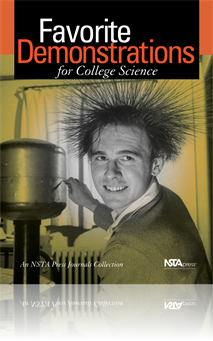
Favorite Demonstrations for College Science (e-book)
Peer-reviewed, classroom-tested, and tailored specifically for introductory science courses, Favorite Demonstrations is an essential complement to every college instructor’s lesson plans. The book is an all-in-one compilation of 36 popular cl...
Journal Article
Science Sampler: Sending in the Pinch Hitter
Even the most conscientious teacher will eventually need a substitute. The classroom can continue to function smoothly and effectively when substitute planning is viewed as another important aspect of preparation. Like any pinch hitter, the substitut...

Journal Article
I Lost the Answer Key! Authentic science flourishes when a teacher loses the prepared answer key
A popular exploratory activity is “Mystery Powders,” a chemistry investigation during which students identify the composition of white, powdery mixtures. In this article, the teacher loses the key to the mystery powders lab and the students take ...
Journal Article
Racing with the Sun: Students learn physics while designing a solar-powered vehicle
Through this yearlong inquiry investigation, high school physics students design, create, and race a solar-powered vehicle. The design process helps students learn invaluable science, technology, mathematics, communication, and critical thinking skil...
Journal Article
Editor's Corner: Designing Inquiry Pathways
The Science Teacher’s editor shares thoughts on the current issue....
Journal Article
Harry Potter as a Context for Problem-Based Learning
This innovative thematic unit for middle school students builds on the Harry Potter phenomenon. Students are immersed in problem-based learning as they study a science and language arts curriculum as it might have been taught at Hogwarts School. The ...
Journal Article
Career of the Month: An Interview with Perfumer Christopher Laudamiel
This column shares interviews with professionals using science in the workplace. This month’s column focuses on the job of a perfumer....
Journal Article
After the Bell: Breaking the Code: Examining Your Mail
Given the amount of mail that arrives during the holidays--from early December to early January--the post holiday season provides an excellent opportunity to perform an informal science and mathematics classification activity--determining where our m...
Journal Article
Seeking to revitalize a unit on rocks, sand, and soil for first-graders, the authors created new hands-on lessons. These included testing the hardness of rocks, making models of the Earth, and sorting rocks. As a culminating activity, students partic...
Journal Article
In this month's section we explore the integration of math into the science curriculum. Meaningful math and science integration can also help teachers identify specific skills and standards that support their science and mathematics curricula. ...
Journal Article
Home Connections: Counting Populations
This activity, designed for students to do at home, introduces the concept of population sampling. Students scatter pasta on a grid and count the number of pieces in three sample boxes....
Journal Article
The Idea Bank provides tips and techniques for creative teaching, in about 1,000 words. In this month’s Idea Bank, the science faculty is looking for ways to engage all students in a course that allows them to achieve their greatest individual pote...
Journal Article
Ask the Experts (January 2004)
Why does the Moon appear larger in winter? Why doesn't glue stick to the inside of its container?This article contains the expert's answers....
Journal Article
A new activity model for scientific inquiry is presented here with the overall intent of providing students and teachers with a deeper understanding of how science is really done. With this model students learn that the process of inquiry can follow ...

Book Chapter
Aristotle took the ideas of those who had come before him and melded them into a grand theory that attempted to explain and classify everything know. It was an enormous accomplishment, and it set a base for science that is still with us today. ...
Book Chapter
For decades, many of the nation’s life science classrooms have been anything but lively. Biology has been criticized for being content heavy, overloaded with vocabulary, and tested by rote. Six to seven hundred pages of text, presented to teenagers...

Book Chapter
Introduction to Watershed Dynamics
The title of this book, Watershed Dynamics, refers to the idea that streams, rivers, lakes, and other water bodies are dynamic systems, continuously changing in many ways—physically, chemically, and biologically. Have you ever wondered why some st...
Book Chapter
Opponents to teaching the theory of evolution declare that it is only a theory and not a fact; and that science relies on observation, replication, and experimentation, but nobody has seen the origin of the universe or the evolution of species, nor h...
Book Chapter
Classroom Management and Safety
Welcome to the challenge of making good science come to life in your classroom. In this chapter, we look at how to get the science classroom ready for inquiry-based lessons and how to prepare students for engaging, productive, and safe activities. In...