


 Join
Safety Blog
Addressing Potential School STEM Laboratory Instructional Space Safety Issues
By Ken Roy
Posted on 2026-11-24
Disclaimer: The views expressed in this blog post are those of the author(s) and do not necessarily reflect the official position of the National Science Teaching Association (NSTA).
High school and middle school STEM laboratory instructional spaces are designed to integrate science, technology, engineering, and mathematics into hands‑on, project‑based learning. These instructional spaces have a range of potential biological, chemical, and physical safety hazards and resulting health and safety risks. To ensure participants’ safety, programs need to identify potential safety hazards, assess the resulting risks for students and staff, and implement appropriate safety controls before hands-on activities and demonstrations begin.
Those in charge of implementing these programs also need to distinguish between legally required safety standard controls (e.g., applicable Occupational Safety and Health Administration [OSHA] requirements, fire and building-code requirements) and recognized better professional safety practices. Those categories aren’t necessarily interchangeable when evaluating whether an activity is planned as safely as possible.
KEY STEM LAB INSTRUCTIONAL SPACE SAFETY AREAS, ISSUES, AND ACTIONS
The following table organizes key potential safety hazards and resulting health and safety risk issues, followed by important safety actions that must be included in a high school or middle school STEM laboratory instructional space safety review, inspection, or written safety plan.
Area | Potential Safety Hazards and Resulting Risks | Required Safety Actions |
| Chemical safety | Exposure to corrosive, toxic, flammable, reactive, or irritating chemicals; incompatible chemical storage. | Maintain a chemical inventory and current safety data sheets (SDSs); label containers; segregate incompatible chemicals; use safer substitutes and appropriate engineering controls. |
| Personal protective equipment (PPE) | Eye injuries, chemical splashes, burns, cuts, and exposure to dust or biological materials. | Conduct and document an activity-specific hazard assessment; require appropriate sanitized eye protection, gloves, aprons, or other PPE; inspect and replace damaged PPE. |
| Machine and power tool safety | Contact with saw blades, drills, lathes, grinders, CNC equipment, and other moving machinery. | Install and maintain guards; provide equipment-specific training and supervision; control access; establish emergency shutoffs; prohibit unauthorized operation; establish work zones; post appropriate safety signage. |
| Electrical safety | Electric shock, burns, short circuits, damaged cords, overloaded circuits, and exposed wiring. | Inspect electrical equipment; remove defective equipment from service; provide appropriate grounding and GFCI protection where required; avoid overloaded circuits and exposed energized parts. |
| Fire and explosion hazards | Flammable liquids, combustible materials, gas burners, sparks, batteries, and operations that produce wood and metal dusts. | Control ignition sources; store flammables appropriately; manage combustible dust; maintain suitable fire protection and clear exits; train staff in emergency procedures. |
| Ventilation and airborne contaminants | Inhalation of chemical vapors, fumes, soldering emissions, welding fumes, dust, or 3D-printing emissions. | Use appropriate local exhaust ventilation, fume hoods, or other suitable capture systems; maintain and inspect systems; verify that the control is appropriate for the specific contaminant and exposure level anticipated. |
| Biological safety | Exposure to microorganisms, contaminated specimens, human-derived materials, sharps, or biological waste. | Use approved organisms and materials; establish hygiene and disinfection procedures; prohibit mouth pipetting; provide appropriate containment, PPE, and waste disposal. |
| Robotics and automation | Pinch points, crushing, unexpected movement, autonomous vehicles, and robot arms operating near students. | Use physical barriers, guarding, designated safer operating zones, speed and force limits, emergency stops, and controlled testing procedures; keep students clear during hazardous motion; consider lockout or tagout principles during equipment servicing and maintenance activities. |
| Batteries and energy storage | Short circuits, overheating, burns, fires, and battery rupture, particularly with damaged or improperly charged lithium-ion batteries. | Use appropriately rated power sources; prevent short circuits; inspect batteries; follow manufacturer charging and storage instructions; remove damaged batteries from service and follow approved disposal procedures; establish procedures for thermal runaway incidents involving lithium-ion batteries. |
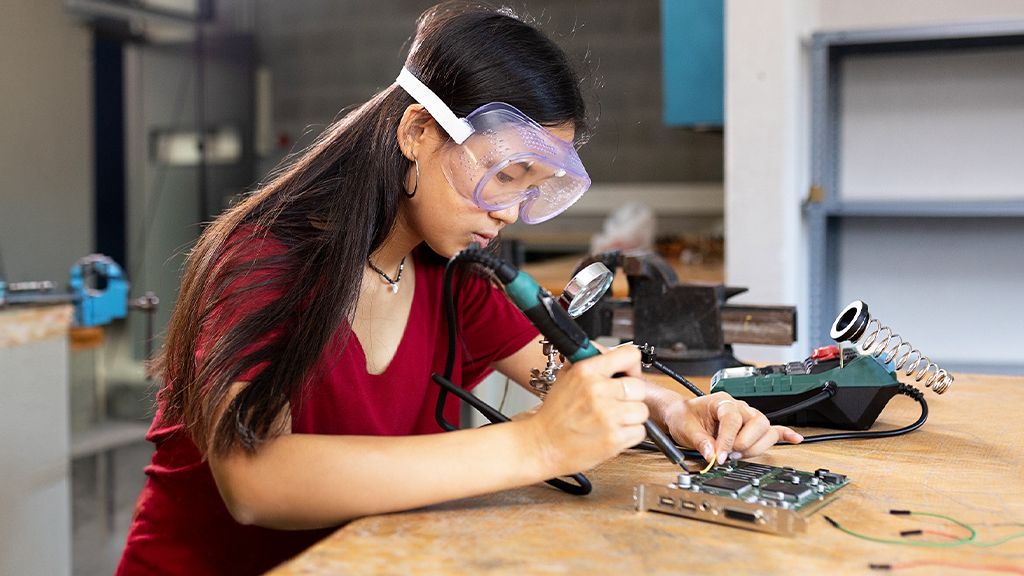
| Soldering, hot tools, and thermal processes | Burns from soldering irons, hot-glue guns, heated materials, furnaces, hot surfaces and potential fumes | Provide stable heat-resistant workstations, suitable holders, appropriate ventilation, clear hot-tool zones, supervision, and safer shutdown and cooling procedures. |
| 3D printing and fabrication | Hot surfaces, moving components, airborne emissions, resin exposure, lasers, and postprocessing dust. | Follow equipment-specific controls; assess filament and resin hazards; provide ventilation and appropriate PPE; restrict access to hazardous moving or hot components. |
| Hand tools and materials | Cuts, punctures, flying fragments, splinters, sharp sheet metal, and improper tool use. | Use the correct tool for each task; inspect tools; secure work pieces; provide training and eye protection where warranted; store sharp tools safely. |
| Compressed gases and pressure systems | Cylinder tipping, high-pressure releases, ruptured tubing, pressure vessel failure, and flying components. | Secure cylinders; use compatible regulators and fittings; inspect pressure equipment; use rated components and appropriate pressure relief; establish safer operating limits; ensure users receive training on compressed gas hazards and cylinder-handling requirements. |
| Lasers and optical equipment | Eye or skin injury from direct or reflected laser beams; exposure to intense light sources. | Use appropriately classified equipment; control beam paths and reflections; prevent eye-level exposure; restrict access and follow applicable laser-safety requirements. |
| Ergonomics and physical workspace | Trips, slips, falls, awkward lifting, repetitive movements, clutter, and unstable workpieces or shelving. | Keep aisles and exits clear; secure shelving and materials; provide suitable work heights; manage cords and spills; use safe lifting and material-handling practices. |
| Emergency equipment and access | Obstructed eyewashes, emergency showers, fire extinguishers, exits, electrical disconnects, or emergency stops. | Keep required equipment accessible; inspect and maintain equipment; provide appropriate signage; verify emergency equipment suitability; ensure students and staff know how to respond to emergencies. |
| Training and supervision | Student use of unfamiliar equipment or hazardous materials without adequate instruction or supervision. | Provide documented, activity-specific instruction; verify competency before use; establish age-appropriate restrictions, supervision levels, and clear stop-work authority; periodically re-evaluate competency for infrequently used or higher-risk equipment. |
| Chemical and other waste | Improper disposal of chemical waste, contaminated materials, sharps, batteries, and electronic waste. | Identify waste streams; segregate and label waste; use approved collection and disposal methods; prohibit unapproved drain disposal and mixing of incompatible wastes. |
| STEM activity design and risk assessment | Projects involving untested prototypes, high speeds, stored energy, heat, chemicals, or student-designed apparatus. | Review hazards before activities begin; evaluate foreseeable failure modes; establish operating limits; test prototypes under controlled conditions; use safer alternatives when feasible; document significant findings from activity-specific risk assessments and review them when activities, equipment, or materials change. |
| Safety management and accountability | Outdated procedures, inadequate inspections, unclear responsibilities, and uncorrected hazards. | Maintain written safety procedures; assign responsibilities; conduct and document inspections; correct deficiencies promptly; report incidents and near-misses; review procedures periodically. |
HIGHEST-PRIORITY SAFETY ACTIONS
For a practical high school and middle school STEM safety assessment, evaluating the following areas is highly recommended:
- Engineering controls: machine guards, suitable ventilation, barriers, interlocks, and emergency stops.
- Hazardous materials: chemical inventory, compatible storage, labeling, SDS access, and waste management.
- Student authorization and supervision: training and demonstrated competency before use of hazardous equipment.
- Emergency readiness: accessible emergency equipment, unobstructed exits, and practiced response procedures.
- Inspection and maintenance: documented checks of equipment, guards, electrical systems, ventilation, and emergency devices.
- Activity-specific risk assessment: review of each proposed experiment, design project, or fabrication activity before students begin.
LEGAL SAFETY REQUIREMENTS VS. RECOMMENDED PROFESSIONAL SAFETY PRACTICES
For high school and middle school STEM laboratory instructional spaces, it is important to distinguish legal safety standard requirements from recommended better professional safety practices.
- OSHA requirements: Applicability depends on the employer, workplace, activity, and applicable state-plan or other legal provisions. Relevant standards can include the Hazard Communication Standard, machine guarding, electrical safety, and the Laboratory Standard when its scope and conditions are met.
- Fire and building codes: Applicable requirements depend on the adopted code editions, occupancy, equipment, and local enforcement.
- Professional guidance: Resources from organizations such as NSTA, the International Technology and Engineering Educators Association, and the American Chemical Society can help teachers establish better professional safety practices.
FINAL THOUGHTS
This commentary is a starting point, not a substitute for a site-specific assessment of potential safety hazards and resulting health and safety risks, as well as requirements to address these hazards and risks. The appropriate safety actions depend on the actual instructional activities, laboratory equipment and materials, and student population.
Submit questions regarding health and safety issues in science and STEM instructional spaces to Ken Roy at safersci@gmail.com. Follow Ken Roy on X: @drroysafersci.
Acknowledgment: I wish to sincerely thank Connor Yanicky, environment, health, and safety manager for the Rogers Corporation in Chandler, Arizona, for his professional review of and contributions to this commentary.
The mission of NSTA is to transform science education to benefit all through professional learning, partnerships, and advocacy.