

 Join
JoinA Conversation with Dr. Carlotta A. Berry: Engineering, Education, and The STEM Kids Make a Robot
By Jason Strohl
Posted on 2026-04-08
Disclaimer: The views expressed in this blog post are those of the author(s) and do not necessarily reflect the official position of the National Science Teaching Association (NSTA).
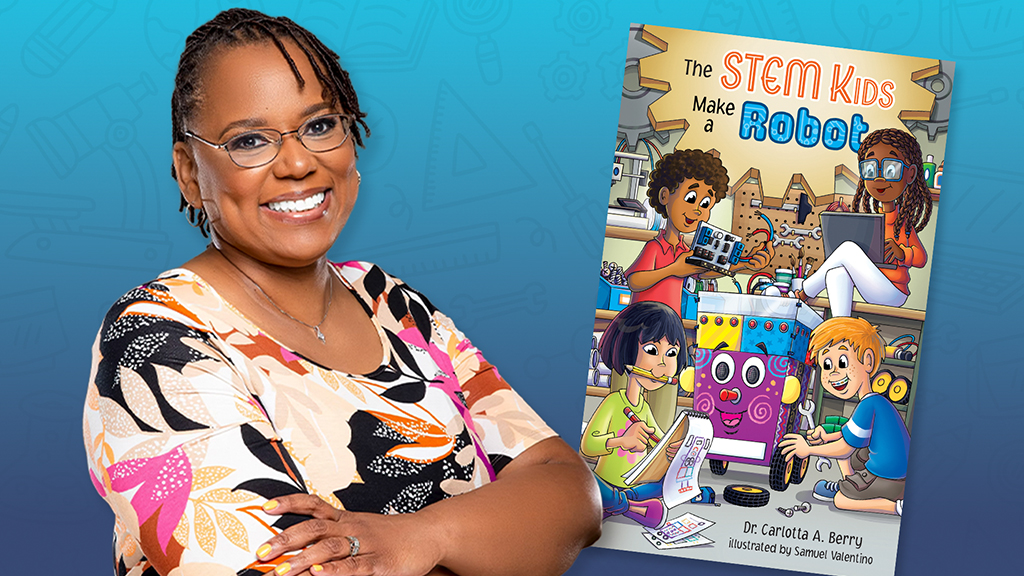
Dr. Carlotta A. Berry, a professor of electrical engineering at Rose-Hulman Institute of Technology for more than 20 years, has dedicated her career to demystifying science, technology, engineering, and mathematics (STEM) by bridging the gap between abstract theory and real-world application. As a science educator, Berry is fueled by a desire to humanize a field that she feels is often taught without personal engagement or warmth. Her passion for diversifying the scientific landscape and promoting creative problem-solving has culminated in her first traditionally published children’s book, The STEM Kids Make a Robot, which emphasizes that engineering is a collaborative and accessible art form. Through her work, she seeks to foster curiosity in young creators, teaching them that with a bit of “systems thinking,” any complex challenge can be broken down into bite-size, solvable steps.
NSTA: You’ve been a college professor for more than two decades, yet you often describe yourself as “just a math teacher.” Why do you use that specific phrasing?
Dr. Berry: I say that because so much of teaching engineering is simply applying math and science in a specific context. Some days I am literally teaching trigonometry, calculus, or linear algebra because students need those skills to handle the applications I’m giving them. My path to becoming a professor actually came from a place of frustration. When I was an undergraduate at Georgia Tech, it felt like an “engineering factory” where subjects were taught without personal engagement or warmth. I remember thinking, “How can you be teaching something so cool and make it look so very uncool?” I wanted to bring that spark back.
NSTA: What were the specific gaps you saw in the classroom that inspired you to write The STEM Kids Make a Robot?
Dr. Berry: I noticed a real deficiency in “systems thinking” and analytical problem-solving among first-year students. Many students are great at the hands-on stuff—they can put a TV together—but they struggle to break a complicated problem down into simple, testable steps. I wrote this book to show the engineering problem-solving process from soup to nuts. It isn’t just for the kids, though—it’s for the teachers. You can’t assume a middle school STEM teacher has a STEM degree; sometimes it’s the basketball coach who was available. I wanted to show them all that engineering isn’t a scary, foreign thing.
NSTA: In the book, you focus heavily on the engineering design process. How does that help a child approach a daunting task?
Dr. Berry: It makes the problem less scary by breaking it into bite-size chunks. In the book, the character Mikey keeps saying, “I can’t build a robot,” because the whole project feels too big. But if I ask, “Can you draw a robot? Can you tell me what it needs to move?” it becomes attainable. It’s about helping kids stop being just consumers of technology and start becoming creators. That process—designing, testing, and iterating to make it work better—is a skill they can use for life, whether they’re fixing a video game or looking for a lost sneaker.
NSTA: You are very vocal about the importance of representation in STEM. How do your own experiences as a woman in engineering shape that view?
Dr. Berry: My mantra is “You can be what you cannot see, but it’s an awful lot easier to be what you can see.” I didn’t know any Black women engineers growing up, and I never had a Black engineering professor at Georgia Tech. I continued because I was stubborn and had invested too much to quit, but many others might not. I write books that reflect the world I want to see. We need diverse teams because they come up with the most impactful solutions. When teams lack diversity, you get technology that fails people—like hand soap dispensers that don’t recognize dark skin or crash test dummies that only fit the size of an average man.
NSTA: Beyond race and gender, the characters in your book represent other forms of diversity. Can you tell us about Mikey and Min Juan?
Dr. Berry: Diversity includes intellectual and socioeconomic diversity as well as visible and invisible disabilities. Mikey is actually on the autism spectrum; that’s why he sometimes blurts things out and wears sensory headphones at the maker lab. Min Juan is severely shy, a trait inspired by my own daughter. Her engineering design idea in the book is actually a way for kids who sit alone to make a friend. I wanted to show how these different perspectives and ways of thinking all [help people] engage with technology in unique and important ways.
NSTA: You are a strong advocate for STEAM rather than just STEM. Why is the A for the arts so critical for future engineers?
Dr. Berry: It’s often arrogance that keeps people from seeing the value of the arts. If you do STEM design in a vacuum without thinking about creativity or the human beings using the product, you get “ugly” results. More importantly, without the arts and humanities, you get unethical technology. You get scary things like robots designed to harm humans instead of abiding by ethics. The arts provide the “why” and the human connection that technology desperately needs.
NSTA: What is the most important piece of advice you have for parents who want to get their kids interested in these fields?
Dr. Berry: You don’t have to buy expensive $500 toy sets. Lean into [kids’] natural curiosity and creativity. Take a pen apart, and have [kids] sit in a corner and figure out how to put it back together. Encourage them to walk around the house and ask, “How could we make this better?” Also, foster a love of reading from a very young age. It makes the brain elastic and ready to pull in knowledge. Mostly, just let them play and repurpose things. There is never enough curiosity you can foster in a child.
The mission of NSTA is to transform science education to benefit all through professional learning, partnerships, and advocacy.