


 Join
JoinMeet Dr. Michael A. Marino
A Q&A with the New Field Editor of the Journal of College Science Teaching
By Jason Strohl
Posted on 2025-12-18
Disclaimer: The views expressed in this blog post are those of the author(s) and do not necessarily reflect the official position of the National Science Teaching Association (NSTA).
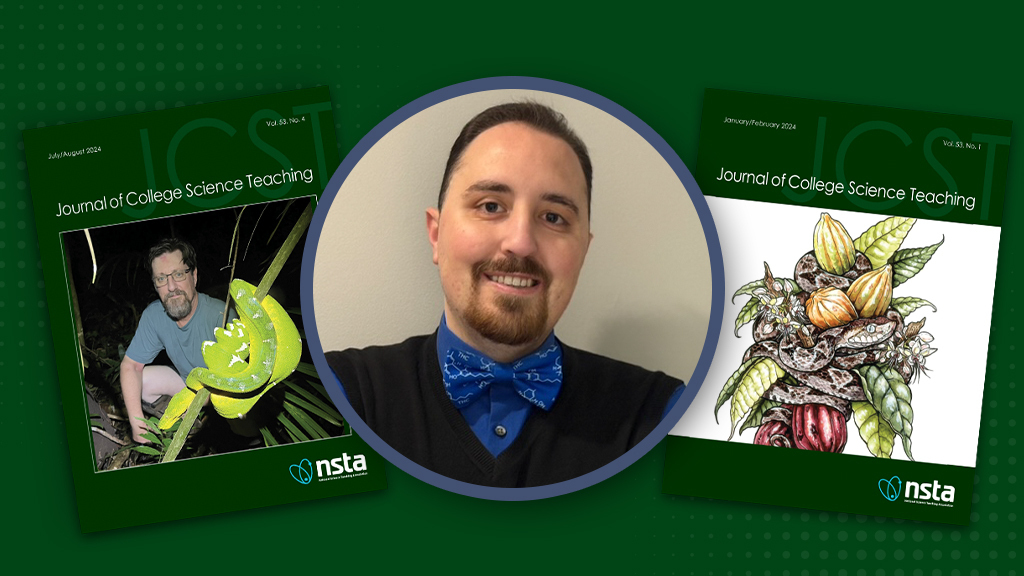
We’re excited to welcome Dr. Michael Marino as the incoming field editor of NSTA’s Journal of College Science Teaching (JCST), a role he will assume in January 2026. An associate professor at Molloy University, Marino brings a strong background in chemistry and college science education to the journal. In the Q&A below, he shares more about his path into education, how his research on smell and memory in chemistry education developed, his thoughts on AI in the classroom, and his vision for the journal as he steps into this new role.
Q: Can you tell us about your background and how you arrived in education?
A: I’ve taught chemistry at Molloy University on Long Island, New York, for 11 years - plus two years of high school teaching before that. My journey into education began with a high school mentorship program where I shadowed my chemistry teacher, even though I wasn’t a particularly good chemistry student. When I arrived at Hofstra I started as pre-med but realized I couldn't handle blood. Since I did well in my college chemistry classes, I shifted toward chemistry education. Someone in my master's program recognized my ability in the classroom and encouraged me to pursue doctoral work, which led me to college-level teaching. It's been an amazing journey - teaching is really like performing for an audience, and I'm very passionate about it.
Q: Your research on smell and memory in chemistry education is fascinating. How did that develop?
A: That's the project that's truly mine - one of the first I developed from scratch. In organic chemistry labs, students create fragrant compounds called esters that produce distinct smells like those in perfumes and fruits. I wondered if we could use these naturally occurring fragrances to help students remember lab content. We had students create a smell during the experiment, then tested them on lab procedures, glassware names, and chemical concepts. The following week, we reintroduced the scent to half the class and found they remembered about 10% more than the no-smell group. The key difference from other olfactory research is that students created the smell themselves - since it was theirs, it meant so much more and recall increased. I wanted to integrate multisensory learning into something already built into the classroom so that any chemistry educator could use it.
Q: Why is smell such a powerful tool for learning?
A: Smell is unique among our senses because it's the only one that doesn't go through the thalamus, the brain's main relay station, before reaching areas where we process it. The other four senses go through this "thinking" area first, but smell goes directly to the amygdala and emotion centers. Think about it: if you see something weird, you can catch yourself before reacting, but if you smell something good or bad, you immediately react. That's why smell is so powerful for long-term memory. If you close your eyes and think of your grandmother's perfume, you can probably visualize her living room right now - smell brings you back to that time and place with incredible clarity.
Q: How have you had to adapt your teaching methods over your 13 years in education?
A: Students today want quick, fast-paced content - if it's not instantly engaging, it's hard to maintain attention. I've created what I call "Give Me Five" videos, where I promise to teach any science related topic in five minutes or less. This approach leverages the way students consume information now.
I'm also big on student feedback throughout the semester. I meet my students in the fall, reassess needs based on their input, and come back with improvements in the spring. This past semester students struggled with note-taking, so I created more structured note-keeping systems. The key is asking students what's working and what's not - you need to know your “customer” though that sounds a bit odd to say about education. Meeting students where they are and letting them guide the learning is crucial.
Q: AI is the elephant in the room right now. How do you approach AI in your classroom?
A: I treat AI like another intelligence. If you and I were working together and you helped me brainstorm topics for a paper, that would be okay. But if I asked you to write the introduction while I wrote the body of the piece, that would be cheating. Whether it's artificial or human intelligence, the same principles apply. AI is excellent at generating practice problems when you're very specific with your prompts - it's more of a conversation than a single command. However, AI can be wrong, so when students create problems using it, I always have them send the questions through me first. I encourage using AI for lesson planning and creating engaging content, but the teacher still needs to evaluate how those ideas are presented and connected with what students are learning. The key is not shoving it in everywhere, but using it thoughtfully where it makes sense.
Q: With so much content available online, why are academic journals still relevant in 2025?
A: Academic journals are still the common language and meeting place for college science educators. While there's plenty of interesting content on the internet, journals provide a standardized platform where educators can discuss ideas using academic language and present research with proper experimental design, figures, and data analysis. This is simply how college science scholars communicate their work effectively.
Journals serve as a formal forum where the field can grow and develop in a controlled, systematic way. When educators build on published research, they're not starting from scratch - they can see what colleagues at other institutions have already explored and build upon those ideas. They might recognize a good approach but identify areas that need more time or additional research. This continuity and standardization across institutions is what makes journals invaluable for advancing teaching practices in a meaningful, collaborative way.
Q: What's your vision as the new field editor for the Journal of College Science Teaching?
A: I have four main pillars for my editorial vision. First is innovation in science teaching. I want JCST to showcase cutting-edge, forward-thinking approaches that make people say "Wow, NSTA is really ahead of the curve." Second is rigor and accessibility - building assessment and research methodology into classroom activities, like we did with the smell and memory research. Third is connection and collaboration. I love seeing cross-disciplinary approaches because that's how you get people interested. Finally, sustainability of impact, not just "here's a cool lesson," but digging in and asking "how does it grow and develop?" I want every issue to include something educators can immediately use in their classroom, regardless of scientific discipline.
The mission of NSTA is to transform science education to benefit all through professional learning, partnerships, and advocacy.