


 Join
JoinOutdoor and Place-Based Science Education
By Brooke A. Whitworth, PhD
Posted on 2026-10-09
Disclaimer: The views expressed in this blog post are those of the author(s) and do not necessarily reflect the official position of the National Science Teaching Association (NSTA).
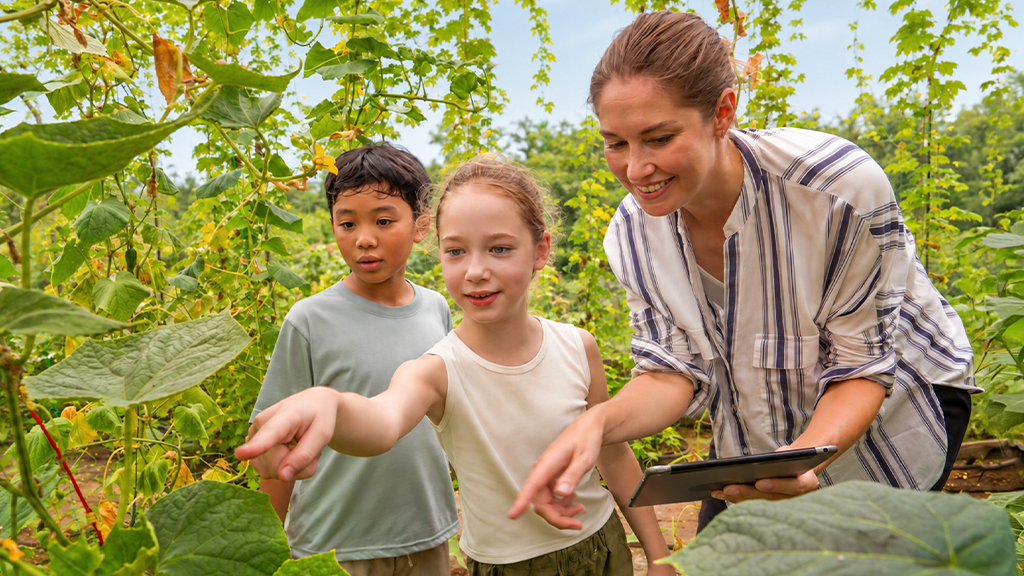
Students have a plethora of information at their fingertips, yet many know surprisingly little about the ecosystems just beyond the school parking lot or the science shaping their own communities. I am reminded of Comenius’s assertion that “Knowledge of the nearest things should be acquired first, then that of those farther and farther off”. How do we get students and teachers to trade fluorescent-lit classrooms and worksheets for community gardens, native forests, and engineering design challenges? To seek to understand the world around them and right out their doors. How do we help them recognize that science doesn’t live in a textbook or lab kit? Science is under their feet, in their lungs, and tied to the decisions their community makes about land, water, and energy.
Years ago, I worked with a team to design “STEM Instead,” a three-week, place-based summer program for middle school students in Waimea, Hawai’i (Beyea & Whitworth, 2017; Whitworth et al., 2016). What I saw and learned through that experience made me recognize the value of outdoor and place-based science education. As students headed outside, some were instantly absorbed, arguing over leaf margins and bark texture. Others were clearly unconvinced that this counted as “real” science.
As they began to treat the environment as a living data set, they became more intrigued and more invested. They were doing science from and in “their place” rather than from an abstract scenario. The combination of field work, journaling, and creative synthesis, students keeping observation notebooks, creating art pieces to represent plant diversity, and tying their work to local culture, created meaningful opportunities for students to do, experience, and see science in their own backyards.
These experiences have convinced me that place-based and outdoor learning are not just for younger students or for schools blessed with spectacular landscapes. The Waimea summer program shows what is possible when teachers, field educators, and community partners work together to design sustained, place-rich experiences that foreground local culture, ecological questions, and the science and engineering practices (Whitworth et al., 2016). The plant-diversity unit demonstrates how even a single, thoughtfully designed sequence of outdoor investigations can deepen students’ understanding of core life science concepts while cultivating a sense of stewardship and connection (Beyea & Whitworth, 2017).
I wonder what your context is? How could your context inform and relate to the science content you teach? Maybe it is a city park, a stormwater retention pond fringed with cattails, a patch of scrubby woods behind the football stadium, or a school courtyard where pollinators thread their way through ornamental plantings. The same principles hold: start with the nearest things, honor the expertise embedded in local people and places, and use outdoor experiences as the spine, not the sidebar, for rigorous science instruction.
It is tempting to treat outdoor and community-based experiences as enrichment layered on top of “real” instruction focused on coverage and test preparation. Yet research on place-based and outdoor science education suggests the opposite: frequent, guided outdoor learning can enhance science achievement and deepen conceptual understanding, not detract from it (Rios & Brewer, 2014; Stern et al., 2014). Reviews of school-based outdoor programs report that students show increased science achievement, stronger environmental attitudes, and greater engagement when teachers regularly use nearby outdoor spaces as extensions of the classroom.
Studies of place-based STEM programs at the secondary and early postsecondary levels show that organizing learning around place can strengthen students’ sense of belonging, improve performance in foundational STEM courses, and narrow equity gaps for students historically underrepresented in science (Johnson et al., 2022). When high school students analyze data tied to their own communities, they report stronger connections to science content and greater confidence in their ability to use science to address real problems.
The reality is that tight schedules, high-stakes assessments, varied facilities, and safety considerations are real constraints. The research base suggests that impactful outdoor and place-based learning does not require elaborate field sites or expensive equipment (Promise of Place, 2020; NAAEE, n.d.). Schoolyards, parking lots, nearby streams or parks, and digital access to community and environmental datasets can all serve as accessible starting points for inquiry. The key is intentional design. Guidance from place-based and equity-focused science education emphasizes connecting learning inside and outside the classroom, aligning investigations with disciplinary core ideas and practices, and leveraging community assets and partnerships (Bang et al., 2018; NSTA, 2022).
As science educators, you are preparing young people who are already making decisions with scientific and civic consequences. Place-based and outdoor science education offer a way to honor that reality. When high school students investigate phenomena in their own communities, use real data to inform local decisions, and see their cultural and community knowledge reflected in the curriculum, science becomes more than a graduation requirement; it becomes a way of understanding and shaping the world they are inheriting (Promise of Place, 2020). As I read the articles in this issue—on urban biodiversity, small watersheds, community science, and systems approaches—I see a throughline that connects Waimea and the many places where students are learning to read the landscapes they inhabit. Place-based and outdoor science education offer us a way to respond to students’ very real questions about climate, justice, and community well-being, while still attending to standards, assessment, and college and career readiness. The challenge--and the opportunity--is to design rigorous high school experiences that make science visible, tangible, and consequential right where they live.
For more on outdoor and place-based science education, please see the May-June 2026 issue of The Science Teacher.
References
Bang, M., Brown, B. A., Calabrese Barton, A., Rosebery, A. S., & Warren, B. (2018). Toward more equitable learning in science. In Helping students make sense of the world using next generation science and engineering practices (pp. 33–58). National Science Teaching Association Press.
Beyea, S. M.* & Whitworth, B. A. (2017). Out in the field: Learning about plant diversity. Science Scope, 41(3), 50-58.
Johnson, M., Miller, J., & Lopez, R. (2020). Impact of a first-year place-based learning community on belonging, STEM performance, and equity. Innovative Higher Education, 47(4), 355–371.
North American Association for Environmental Education. (n.d.). The promise of outdoor education in schools. NAAEE.
National Science Teaching Association. (2022, June 17). Contemporary approaches in science education with all students.
Promise of Place. (2020, May 31). Benefits of place-based education. Place-Based Education Evaluation Collaborative.
Rios, J. M., & Brewer, J. (2014). Outdoor education and science achievement. Applied Environmental Education & Communication, 13(4), 234–240.
Stern, M. J., Powell, R. B., & Hill, D. (2014). Environmental education program evaluation in the new millennium. Evaluation and Program Planning, 45, 1–8.
Whitworth, B. A., Beyea, S. M.*, & Purell, M. (2016, Winter). STEM Learning in Your Own Backyard: Designing a place-based middle school summer program. Green Teacher, (108), 21-25. Retrieved from: http://greenteacher.com/stem-learning-in-your-own-backyard/
 Brooke A. Whitworth, PhD, (bwhit@sc.edu) is editor of The Science Teacher and a professor of science education at the University of South Carolina. Her current research is focused on investigating the role of district science coordinators, professional development models, the differentiation of professional learning, and science teacher leaders. She previously served as an Associate Professor at Clemson University where she also served as the Assistant Chair of Teaching & Learning and the Teaching & Learning Doctoral Program Coordinator.
The mission of NSTA is to transform science education to benefit all through professional learning, partnerships, and advocacy.