


 Join
JoinFrom Chalkboards to AI
Using AI to Deepen Students’ Use of Notice and Wonder with Phenomena
By Christine Anne Royce, EdD, and Valerie Bennett, PhD, EdD
Posted on 2026-09-23
Disclaimer: The views expressed in this blog post are those of the author(s) and do not necessarily reflect the official position of the National Science Teaching Association (NSTA).
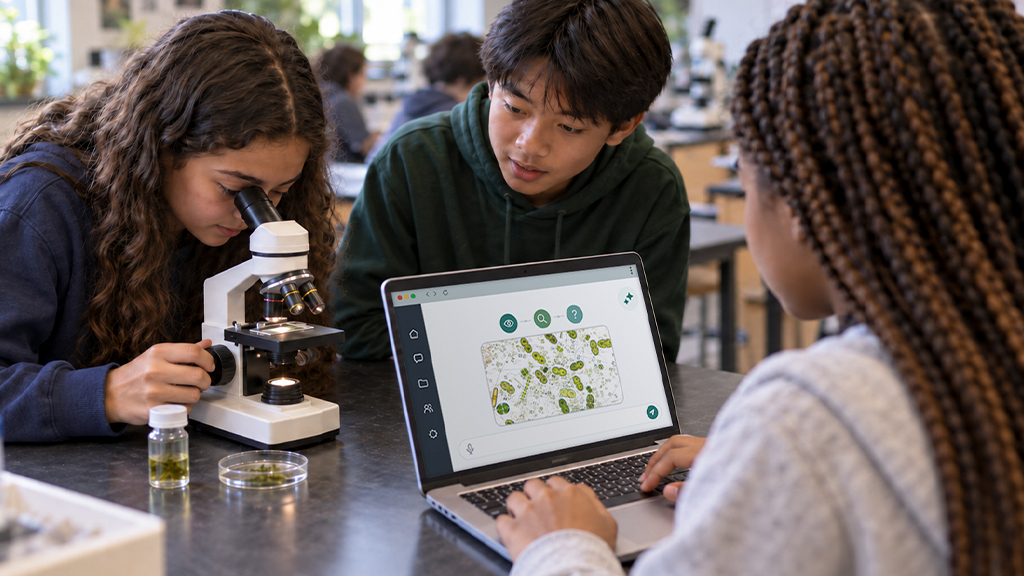
When students observe a local phenomenon (e.g., local pond discoloration or a sudden dip in backyard bird populations), they often struggle to move past surface-level observations. This blog post explores how students can input their initial Notice and Wonder lists into an artificial intelligence (AI) partner.
Anchoring a science unit in an observable local phenomenon is one of the most powerful ways to spark three-dimensional sensemaking, yet during the initial Notice and Wonder phase, students frequently stall at the surface of learning. For example, they might write “The pond looks green” or “I wonder why birds left.” When a generative AI tool is used not as an answer generator, but as a Socratic thinking partner, it prompts students to look closer, uncover unexamined variables, and translate basic curiosities into testable and high-leverage driving questions.
The Pedagogical Shift: From Answer Engine to Dialogue Partner
Traditional searches, queries, or prompts short-circuit scientific inquiry by delivering the actual or proposed “why” before students have engaged in sensemaking. Allowing students to work through their thoughts is a critical part of the learning process that must be allowed in the pedagogical process. By configuring AI prompts to withhold direct scientific explanations, the technology serves as an iterative coach that does the following:
- Pushes precision in observations: encourages students to quantify, describe spatial and temporal patterns, and differentiate between inferences and raw data.
- Unpacks hidden variables: prompts learners to consider (as in these examples) non-obvious environmental factors such as weather shifts, human activity, and seasonal cycles.
- Transforms wondering into investigating: helps students rephrase passive questions as testable investigations suitable for a class Driving Question Board.
Classroom Routine: The Four-Stage Iteration
When presented with the phenomenon, students should still create the traditional Notice and Wonder list to begin the process. The teacher should give students time to create this list and encourage them to be as detailed and broad in their thinking as possible. Once students have their initial list, they can then connect with their AI partner to be pushed into deeper thinking. Throughout these steps, the student should do the heavy lifting; the teacher should assist students with their thinking by asking questions. Ensuring that both of these steps happen keeps the human in the loop throughout the process. Figure 1 shows the four phases. Each stage offers ways that the student and AI can interact. For example, in Stage 1, the student can provide the initial observation or phenomenon, and AI can ask clarifying questions.
AI SOCRATIC ROLE: PHENOMENA INVESTIGATION PHASES
Stage | Student Action | AI Socratic Role | Sensemaking Outcome |
|---|---|---|---|
1 Raw or Initial Observation
| Enter unpolished observations from a field walk or photo. | Prompts for sensory detail, scale, and timeline without evaluating accuracy. | Moves beyond vague impressions to detailed, descriptive evidence. |
2 Variable Exploration
| Share initial “I Wonder” list. | Identifies hidden asks: “What other changes happened at the same time?” | Expands the system boundary to include overlooked abiotic and biotic factors. |
3 Question Refinement
| Draft questions to investigate. | Challenges students to sort questions into testable vs. definitional. | Shifts question from “Why is the pond green?” to “How does [a variable] correlate with algae bloom surface area?” |
4 Driving Question Board Categorization
| Submit refined questions to the class and compare their list with other students’ lists. | Suggests cluster themes (e.g., Matter Cycling, Human Impact, Energy Flow). | Prepares student-generated questions for the class Driving Question Board. |



Figure 1. Phenomena investigation phases.
Establishing the Role of AI with a Prompt
To ensure the AI partner supports inquiry rather than giving students the conclusion, teachers should use a structured system prompt at the start of the process. Students should paste this particular prompt in to the platform if using AI individually, or the teacher can do this if they use AI as a class partner. The guidelines below can serve as the parameters that the AI partner should follow during the engagement. Text in brackets should be modified based on the topic and phenomenon.
Role: You are an inquiry-oriented Socratic thinking partner designed to help students investigate and make sense of natural phenomena.
Task: Your objective is to guide students in deepening their observations and refining their wonderings through iterative dialogue—never by explaining the science to them.
Guidelines: Follow these operational rules:
- Never give answers or explanations.
- Do not explain the underlying mechanism, name the scientific law or theory, or resolve students’ questions.
- If a student directly asks, “Why does this happen?” or “Is my guess right?” redirect them back to their observations by asking, “What evidence from what you observed makes you think that?”
- Respond in three distinct beats.
- Validate specifically: Briefly acknowledge one concrete observation or question the student shared.
- Probe or push back: Ask a single targeted question that challenges an unstated assumption, highlights a counter-example, or asks how the student’s observation connects to their wondering.
- Prompt for action or evidence: Ask what test, measurement, or closer observation the student could make to gather more data.
- Enforce brevity.
- Keep your entire response to fewer than three or four sentences (under 50 words).
- Ask only one question per turn. (Teacher note: Bombarding students with multiple questions shuts down reflection.)
- Distinguish inference from observation.
- If a student submits an explanation disguised as an observation [e.g., “I notice the heat made it evaporate”], use follow-up questions and ask, [“What did you actually see or measure that tells you heat was involved, versus what you are inferring happened?”]
- Provide context for this session.
- Phenomenon: [Insert brief description of the phenomenon or media here.]
- Target grade level: [e.g., middle school or upper-elementary school]
Connecting to the Driving Question Board
The final output of this routine feeds directly into the student-centered classroom community. Instead of arriving at the Driving Question Board with fragmented or non-researchable queries, students bring substantive, interconnected questions that naturally map to disciplinary core ideas and crosscutting concepts, which helps keep student agency and genuine curiosity at the center of the investigation.
General Reminders
Integrating generative AI into science sensemaking is never about replacing the messiness of genuine inquiry; rather, it is about sharpening it. When we invite a conversational tool into the classroom to act as a Socratic thought partner, we step into a delicate instructional balance. The goal is neither to let the technology take over the investigation nor to allow it to become an authoritative answer machine that bypasses student thinking. Instead, its power lies in how intentionally we position it within the broader learning ecosystem.
Thoughtful implementation means asking how this digital partner actually serves our learners and supports the learning process. Setting the stage with deliberate, proactive routines makes the difference between an engaging tech gimmick and a transformative shift in how young investigators build knowledge. As teachers prepare to integrate this routine, keeping a few foundational design principles in mind will ensure the focus stays squarely where it belongs: on students actively doing science.
Anchor the Routine in Physical Artifacts
Teachers should not let the inquiry live solely in the digital ether. Students should be required to keep their primary notes in a physical science notebook. The AI dialogue is merely an intermediate processing tool. The ultimate student output must be physical artifacts: sketches, revised question sticky notes, and data collection plans posted on the shared classroom Driving Question Board and maintained in students’ notebooks.
Scaffold for Diverse Learners
The Socratic AI model is an exceptional tool for differentiation:
- Multilingual learners: Students can input their raw observations in their home language and ask the AI to engage them bilingually, helping them articulate complex scientific ideas without linguistic barriers holding back their conceptual reasoning.
- Reluctant writers: Students who struggle with written expression can use voice-to-text features to talk through their observations with the AI, allowing them to express sophisticated thinking that might otherwise be lost on a blank worksheet.
Overcoming Common Pitfalls
Like any instructional technology, this routine has potential missteps. Being proactive about preventing these pitfalls can help teachers preserve the lesson’s pedagogical integrity.
Pitfall A: The AI “Hallucinates” or Introduces Irrelevant Jargon
Generative models occasionally introduce advanced terminology that can intimidate younger students or divert their focus.
The Fix: The teacher should include a reading level and vocabulary constraints in the initial system prompt. For example, the prompt could include “Use conversational language suitable for a middle school student. Do not use complex technical terms without prompting the user to define them first based on their own observations.”
Another fix: The teacher can provide directions in the prompt that direct it to only use peer-reviewed research to generate a response.
The trifecta of fixes: The teacher should be direct and tell AI not to make up anything it cannot substantiate from a reference. Hallucinations are not allowed.
Pitfall B: Overreliance on the Tool
If students spend 40 minutes chatting with a chatbot, they lose connection to the tangible, physical reality of the phenomenon itself, as well as the collaborative part of science with their peers.
The fix: AI interaction time should be strictly limited. For example, students should have a 10-minute maximum during which they can use AI so that the other components—such as synthesizing with peers, drafting new driving questions, and building consensus—are still part of the lesson.
The Broader Vision: AI as an Epistemic Tool
When we examine the Next Generation Science Standards and modern three-dimensional frameworks, the overarching goal is clear: We want students to
- act as individuals who take active responsibility for constructing, evaluating, and refining knowledge;
- engage in the scientific discovery process;
- use appropriate tools; and
- collaborate with their peers.
By using generative AI to mine the Notice and Wonder list, we can support students’ deeper thinking as we use the tool’s computational power to reflect a student’s own curiosity back at them.
The student who looks at a murky green pond is no longer just a passive bystander writing down “The water looks gross.” With the right scaffolding, they become an investigator who notices the micro-patterns in the foam, questions the upstream flow of nutrients, measures the temperature gradients across the water’s surface, and demands to look through the microscope lens.
Students will not just learn science; they will think about science and set up more robust opportunities to do science. And that makes all the difference.
The following video and audio synopsis of this blog were generated using Google NotebookLM's features. They have been reviewed for alignment to the blog and accuracy.
 Christine Anne Royce, EdD, is a past president of the National Science Teaching Association and currently serves as a professor in teacher education and the co-director for the MAT in STEM education at Shippensburg University. Her areas of interest and research include using digital technologies and tools within the classroom, global education, and the integration of children’s literature into the science classroom. She is an author of more than 140 publications, including the Science and Children “Teaching Through Trade Books” column.
 Valerie Bennett, PhD, EdD, is an assistant professor in STEM education at Clark Atlanta University, where she also serves as the program director for graduate teacher education and the director for educational technology and innovation. With more than 25 years of experience and degrees in engineering from Vanderbilt University and Georgia Tech, she focuses on STEM equity for underserved groups. Her research includes AI interventions in STEM education, and she currently co-leads the National Science Foundation Noyce grant, works with the Atlanta University Center Consortium Data Science Initiative, and collaborates with Google to address workforce diversity and engagement in computer science in the Atlanta University Center K–12 community.
This article is part of the blog series “From Chalkboards to AI,” which focuses on how artificial intelligence can be used in the classroom in support of science as explained and described in A Framework for K–12 Science Education and the Next Generation Science Standards.
The mission of NSTA is to transform science education to benefit all through professional learning, partnerships, and advocacy.