

 Join
JoinAll Resources
Journal Article
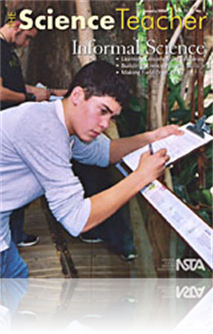
Idea Bank: A Sense of Place--GPS and the Biology Field Trip
In this month's Idea Bank column, a high school biology teacher describes an inquiry-based, high-tech scavenger hunt based on a hybrid form of geocaching that he developed called "BioCache," where students explore the wonders of nature and biology us...
Journal Article
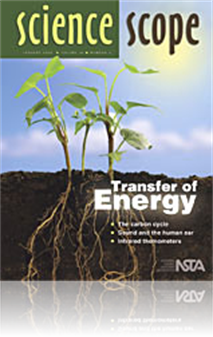
Science Sampler: Developing the scientist in your students
Develop the budding scientist within your students by weaving this hands-on, exciting project into your science curriculum. This inquiry-based project allows students to design, carry out, annalyze, and communicate their findings to their peers while...
Book Chapter
Building on the Natural Wonder Inherent in Us All
The Gladbrook-Reinbeck School District is located in Iowa, a state of just over three million people. The rich farmland that surrounds the district produces corn, beans, cattle, swine, and proud hardworking people. Naturally, many of the businesses ...
Book Chapter
Teaching Science With Student Thinking in Mind
This chapter describes the Discover Lab Concept (DLC), a project that began in a teaching/learning laboratory at Stony Brook University, and today is a foundation of science instruction in classrooms on Long Island and regions beyond. The chapter des...
Book Chapter
Unlocking the National Science Education Standards With IMaST
The National Science Foundation funded the IMaST project for three consecutive developmental cycles to design an integrated middle school curriculum. As a developmental research project, the IMaST developed 16 standards-based curriculum modules that ...
Book Chapter
Achieving a Vision of Inquiry: Rigorous, Engaging Curriculum and Instruction
The changing emphases of the National Science Education Standards (NSES) have spurred many school districts to reinvent their science programs. New curricula development by National Science Foundation-funded programs have been at the core of some dis...
Book Chapter
Adapting the JASON Project: Real Science, Real Time, Real Learning
The JASON Project is a multidisciplinary curriculum involving real science studies and comparing them to local studies performed by students. The Plymouth Public School System, located on the south shore of Massachusetts, adopted the JASON Project as...
Book Chapter
"Re-Inventing" Science Instruction: Inquiry-Based Instruction in a Fifth/Sixth-Grade Classroom
The author's purpose in sharing her experiences in this monograph is to help other teachers who may be less confident in teaching science than they are teaching other subjects, to help them see the value in what the Standards envision for students, a...
Book Chapter
What Do We Get to Do Today? The Middle School Full Option Science System Program
This chapter presents the Full Option Science System (FOSS) and the features that address the four National Science Education Standards (NSES). With FOSS curriculum students are introduced to content through exploration of and asking questions about ...
Book Chapter
ARIES: Science as Discovery . . . and Discovery as Science!
This chapter presents Project ARIES, developed at the Harvard-Smithsonian Center for Astrophysics and funded by the National Science Foundation, with additional support from Harvard University and the Smithsonian Institution. ARIES is a modular, astr...
Book Chapter
The 15 previous stories give evidence of the Standards' impact, along with important examples for others for improvements they might consider if they want to move in directions like those advanced by the persons involved in preparing the Standards. A...
Book Chapter
In light of the increasing emphasis placed on the importance of teachers and their actions and the reality that we have an inadequate pool of qualified science and mathematics teachers to meet our needs, many reform efforts and funding initiatives fo...
Book Chapter
Teaching Science With Pictures
The state of Texas is divided into 20 Regional Education Service Centers (ESC). Schools located in three of the independent school districts of the largest region—Region IV ESC—were selected as pilot sites for a program designed to increase stude...
Book Chapter
Finding Out What...and How They Know
The setting for this chapter is Hawkins Middle School located in a small rural city, the county seat of one of the poorest counties in Wisconsin. In this project students engaged in a learning experience that was integrated across subject areas and f...
Book Chapter
The reader may question how the "Teach them to fish" proverb relates to science education. Yet, a shift in emphasis from presenting knowledge through lecture and demonstration to encouraging active learning, in which students learn with understanding...
Book Chapter
Creating a Classroom Culture of Scientific Practices
Scientific practices are the activities that scientists engage in as they investigate the natural world. These daily practices include asking questions, designing investigations, finding, incorporating, and using information, collecting and organizin...
Book Chapter
More Emphasis on Scientific Explanation: Developing Conceptual Understanding and Science Literacy
This chapter describes a process for engaging middle school students in writing scientific explanations in the context of project-based science. In four Detroit classrooms, teachers enacted strategies for explanation writing that aimed to help studen...
Book Chapter
Traveling the Inquiry Continuum: Learning Through Teacher Action Research
This chapter addresses the More Emphasis on Teaching and the Content and Inquiry Standards from the National Science Education Standards (NSES). Using the knowledge gained through the Community of Excellence in Mathematics and Science (CEMS) program,...
Book Chapter
Modeling: Naturally Selecting an Effective Teaching Method
This chapter examines middle school level curriculum for evolution which incorporates many aspects of the More Emphasis conditions from the National Science Education Standards (NSES). Taking into account that in order to teach evolution successfully...
Book Chapter
Teaching English Through Science and Science Through English
What better way to learn English than through the study of science, and what better way to learn about science than experiencing it through language and literacy in and out of the classroom. Sutman, Allen, and Shoemaker (1986) observed in Learning E...
Book Chapter
Perspectives on Teaching and Integrating English as a Second Language and Science
In the chapter, the authors briefly review the evolution of ESL instruction and science education. They discuss current promising practices that integrate ESL, literacy, and science. Finally, they highlight innovative programs in schools that offer i...
Book Chapter
Learners, Programs, and Teaching Practices
The changing demographics of the United States and recent focus on educational standards have made it increasingly critical to address the needs of the many linguistically and culturally diverse students in our schools. Schools throughout the United ...
Book Chapter
Planning Science and English Instruction: One Teacher's Experience
The authors of this chapter describe how to incorporate science, language arts, and ESL standards into the classroom. They offer practical suggestions on how to plan, organize, and implement activities based upon standards, teaching and learning stra...
Book Chapter
Strategies for Teaching Science to English Learners
Teachers who teach science play a key role with English language learners (ELLs). In this chapter, the authors discuss strategies teachers can use to help English language learners learn science while improving their speaking, listening, reading, an...
Book Chapter
Strategies for Assessing Science and Language Learning
In this chapter, the authors give an overview of principles for assessing language learners in science. They describe how to plan assessment, how to use it in the classroom, and how to provide feedback and improve learning, ...
Book Chapter
Science Beyond Classroom Walls: Fairs, Family Nights, Museums, and the Internet
A field trip is only one example of how valuable connections between formal and informal education settings are for the teaching and learning of science. In this chapter, the authors provide ideas on expanding learning beyond the classroom. They desc...
Book Chapter
Designing Lessons: Inquiry Approach to Science Using the SIOP Model
Using the Sheltered Instructional Operation Protocol (SIOP) Model, the authors in this chapter discuss science inquiry, the SIOP Model, and how to blend the two for good science instruction. They finish the chapter with a conversation between a scien...
Book Chapter
Lessons That Work: Science Lessons for English Learners
In this chapter, the authors present formats for science lesson plans that incorporate inquiry and language and science objectives. Teachers from elementary, middle, and secondary levels describe successful lessons and discuss the benefits of these l...
Book Chapter
Standards for Science and English Language Proficiency
In this chapter, the authors describe the development of the National Science Education Standards (NSES) and English language proficiency standards. They then discuss new language proficiency standards that integrate science and other content area st...
Book Chapter
The Impact of Technology on the 21st Century Classroom
This chapter explores how educational technology has changed and will continue to change the ways that teachers teach and students learn in classrooms of the 21st century. The chapter begins with a description of how students can learn from computers...
Book Chapter
Leadership in Science Education for the 21st Century
In the early decades of the 21st century, science educators face some problems unique to the times and some common to all eras. Some of the issues will be with us for the relative brief time of political administrations, and some trends have a longer...
Book Chapter
The Principal as Leader of Change
As long as the job of principal remains as complex and undoable as it is currently, and as long as either teaching faculties or local school boards pressure an innovative principal until that principal chooses to leave, true innovation will be an uph...
Book Chapter
Keeping Good Science Teachers: What Science Leaders Can Do
Only when teachers have had the kind of training and experience that makes them successful with students can schools become and remain effective. Creating the conditions to retain strong teachers preserves this essential human capital; hiring, traini...
Book Chapter
Understanding Supply and Demand Among Mathematics and Science Teachers
Concern over school staffing problems has given impetus to empirical research on teacher shortages and turnover. As a result, the National Center for Education Statistics (NCES), the statistical arm of the U.S. Department of Education, designed the S...
Book Chapter
The Importance of Partnerships in Science Education Reform
In this chapter, the authors make the case for the importance of partnerships for science education reform. Building and nurturing appropriate partners for tasks large and small helps to overcome formidable barriers. Good partnerships can shorten the...
Book Chapter
Developing Professional Learning Communities
Adlai E. Stevenson High School (AESHS) is a suburban school in Illinois that has been consistently cited in educational literature as an exemplary professional learning community (DuFour et al. 2004; Richardson 2004; Schmoker 2001). How did this happ...
Book Chapter
No Child Left Behind: Implications for Science Education
The No Child Left Behind Act of 2001 (NCLB 2002) acknowledges and supports the need for partnership and collaboration among the many stakeholder groups to increase learning for all students—especially students in poverty who have traditionally fare...
Book Chapter
Alternative Certification: Aspirations and Realities
Although the number of alternative programs is ever increasing, shortages in the number of qualified science teachers continue. These programs have not solved the teacher shortage problem alone, but they should not bear full responsibility. Numerous ...
Book Chapter
Brain Research: Implications for Teaching and Learning
As knowledge of many aspects of the brain has exploded over the past few decades, there has been a strong desire to link the study of the brain, i.e., neuroscience, with education, the applied learning endeavor of students. This interest accelerated ...
Book Chapter
How Do Students Learn Science?
As we search for ways to improve classroom science experiences for students, we repeat the same question over and over: “How do students learn science?” In one sense, how students learn science falls within the realm of cognitive neuroscience. Pe...