


 Join
JoinA New Dawn on the Lunar Horizon: #WeAreGoing
By Christine Anne Royce, EdD
Posted on 2026-04-02
Disclaimer: The views expressed in this blog post are those of the author(s) and do not necessarily reflect the official position of the National Science Teaching Association (NSTA).
For over five decades, the Moon has been a silent monument to "what we once did." We’ve seen the grainy, flickering footage of the Apollo era, a black-and-white memory of a generation that proved the impossible was possible. But for today’s students, the Artemis Generation, the Moon is no longer a museum. It is a destination.
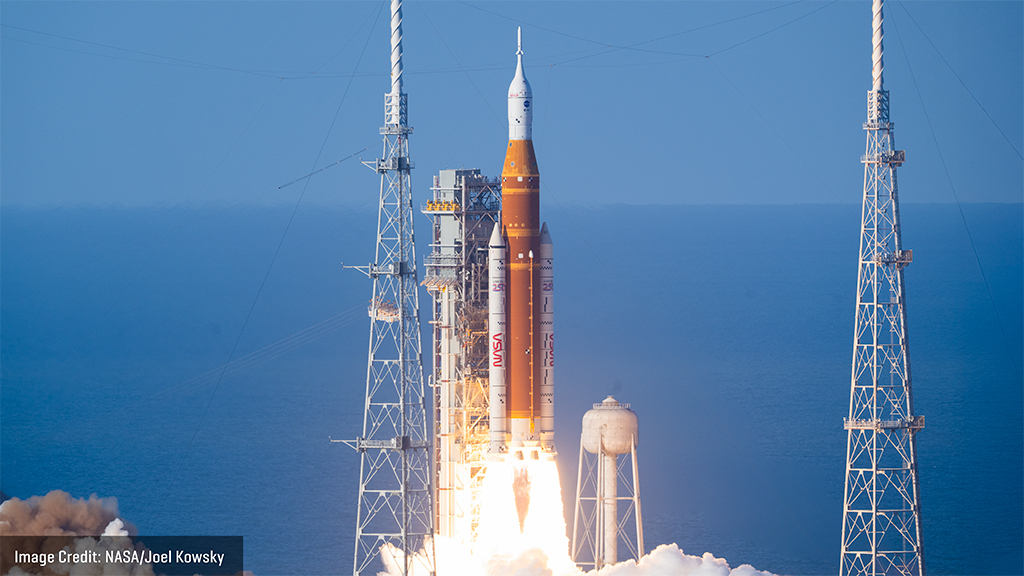
Yesterday, the Space Launch System (SLS) engines ignited, lift off occurred, and Artemis II is now headed to the moon. It carries more than just the Orion capsule. It carries the first four humans to venture into the deep-space proving ground in a half century.
When Mission Commander Reid Wiseman, Pilot Victor Glover, and Mission Specialists Christina Koch and Jeremy Hansen peer through the hatch window around day six—nearly 6,000 miles beyond the Moon’s far side—they will witness a sight no human has seen since 1972: Earth rising above a stark, cratered horizon, a fragile blue marble suspended in the vast, velvet darkness of space. This ten-day mission has many checkpoints. Check out the timeline associated with the Artemis II mission.
Artemis II isn’t just a return to the moon; this mission is our bridge to future space exploration. It is the moment we test the limits of our life support, the strength of our heat shields, and the grit of our spirit. We aren't just visiting; we are practicing to stay. We are learning how to live on another world so that one day, we can walk on Mars.
Artemis II is the heartbeat of a new era. It’s the story of a global community coming together to solve the hardest problems imaginable, proving that when we look up at the Moon, we aren't just looking at a rock in the sky: we’re looking at our next front porch.
Looking for resources to create those teachable moments over the next ten days? Check out these NSTA resources paired with NASA resources.
Early Childhood/Elementary
Moon, Math, and Literacy: Interdisciplinary connections through a space science study in preschool: This interdisciplinary preschool activity integrates science, math, and literacy by having students investigate the Moon’s surface through hands-on "Moon sand" crater experiments, vocabulary building, and observational journaling. Make connections to what the Artemis II crew will see on their flyby of the lunar surface.
Middle School
Keep Space Scurvy Away with Ascorbic Acid a Day: This is a global citizen science project for middle school students that combines chemistry and life science to investigate the vitamin C content of various fruit juices. Connect this to the different types of food that the astronauts will be eating during their mission.
High School
Aha! Moments in Sun and Moon Measurements: This high school physics lesson uses historical methods from Eratosthenes and Aristarchus to help students calculate the scale and distance of celestial bodies, demonstrating that 110 Moons could fit between the Earth and the Moon, a spatial realization that highlights the vast journey the Artemis II crew will undertake as they venture 6,000 miles beyond the lunar far side. The Artemis II path is available in this infographic.
Looking for some additional activities to help build the excitement? Engage students in a lesson on selecting the moon crew, which focuses on teamwork.
And speaking of teamwork, NSTA thanks all educators for all they do to help students reach for the stars!

Christine Anne Royce, Ed.D., is a past president of the National Science Teaching Association and currently serves as a Professor in Teacher Education and the Co-Director for the MAT in STEM Education at Shippensburg University. Her areas of interest and research include utilizing digital technologies and tools within the classroom, global education, and the integration of children's literature into the science classroom. She is an author of more than 140 publications, including the Science and Children Teaching Through Trade Books column.
The mission of NSTA is to transform science education to benefit all through professional learning, partnerships, and advocacy.