


 Join
All Resources

Journal Article
Career of the Month: Nutritional Biochemist
This column shares interviews with professionals using science in the workplace. This month’s issue talks about being a nutritional biochemist....
Journal Article
This article discusses the Mayo Innovation Scholars Program, which introduces undergraduates to technology transfer in biomedical sciences by having teams of students from multiple disciplines analyze inventions in development at the Mayo Clinic....

Journal Article
Science Circus: Preparing Students and Engaging the Scientific Community
Demonstrate the interconnectedness of Earth, life, and physical science using community-based exhibits....
Journal Article
Guest Editorial: MOOCs in Your Future
Guest editor Lester Paldy talks about massive open online courses....

Journal Article
An interdisciplinary project-based unit for fifth and sixth graders allows students to learn about solid waste management, actively construct their ideas, and collaboratively engage in tasks that emphasize the connection of science and mathematical k...
Journal Article
Editor's Note: It's Electrifying!
Science and Children’s editor shares thoughts regarding the current issue....
Journal Article
A color-sorting activity in which students collect data and articulate scientific explanations....
Journal Article
Kindergarteners discover bats through using models of different types of bats....
Journal Article
A Look at the <i>Next Generation Science Standards<i/>
This article and the accompanying diagram provide an overview on the architecture of the Next Generation Science Standards....
Journal Article
Health Wise: Unplug to Power Up
This Q&A style column provides up-to-date information on current health topics—helping students (and teachers) make healthy choices. This month’s issue discusses National Screen-Free Week....
Journal Article
This article describes an inquiry-based lesson to deepen preservice teachers' understanding of the spherical Earth model using the Global Positioning System....
Journal Article
This article reports outcomes that individuals experienced through participation in International Polar Year—Research and Educational Opportunities in Antarctica for Minorities as related to their career and educational aspirations....
Journal Article
Using Social Networking Sites to Facilitate Teaching and Learning in the Science Classroom
Connect students to information and each other as they learn how to access, retrieve, process, and communicate information....
Journal Article
The <i>Next Generation Science Standards</i>: A Focus on Physical Science
This article focuses on the NGSS disciplinary core ideas in physical science, the development of those ideas across time, the importance of blending core ideas with scientific and engineering practices to build understanding, and the development of p...
Journal Article
Field-Trip Pedagogy for Teaching "Sense of Place" in Middle School
Head outdoors to explore local geology, ecology, and the interactions between humans and the environment....
Journal Article
The community college transfer pathway is vital for students pursuing 4-year degrees in science, technology, engineering and math fields today. The study discussed in this article focused on the important role of advising by examining the ways in whi...
eBook
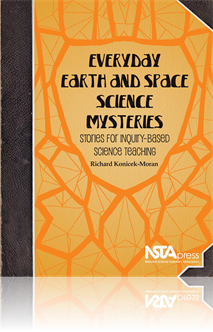
Everyday Earth and Space Science Mysteries: Stories for Inquiry-Based Science Teaching (e-book)
What are the odds that a meteor will hit your house? Do you actually get more sunlight from Daylight Saving Time? Where do puddles go? By presenting everyday mysteries like these, this book will motivate your students to carry out hands-on science in...
eBook
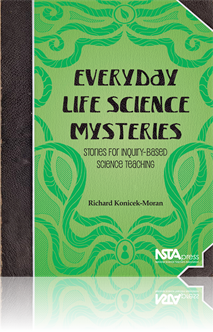
Everyday Life Science Mysteries: Stories for Inquiry-Based Science Teaching (e-book)
How do tiny bugs get into oatmeal? What makes children look like—or different from—their parents? Where do rotten apples go after they fall off the tree? By presenting everyday mysteries like these, this book will motivate your students to carry ...
eBook
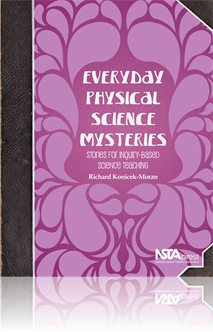
Everyday Physical Science Mysteries: Stories for Inquiry-Based Science Teaching (e-book)
What can make a ball roll faster? Does the temperature of wood affect the heat of a fire? How can old-fashioned tin can telephones teach today’s students about sound and technology? By presenting everyday mysteries like these, this book will motiva...
NSTA Press Book
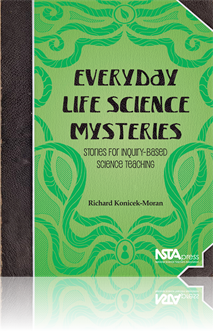
Everyday Life Science Mysteries: Stories for Inquiry-Based Science Teaching
How do tiny bugs get into oatmeal? What makes children look like—or different from—their parents? Where do rotten apples go after they fall off the tree? By presenting everyday mysteries like these, this book will motivate your students to carry ...
By Richard Konicek-Moran
NSTA Press Book
Everyday Earth and Space Science Mysteries: Stories for Inquiry-Based Science Teaching
What are the odds that a meteor will hit your house? Do you actually get more sunlight from Daylight Saving Time? Where do puddles go? By presenting everyday mysteries like these, this book will motivate your students to carry out hands-on science in...
By Richard Konicek-Moran
Book Chapter
The story in this chapter tries to set the stage for discussions and inquiry into the nature of temperature and heat and to the fact that heat exchange is the cause of what scientists call a phase change—when something goes from liquid to solid or ...
Book Chapter
In this chapter, this story really leaves us hanging! It’s a great one for real investigation! There are two purposes of the story: the first is to investigate closed systems. Anything that happens inside uses up only the materials in the jar, beca...
Book Chapter
The incident described in this story actually happened to the author during a camping trip in Everglades National Park years ago. The humidity was fierce but the air cooled down and overnight he awoke to a wet face and wet pillow. This story is des...
Book Chapter
This story is aimed at promoting not only inquiry into the germination of tree seeds but seeing trees as typical flowering plants, also known as angiosperms. There is also ample opportunity to take an excursion into fruits and seeds and the germinati...
Book Chapter
Trees From Helicopters, Continued
Maples are very interesting trees with lots of variation in form. They provide a view of diversity in plants as well as a chance to look at natural phenomena that is very common to anyone who has had a maple tree near them. The main purpose of this s...
Book Chapter
Flowers: More Than Just Pretty
Children love to look at flowers but few are inclined to become familiar with the structure and function of the flower. This story is aimed at providing some motivation for children to learn about one of the most important evolutionary developments i...
Book Chapter
Children as well as adults are usually intrigued by the ideas of bargains. More seeds for less money is often enough to convince them to buy a larger, cheaper package. In this case, the children are savvy enough to question the value of either packag...
Book Chapter
Children and adults alike are prone to believe that if a little of something is good, more is better. In the case of this story, your students will probably believe that if fertilizer is good for growing plants, it must be good for germinating seeds....
Book Chapter
Water makes up a very high percentage of all living things. This story is aimed at providing children with the opportunity to measure the surprising amount of water found in fruit. It also provides an opportunity for the teacher to emphasize the impo...
Book Chapter
What happens when seeds are soaked in water, you may find that your students cannot perceive of seeds absorbing so much water, for they may equate the seeds with how a sponge soaks up water. The story in this chapter offers students an opportunity to...
Book Chapter
Students are usually aware that seed plants have adapted to overcrowding by developing mechanisms that disperse their seeds to other locations. In this chapter, the story explores one of the important characteristics of plant evolution, the wide dist...
Book Chapter
Students may well have the usual “bigger is better” conception about comparing different items. Pumpkins are the perfect object to help engage students in investigative science and answer most of their questions by direct observation....
Book Chapter
Children may not be aware of what is exactly happening when they have their pulse taken by a doctor or nurse or even why it is important. The story in this chapter is aimed at helping children discover what kinds of activities change their heart rate...
Book Chapter
Most students are totally unaware of the amount of sugar in bubble gum and don’t know that they are literally eating sugar in huge amounts. In this chapter, the author is concerned with finding out what happens to the weight of gum when it is chewe...
Book Chapter
Just what kinds of characteristics do living things receive from their parents and what kinds of traits do they not? What makes the offspring of any animal or plant have the basic characteristics of the parents? There happen to be a great number of h...
Book Chapter
Hardly a day goes by without something arriving by e-mail or being posted on the internet that just doesn’t sound true. The students in this story are depicted as having alert skepticism about things that don’t actually add up in their minds and ...
Book Chapter
Students may have the impression that all kinds of reaction time responses can be improved through practice. They may believe also that every kind of stimulus produces the same kind of reaction time. The story, in the chapter, provides the opportun...