


 Join
JoinAll Resources
eBook
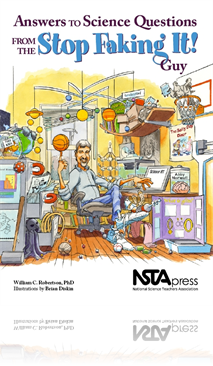
Answers to Science Questions From the <em>Stop Faking It!</em> Guy (e-book)
This valuable and entertaining compendium of Bill Robertson’s popular “Science 101” columns, from NSTA member journal Science and Children, proves you don’t have to be a science geek to understand basic scientific concepts. The author of the ...
eBook
Lecture-Free Teaching: A Learning Partnership Between Science Educators and Their Students (e-book)
Lecture-Free Teaching: A Learning Partnership Between Science Educators and Their Students provides readers with an innovative alternative to routine lecturing. With the Lecture-Free Teaching method, teachers build “learning partnerships” with th...
Journal Article
Hurricane Katrina: A Teachable Moment
This article presents suggestions for integrating the phenomenon of hurricanes into the teaching of high school fluid mechanics. Students come to understand core science concepts in the context of their impact upon both the environment and human popu...
Journal Article
Methods and Strategies: Literacy in the Learning Cycle
Trade books can be used in all phases of the learning cycle to support effective teaching and learning. Romance and Vitale (1992) found that texts and other nonfiction science books can be effective tools for teaching reading, as the science activiti...
Journal Article
Idea Bank: Earth Systems in Silence
The “Earth Systems in Silence” activity is designed to help high school students make personal connections to the people and the science involved in natural disasters. It is used as a culminating project in a semester-long required course, open t...
Journal Article
Contrary to what we often hear and teach, there is good news to be found on the environmental front. Environmental success stories show us not only that sustainability is possible, but also how people have made it happen. We can make these stories an...
Journal Article
Providing opportunities for students to grapple with collecting and organizing data, struggle with how to represent and communicate ideas emerging from the data, and consider the alignment of these ideas with the science content being learned is refl...

Journal Article
Tried and True: Inquiry-based dissolving
This project highlights a dissolving unit that was part of an eighth-grade, semester-long investigation into matter. During the dissolving unit, students explored the concepts of mixture, solution, dissolving, saturation, and conservation of mass. Di...
Journal Article
Natural Resources: For the Birds
More than ticking off a checklist (though that is fun, too), birding fosters an appreciation for nature. The following citizen science opportunities connect children to the scientific community. The websites listed here include tips on feeding and ob...
Journal Article
Science Sampler: The Element Walk
“The Element Walk” lesson is effective at teaching students the elements that exist in common substances encountered every day. Students walk away from the lesson with a set of general rules that help them to easily identify the elements around t...
Journal Article
Watching the Pot to Improve Inquiry Skills
The International Boiling Point Project is an online, collaborative project for students in grades 6–12 in which they investigate the impact of four factors (room temperature, elevation, volume of water and heating device) on the boiling point of w...
Journal Article
Safer Science: Chemical Storage
Using chemicals safely requires a number of things, including current inventory control, appropriate labeling and storage segregation, ongoing inspections, and more. How can a science teacher find the appropriate storage information? Read on. This mo...
Journal Article
No More Leaks: A Process-Oriented Lesson Exploring the Invention and Chemistry of Disposable Diapers
High school chemistry can be intimidating to some students, so it is critical that we engage students in nonthreatening preparatory investigations during middle school. Based on the learning cycle model (Bybee and Landes 1990), this lesson invites st...
Journal Article
The Early Years: Safe Smelling
Using the sense of smell, animals find food or a mate and detect the presence of predators; their survival depends on this. In a discussion on using our sense of smell to keep use safe, some children may relate experiences of smelling something burni...
Journal Article
In a unique school—university partnership, methods students collaborated with fifth graders to use the engineering design process to build their problem-solving skills. By placing the problem in the context of a client having particular needs, the ...
Journal Article
Teaching through Trade Books: Secrets of Flight
The date was December 17, 1903. The place was a windswept beach near Kitty hawk, North Carolina. With Orville Wright at the controls and his brother Wilbur running alongside, the plane took off. This event lasted only 12 seconds, but it made history ...
Journal Article
Editor’s Note: Creating Problem Solvers
You’ll see that even young children are able to raise questions about the world around them and are willing to seek answers while making careful observations. Although there is no prescription for how to problem solve, the author provides some sugg...
Journal Article
Today’s Authors, Tomorrow’s Scientists
Although not all teachers can invite scientists into classrooms on a regular basis, they can invite them into their students’ worlds through literature. Here the author shares how she used the nonfiction selection, Science to the Rescue (Markle 199...
Journal Article
Commentary: Why Societal Issues Belong in Science Class
Young people face a future filled with important issues that should be informed by science—such as climate change, genetic manipulation, and the management of pandemics. To meet these challenges, students need an understanding of scientific concept...
Journal Article
Scope on Safety: Science storage requirements
Middle school science teachers need to address two issues concerning storage. First, if it is insufficient, they need to work with administrators to secure additional storage area(s). Second, whether sufficient or not, good housekeeping practices are...