


 Join
JoinAll Resources
Book Chapter
Burdock and Velcro: Mother Nature Knows Best
In this chapter’s activity, Velcro is explored as an example of a human-engineered invention that was a “copycat” inspired by a naturally evolved, “bio-engineered” seed distribution innovation....

Book Chapter
Book Chapter
Greenhouses are made almost completely of glass for two reasons. First, glass allows the maximum amount of sunlight into the building. Plants need the sunlight for photosynthesis. Second, glass prevents heat produced in the greenhouse from escaping....
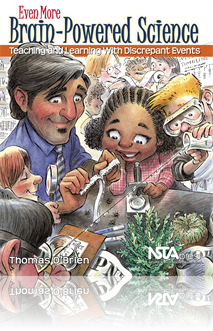
NSTA Press Book
Even More Brain-Powered Science: Teaching and Learning With Discrepant Events
• How can water and a penny demonstrate the power of mathematics and molecular theory? • Do spelling and punctuation really matter to the human brain? ...
By Thomas O'Brien

Journal Article
Promote better eating habits by examining the role of plants in students' diets. Students learn about biodiversity, monocultural agriculture, dangers to the food supply, and the potential power and safety of biodiverse food systems....

Journal Article
Earth's Most Important Producers: Meet the Phytoplankton!
Students learn about single-celled, plantlike organisms called phytoplankton, which are the base of nearly all marine food webs. During the lesson students construct and use a phytoplankton net and create a phytoplankton bloom in the classroom....
Journal Article
The Green Room: What's in Your Trash?
Each year, Americans generate 250 million tons of waste, recycle or compost about 33% of it, and dispose of most of the rest in landfills (EPA 2009). Though recycling has increased in the United States since 1980, waste generation has increased along...
Journal Article
Guest Editorial: What a copper-plated nail taught me about sharing research results
Linda Shore relives the first time she shared the results of a science experiment....
Journal Article
From Misconceptions to Conceptual Change
We all have misconceptions about the world in which we live—how it works, how we interact with it, how it changes, and the reasons behind those changes. These misunderstandings are personal notions we create to make meaning of our surroundings. Oft...
Journal Article
Scope on the Skies: A Planetpalooza
This column focuses on astronomy throughout the year. This month’s column discusses planet viewing and space flights....
Journal Article
The Early Years: Sharing Research Results
Students collect data about the qualities of various play doughs. ...
Journal Article
Science 101: How does a lever work?
Two approaches to how a lever works: one dealing with torque, one dealing with energy....
Journal Article
PD Pathways: Have a Kids Inquiry Conference
Encourage students to develop their own inquiry projects, carry them out using an inquiry-based model, and prepare for a public sharing event....
Journal Article
Editor's Roundtable: Words to Grow On
Science Scope’s editor shares thoughts regarding the current issue....
Journal Article
Guest Editorial: Biodiversity and the Future of Food
The author discusses biodiversity and the future of food....