


 Join
JoinAll Resources

Journal Article
Native American and other cultural stories provide students with a broader perspective on the world. In addition, cultural stories connect science content and knowledge about the world to cultural interpretations and people’s life ways. By implemen...
Journal Article
A prop box is a teacher-created resource full of age-appropriate and meaningful activities focused on a central theme. Prop boxes work much like learning centers in an elementary classroom with the important addition of providing opportunities for so...
Journal Article
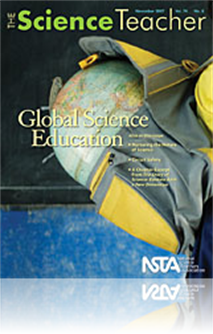
The study of electricity in general science or physics is fascinating for students. Unfortunately, a number of electrical dangers exist in the laboratory that are applicable to all types of science including biology, chemistry, physics, and Earth sci...

Journal Article
Inquiring Into The Digestive System
Teaching science by means of inquiry-based projects has the potential to transform the science lab into a place of debate and discovery, but teachers run the risk of either leaving students to work too independently or forcing them to be too dependen...
Journal Article
Design briefs are plausible situations in which students are asked to solve problems given limited materials, a specific time frame, and a number of rules and limitations. It is the author’s contention that the design brief, an established format i...
Journal Article
Science Shorts: Taking a Look at the Moon
The communication skills of reading and writing go hand in hand with science as natural partners for fostering students’ understandings of the world. The similarities that exist between reading and writing strategies and science-process skills add ...
Journal Article
In this month’s column, the experts address the following questions: If you are in a car traveling at the speed of light, what would you observe if you turned on the headlights? and Given that absolute zero is the lower limit to temperature, a theo...
Journal Article
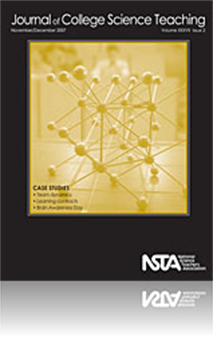
This set of botany demonstrations is a continuation of the inquiry-based lecture activities that provide realistic connections to the history and nature of science and employ technology in data collection (see the September/October issue of JCST fo...
Journal Article
In his article, Dale had constructed a tiered triangle to rank students’ ability to recall information that had been taught six weeks earlier (Dale 1969). Dale had found that only 5% of the knowledge gained through lecture was remembered by student...
NSTA Press Book
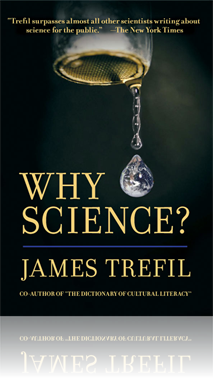
Prize-winning scientist and bestselling author James Trefil contends that in order to participate fully in the democratic process, people must understand fundamental scientific concepts. In Why Science? Trefil details the concepts needed in order to ...
By James Trefil