


 Join
All Assessment resources
Journal Article
Exploring the Role of Student Seating Preference and Performance in a Large Introductory STEM Course
Most introductory courses are held in large lecture halls, with students typically sitting in either the front, middle, or back of the classroom. In a mixed-methods study of student attendance, performance, and seat choice, we found that students who...
By Chloe Wasendorf, Audrey McCombs, and Nancy Boury
Journal Article
Issues of Question Equivalence in Online Exam Pools
During the pandemic, the use of question pools for online testing was recommended to mitigate cheating, exposing multitudes of science, technology, engineering, and mathematics (STEM) students across the globe to this practice. Yet instructors may be...
By Cody Goolsby-Cole, Sarah M. Bass, Liz Stanwyck, Sarah Leupen, Tara S. Carpenter, and Linda C. Hodges
NSTA Press Book
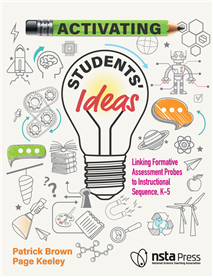
Activating Students' Ideas: Linking Formative Assessment Probes to Instructional Sequence, K-5
Science teachers face an incredible challenging task of combining research on how students learn best, the three dimensions of the Science Education Frameworks that in themselves are complicated to understand, and instructional sequences that lead to...
By Patrick Brown, Page Keeley
Journal Article
The (Trans)Formative Assessment Planning Template
By Caitlin Gailey McClearyCale Fine, Haeyoung Littich, and Maren Getz
Lesson Plan
The purpose of this assessment probe is to elicit students’ ideas about eclipses. The probe is designed to find out what students think happens during a solar eclipse. ...
By Page Keeley
Lesson Plan
The purpose of this assessment probe is to elicit students’ ideas about eclipses. The probe is designed to find out what students think causes a lunar eclipse. ...
By Page Keeley
Lesson Plan
The purpose of this assessment probe is to elicit students’ ideas about light and the Moon. The probe is designed to find out what students think is the source of a full Moon’s light. ...
By Page Keeley
Lesson Plan
The purpose of this assessment probe is to elicit students’ ideas about an important fossil fuel used by humans. The probe is designed to reveal how students trace oil back to its original source of material. ...
By Page Keeley
Lesson Plan
The purpose of this assessment probe is to elicit students’ ideas about global warming. The probe is designed to find out what students think contributes to global warming. ...
By Page Keeley
Lesson Plan
The purpose of this assessment probe is to elicit students’ ideas about the effect of solar radiation on Earth’s temperature. The probe is designed to find out whether students realize the Earth continues to cool after sundown and up to sunrise u...
By Page Keeley
Lesson Plan
The purpose of this assessment probe is to elicit students’ ideas about the digestive system. The probe is designed to find out whether students realize a main function of the digestive system is to break food down into molecules that can be used b...
By Page Keeley
Lesson Plan
The purpose of this assessment probe is to elicit students’ ideas about biological adaptation. The probe is designed to find out if students think animals intentionally adapt to a change in their environment. ...
By Page Keeley
Lesson Plan
The purpose of this assessment probe is to elicit students’ ideas about food, transformation of matter, growth and development, conservation of mass, and systems. The concepts underlying this probe are complex. It is not important that students kno...
By Page Keeley
Lesson Plan
The purpose of this assessment probe is to elicit students’ ideas about magnetism. The probe is specifically designed to determine whether students believe air is necessary for magnets to work. ...
By Page Keeley