


 Join
JoinAll Learning Progression resources
Journal Article
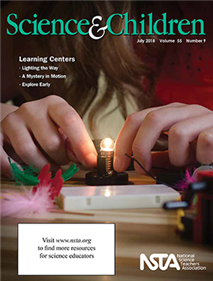
Support scientific development among young children with learning centers....
Journal Article
Science 101: How Do We Best Teach and Learn Science Concepts?
This column provides background science information for elementary teachers. In this issue the author discusses the method he uses to explain a science concept or concepts....

Blog Post
Global Thinking Inside and Outside the Classroom
Dynamic Equilibrium. These two words represent what is essential in teaching Earth science: the idea that forces are constantly working against one another, but often do so in ways that nearly counteract one another....
By Cindy Workosky
NSTA Press Book
Preparing Teachers for Three-Dimensional Instruction
It’s not enough for teachers to read through the Next Generation Science Standards (NGSS) and correlate their content to the established curriculum. Teachers must prepare to make the vision of the NGSS come alive in their classrooms. Editor Jack Rh...
Blog Post
Seeds of Science, Roots of Reading Program Helps Students Develop Explanations
The Next Generation Science Standards (NGSS) encourage three-dimensional thinking in students. 3-D thinking, and the process of developing scientific explanations, are curiosity-driven: They involve wondering, posing questions, and making observation...
By Jim McDonald

Journal Article
Formative Assessment Probes: Uncovering Students’ Ideas About Inherited Traits
This column focuses on promoting learning through assessment. This month’s issue discusses the “Baby Mice” probe, which is designed for middle and high school students, but it can be used with grades 3–5 to elicit students’ initial ideas ab...
Journal Article
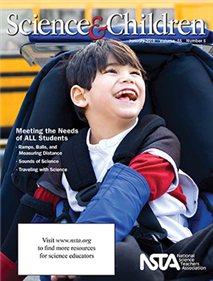
Methods and Strategies: Teaching the Nature of Science to Elementary Students
This column provides ideas and techniques to enhance your science teaching. This month’s issue shares activities so that elementary students can learn about Nature of Science. When effectively integrated into inquiry investigations through proper s...
Blog Post
Gravitational Interactions and 3-D Learning in Middle School
I recently embarked on a journey with K–8 teachers in Vermont to learn how to be intentional about planning for three-dimensional (3-D) learning in the classroom....
By Cindy Workosky
Blog Post
Using Claim, Evidence, and Reasoning (CER) Strategy to Improve Student Learning
This past school year, I used claim, evidence, reasoning (CER) statements to show three-dimensional learning in my classroom. Several tools are available for doing this, but the one my students like is the CER Graphic Organizer and Transition Words L...
By Cindy Workosky
Blog Post
You Teach What? I’m So Sorry! Building a Better Body and Building Better Argumentation
I am always amazed at the looks on people’s faces when I tell them I teach middle school. They seem to pity me for having a position I chose and love! They inform me that middle school “tween-agers” are argumentative, stubborn, and at times, ad...
By Cindy Workosky