

 Join
JoinAll New Science Teachers resources
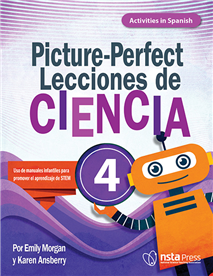
NSTA Press Book
A supplemental book of just the student activity pages in the Picture-Perfect Science series are available for each of the five Picture-Perfect teacher books. All of these activity pages are classroom-ready and written in Spanish. ...
By Emily Morgan, Karen Ansberry
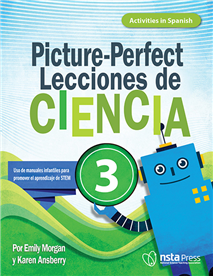
NSTA Press Book
A supplemental book of just the student activity pages in the Picture-Perfect Science series are available for each of the five Picture-Perfect teacher books. All of these activity pages are classroom-ready and written in Spanish. ...
By Emily Morgan, Karen Ansberry
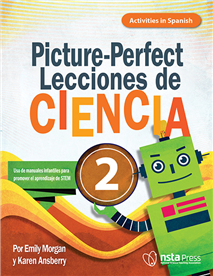
NSTA Press Book
A supplemental book of just the student activity pages in the Picture-Perfect Science series are available for each of the five Picture-Perfect teacher books. All of these activity pages are classroom-ready and written in Spanish....
By Emily Morgan, Karen Ansberry
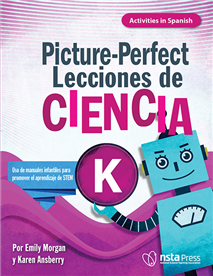
NSTA Press Book
A supplemental book of just the student activity pages in the Picture-Perfect Science series are available for each of the five Picture-Perfect teacher books. All of these activity pages are classroom-ready and written in Spanish....
By Emily Morgan, Karen Ansberry
NSTA Press Book
Human Impacts on Our Climate, Grade 6: STEM Road Map for Middle School
New in 2020!What if you could challenge your sixth graders to come up with a way to help tackle climate change in their own community? With this volume in the STEM Road Map Curriculum Series, you can! Human Impacts on Our Climate outlines a journe...
NSTA Press Book
The NSTA Atlas of the Three Dimensions
Download and read a sample chapter from this book to learn more.A key aspect of learning in K–12 education is the idea that what students know and are able to do grows and evolves over time. Simple ideas learned in the early elementary grades gain...
By Ted Willard
NSTA Press Book
STEM, Standards, and Strategies for High-Quality Units
New in 2020!Download and read a sample chapter from this book to learn more.Do you, your school, or your school district want to align your science curriculum with state standards while meeting the growing demand for STEM instruction? If so, this is ...
By Rodger Bybee
Journal Article
NSTA Press Book
Uncovering Student Ideas About Engineering and Technology: 32 New Formative Assessment Probes
New in 2020! Download and read a sample chapter from this book to learn more.Have you been wondering how well your students understand engineering and technology concepts? Have you been wishing for formative assessment tools in both English and Spani...
By Page Keeley, Cary Sneider, Mihir Ravel
Journal Article

Journal Article
Atmospheric Scientist Shawn Urbanski
Atmospheric scientists study the chemical composition of the atmosphere. More specifically, they look at how atmospheric gases, liquids, and solids interact both with each other and with the earth’s surface. This helps people understand such phenom...
By Luba Vangelova
NSTA Press Book
Creating Engineering Design Challenges: Success Stories From Teachers
If you’ve ever wished for advice you can trust on how to make science and math more relevant to your middle or high school students, Creating Engineering Design Challenges is the book for you. At its core are 13 units grounded in challenge-based le...
NSTA Press Book
Discovery Engineering in Biology: Case Studies for Grades 6–12
Show your students how amazing it can be to just “see what will happen” when they blend biology, engineering, and serendipity. Focusing on innovations sparked by accidental or unexpected observations, the case studies in this resource are a livel...
By Rebecca Hite, Gina Childers, Megan Ennes, M. Gail Jones
NSTA Press Book
Instructional Sequence Matters, Grades 3–5: Explore Before Explain
Instructional Sequence Matters, Grades 3–5 is a one-stop resource that will inspire you to reimagine how you teach science in elementary school. The book discusses two popular approaches for structuring your lessons: POE (Predict, Observe, and Expl...
By Patrick Brown