

 Join
JoinAll Teaching Strategies resources
Journal Article
Using Virtual Reality in the Classroom for Students on the Autism Spectrum
Virtual reality has seen rapid development in the first part of the 21st century, although it has been around for many years. Remember the old ViewMasters? And who could forget the first time a sea monster reached out to grab you while you were wea...
By Wyayn Rasmussen, and Kate Drechsler

Blog Post
I first encountered the KLEWS teaching strategy in an article in Science and Children (NSTA 2015), “KLEWS to Explanation-Building in Science.” I shared the article and modeled the strategy with teachers who wanted to support their K–5 students ...
Blog Post
As several reports have shown, it is critical for teachers to understand instructional strategies that are consistent with the NGSS vision, as well as to have the skills to implement them in their classrooms. I had the privilege of working with two e...
By Diane Johnson
NSTA Press Book
Radioactivity, Grade 11: STEM Road Map for High School
What if you could challenge your 11th graders to figure out the best response to a partial meltdown at a nuclear reactor in fictional Gammatown, USA? With this volume in the STEM Road Map Curriculum Series, you can! Radioactivity outlines a journe...
NSTA Press Book
Supporting Emergent Multilingual Learners in Science, Grades 7–12
Many middle and high school teachers are educated to teach science content—they don’t anticipate that one day they may be teaching it to students who need to learn both content and English. If the day has come when you’re facing that two-pronge...
By Molly Weinburgh, Cecilia Silva, Kathy Horak Smith
NSTA Press Book
A Head Start on Science, Second Edition: Encouraging a Sense of Wonder
Imagine what fun it could be for 3- to 7-year-olds to engage in a game of Prism Play or Magnetic Scavenger Hunt or Where Did the Shadows Go? Then imagine how convenient it would be for you if such activities came with the connections, standards, and ...
By William C. Ritz, William Straits
NSTA Kids
This book will get young readers buzzing about bees! Next Time You See a Bee reveals the big impact these little insects have on the world. It shows how the physical features of bees make them pros at collecting and spreading pollen. It explains how ...
NSTA Kids
Next Time You See a Bee (Hardcover)
This book will get young readers buzzing about bees! Next Time You See a Bee reveals the big impact these little insects have on the world. It shows how the physical features of bees make them pros at collecting and spreading pollen. It explains how ...
NSTA Press Book
Discovery Engineering in Physical Science: Case Studies for Grades 6–12
Who knew that gecko feet inspired scientists to develop a stickier adhesive or that cockleburs in dog fur led to the invention of Velcro? Discovery Engineering in Physical Science uses these and other surprising cases of innovations sparked by accide...
By M. Gail Jones, Elysa Corin, Megan Ennes, Emily Cayton, Gina Childers
Journal Article
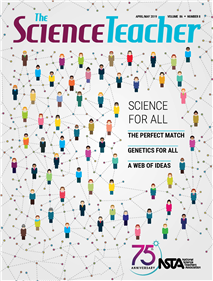
Fostering scientific discourse with spider web discussions ...
By Michael Giamellaro, Jackson Blackburn, Molly Honea, and Jacob LaPlante
Journal Article
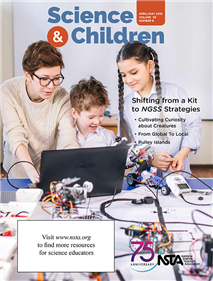
This column discusses resources and science topics related to students in grades preK to 2. This issue describes how teachers can build their own kits....